Ribes nigrum
L.
European Black currant

(c) Nina Filippova, some rights reserved (CC BY), uploaded by Nina Filippova

(c) Marylise Doctrinal, some rights reserved (CC BY-NC-ND)
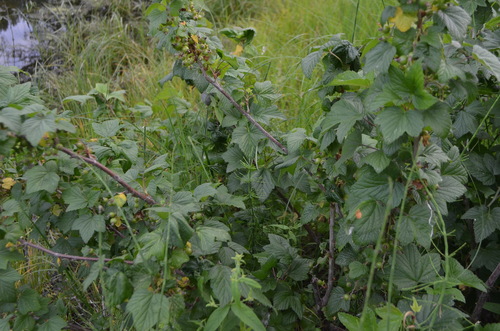
(c) Anna Kichapina, some rights reserved (CC BY-NC), uploaded by Anna Kichapina
What to Eat
Edible parts: Fruit, Leaves - tea, Seeds - oil, Twigs - flavouring
The fruit has an excellent aromatic flavour and is about 10mm in diameter, though selected cultivars produce larger berries. Fully ripe fruit is very good eaten raw, but it is more commonly cooked into pies, jams, and similar preparations. It is very rich in vitamin C. The leaves can be added to soups, and when dried they make a tea substitute or can be blended into herb teas.
Where to Find It
It needs a cool temperate climate. It can stand moderate frosts. It requires constant moisture. In the Himalayas it grows between 2,300-4,300 m altitude. It suits hardiness zones 5-9.
Armenia, Argentina, Asia, Australia, Austria, Balkans, Belarus, Belgium, Bosnia and Herzegovina, Britain, Bulgaria, Canada, Caucasus, Central Asia, China, Czech, Denmark, Estonia, Europe, Falklands, Finland, France, Georgia, Germany, Himalayas, Hungary, India, Ireland, Italy, Kazakhstan, Korea, Kyrgyzstan, Latvia, Lithuania, Luxembourg, Mediterranean, Moldova, Mongolia, Netherlands, New Zealand, North America, Norway, Pakistan, Poland, Romania, Russia, Scandinavia, Serbia, Siberia, Slovakia, Slovenia, Sweden, Switzerland, Tajikistan, Tasmania, Turkey, Türkiye, Ukraine, USA, Yugoslavia,
How to Identify
A small shrub. It grows 2 m high and spreads 1.8 m wide. It loses its leaves during the year. It grows as a group of canes. The young stems are downy. The leaves have 3-5 lobes. These are downy underneath. The flowers are yellow-green with red centres. They hang down and are downy. The fruit hang in loose bunches.
Nutrition Score: 38/100
| Part | Moisture | kJ | kcal | Protein | Vit A | Vit C | Iron | Zinc |
|---|---|---|---|---|---|---|---|---|
| Fruit | 77.4 | 121 | 29 | 0.9 | 200 | 200 | 1.3 | 0.3 |
| Fruit stewed | 80.7 | 103 | 25 | 0.8 | 170 | 150 | 1.1 | — |
How to Grow
Easily grown in a moisture retentive but well-drained loamy soil of at least moderate quality. Best grown on a deep sandy loam. Dislikes very heavy clay, chalky soils and thin dry soils, but it can succeed on most soil types if plenty of organic matter is incorporated. Plants require plenty of nitrogen if they are to do well. Prefers a pH in the range 6.7 to 7 and is intolerant of acid soils. Plants are quite tolerant of shade though do not fruit so well in such a position. Plants fruit less freely when grown in windy sites. The plant is hardy to about -20°c, though flowers are damaged at -1°c. Blackcurrants are widely cultivated in temperate areas for their edible fruit, there are many named varieties. Most fruit is produced on one year old wood. Pruning usually consists of removing about a third of all the stems from just above ground level in the autumn. The oldest stems with least new growth are removed since these will be the poorest fruiters. The plant is able to make new growth from the base of the removed stems and, if the plants are well fed, this growth is very vigorous and will fruit heavily the following year. The flowers can self-fertilize but many cultivars fruit better with insect pollination. Plants can harbour a stage of 'white pine blister rust', so they should not be grown in the vicinity of pine trees. Plants in this genus are notably susceptible to honey fungus. In garden design, as well as the above-ground architecture of a plant, root structure considerations help in choosing plants that work together for their optimal soil requirements including nutrients and water. Currants are usually harvested in mid to late summer, from June to August (Northern Hemisphere), depending on the species and local climate. Ribes species generally flower in spring, around April to June (Northern Hemisphere), with flowering occurring before or as the leaves emerge. Currant plants are relatively fast-growing, reaching maturity in about 2 to 3 years. They typically grow to 1 to 2 meters (3 to 6 feet) and can be quite productive. Most Ribes species, including black, red, and white currants, are self-fertile, meaning they can produce fruit without needing cross-pollination. However, cross-pollination with another Ribes plant can improve fruiting.
Propagation: Seed is best sown as soon as it is ripe in autumn in a cold frame. Stored seed requires 3 months of cold stratification at 0–5°c and should be sown as early in the year as possible. Under normal storage conditions seed can remain viable for 17 years or more. Prick out seedlings into individual pots when large enough to handle, grow on in a cold frame through their first winter, then plant out in late spring the following year. Cuttings of half-ripe wood, 10–15cm with a heel, taken July/August in a frame. Cuttings of mature wood of the current year's growth, preferably with a heel of the previous year's growth, taken November to February in a cold frame or sheltered bed outdoors.
Medicinal Uses
Blackcurrant fruits are a good source of minerals and vitamins, particularly vitamin C. They have diuretic and diaphoretic actions, help increase the body's resistance to infections, and are a valuable remedy for colds and flu. The fresh or vacuum-sealed juice helps stem diarrhoea and calm indigestion. The leaves are cleansing, diaphoretic, and diuretic; by encouraging fluid elimination they help reduce blood volume and lower blood pressure. An infusion of the leaves is used to treat dropsy, rheumatic pain, and whooping cough, and can be applied externally to slow-healing cuts and abscesses. It can also be used as a gargle for sore throats and mouth ulcers. Leaves are harvested during the growing season and can be used fresh or dried. An infusion of the leaves is believed to increase cortisol secretion by the adrenal glands, stimulating the sympathetic nervous system, which may be useful in treating stress-related conditions. An infusion of the young roots is useful for eruptive fevers. A decoction of the bark has been found helpful in treating calculus, dropsy, and haemorrhoidal tumours. The seed is a source of gamma-linolenic acid, an unsaturated fatty acid that assists the production of hormone-like substances — a process commonly blocked in the body, causing disorders affecting uterine muscles, the nervous system, and metabolism.
Other Uses
The oil from the seed is added to skin preparations and cosmetics, and is often combined with vitamin E to prevent oxidation. A yellow dye is obtained from the leaves, and a blue or violet dye from the fruit. The leaves are used for vegetable preservation. Currants can be used in agroforestry systems as a shrub layer in mixed-species plantings, where they attract pollinators and beneficial insects and their dense growth provides habitat and shelter for wildlife. The flowers are rich in nectar and pollen, attracting bees and other beneficial insects. The berries are a food source for birds and small mammals, and the dense shrubs offer cover, shelter, and nesting sites for birds. Leaf litter and dense growth provide overwintering sites and shelter for invertebrates.
Wikipedia
Ribes nigrum is a fast-growing deciduous shrub reaching 1.8 m tall. Foliage present March to November; flowers April to May with seeds ripening July to August. Hardy to UK zone 5, self-fertile with hermaphroditic bee-pollinated flowers. Attracts wildlife readily. Grows in light, medium, or heavy well-drained soils across mildly acid to basic pH ranges. Tolerates semi-shade or full sun and prefers moist soil.
Production
Plants fruit 2 years after planting.
Other Information
About half a million tons of fruit per year are produced worldwide. It is cultivated.
Notes
The fruit are rich in Vit C. There are about 150 Ribes species.
Names & Synonyms
Casis, Cassis, Chernaia smorodina, Ciihi, Coacac negru, črno grozdičje, Grosella negra, Hei sui cu li, Karagat, Kasis, Kuro fusa suguri, Motskhari, Muradh, Must sostar, Nabar, Nabar beli, Papav, Papear, Ribes nero, Shaktekas, Sitikas, Solbaer, Viinimarja, Zwarte bes
References (58)
- Ambasta S.P. (Ed.), 2000, The Useful Plants of India. CSIR India. p 526
- Bianchini, F., Corbetta, F., and Pistoia, M., 1975, Fruits of the Earth. Cassell. p 156
- Bodkin, F., 1991, Encyclopedia Botanica. Cornstalk publishing, p 883
- Bremness, L., 1994, Herbs. Collins Eyewitness Handbooks. Harper Collins. p 118
- Bussman, R. W., et al, 2016, A comparative ethnobotany of Khevsureti, Samtskhe-Javakheti, Tusheti, Svaneti, and Racha-Lechkhumi, Republic of Georgia (Sakartvelo), Caucasus. Journal of Ethnobiology and Ethnomedicine (2016) 12:4
- Bussman, R. W. et al, 2017, Ethnobotany of Samtskhe-Javakheti, Sakartvelo (Republic of Georgia), Caucasus. Indian Journal of Traditional Knowledge Vol. 16(1) pp 7-24
- Bussman, R. W., et al, 2021, Unity in diversity—food plants and fungi of Sakartvelo (Republic of Georgia), Caucasus. Journal of Ethnobiology and Ethnomedicine (2021) 17:72 p 9
- Cerne, M., 1992, Wild Plants from Slovenia used as Vegetables. Acta Horticulturae 318
- Chamorro, M. F., & Ladio, A., 2020, Native and exotic plants with edible fleshy fruits utilized in Patagonia and their role as sources of local functional foods. BMC Complementary Medicine and Therapies. 20:155
- Christanell, A., et al, 2010, The Cultural Significance of Wild Gathered Plant Species in Kartitsch (Eastern Tyrol, Austria) and the Influence of Socioeconomic Changes on Local Gathering Practices. Chapter 3 in Ethnobotany in the New Europe. Berghahn Books.
- Cheifetz, A., (ed), 1999, 500 popular vegetables, herbs, fruits and nuts for Australian Gardeners. Random House p 239
- Crate, S. A., 2008, "Eating Hay": The Ecology, Economy and Culture of Viliui Sakha Smallholders of Northeastern Siberia. Human Ecology 36:161-174
- Cundall, P., (ed.), 2004, Gardening Australia: flora: the gardener's bible. ABC Books. p 1206
- Denes, A., et al, 2012, Wild plants used for food by Hungarian ethnic groups living in the Carpathian Basin. Acta Societatis Botanicorum Poloniae 81 (4): 381-396
- Ertug, F, Yenen Bitkiler. Resimli Türkiye Florası -I- Flora of Turkey - Ethnobotany supplement
- Esperanca, M. J., 1988. Surviving in the wild. A glance at the wild plants and their uses. Vol. 1. p 112
- Facciola, S., 1998, Cornucopia 2: a Source Book of Edible Plants. Kampong Publications, p 120
- Flora of China @ efloras.org Volume 8
- Flora of Pakistan. www.eFloras.org
- Flowerdew, B., 2000, Complete Fruit Book. Kyle Cathie Ltd., London. p 74
- Girard, N. J., 2020, Sustainable Foraging of Wild Edible Plants in Norway. A Biocultural Approach. M. Sc. thesis Norwegian University. p 131
- Glowinski, L., 1999, The Complete Book of Fruit Growing in Australia. Lothian. p 173
- Hedrick, U.P., 1919, (Ed.), Sturtevant's edible plants of the world. p 564
- Heywood, V. H. & Zohary, D.,1995, A Catalogue of the Wild Relatives of Cultivated Plants Native to Europe. Flora Mediterranea 5 - 1995, p 392
- Hibbert, M., 2002, The Aussie Plant Finder 2002, Florilegium. p 252
- https://en.wikipedia.org/wiki/List of wild edible plants in Mongolian cuisine
- http://www.botanic-gardens-ljubljana.com/en/plants
- Jackes, D. A., 2007, Edible Forest Gardens
- Johansson, A., Laakso, P. and Kallio, H., 1997, Characterization of seed oils of wild, edible Finnish berries. Food Chemistry 204:300-307
- John, L., & Stevenson, V., 1979, The Complete Book of Fruit. Angus & Robertson p 81
- Kalle, R. & Soukand, R., 2012, Historical ethnobotanical review of wild edible plants of Estonia (1770s-1960s) Acta Societatis Botanicorum Poloniae 81(4):271-281
- Keep, E., 1979, Currants, in Simmonds N.W.,(ed), Crop Plant Evolution. Longmans. London. p 145
- Khan, D. & Shaukat, S.S., 2006, The Fruits of Pakistan: Diversity, Distribution, Trends of Production and Use. Int. J. Biol. Biotech., 3(3):463-499
- Kiple, K.F. & Ornelas, K.C., (eds), 2000, The Cambridge World History of Food. CUP p 1766
- Kolosova, V., et al, 2020, Foraging in Boreal Forest: Wild Food Plants of the Republic of Karelia, NW Russia. Foods 2020, 9, 1015; p 17
- Kremer, B.P., 1995, Shrubs in the Wild and in Gardens. Barrons. p 141
- Lazarides, M. & Hince, B., 1993, Handbook of Economic Plants of Australia, CSIRO. p 205
- Luczaj, L., 2012, Ethnobotanical review of wild edible plants of Slovakia. Acta Societatis Botanicorum Poloniae 81(4):245-255
- Mabey, R., 1973, Food for Free. A Guide to the edible wild plants of Britain, Collins. p 181
- Macmillan, H.F. (Revised Barlow, H.S., et al) 1991, Tropical Planting and Gardening. Sixth edition. Malayan Nature Society. Kuala Lumpur. p 319
- Nedelcheva A., 2013, An ethnobotanical study of wild edible plants in Bulgaria. EurAsian Journal of BioSciences 7, 77-94
- Pieroni, A. & Soukand, R., 2017, Are Borders more Important than Geographical Distance? The Wild Food Ethnobotany of the Boykos and its Overlap with that of the Bukovinian Hutsuls in Western Ukraine. Journal of Ethnobiology 37(2): 326–345
- Pieroni, A. & Soukand, R., 2018, Forest as Stronghold of Local Ecological Practice: Currently Used Wild Food Plants in Polesia, Northern Ukraine. Economic Botany, XX(X) pp. 1-21
- Pieroni, A., et al, 2020, Wild food plants traditionally gathered in central Armenia: archaic ingredients or future sustainable foods? Environment, Development and Sustainability. Springer p 10
- Plants for a Future database, The Field, Penpol, Lostwithiel, Cornwall, PL22 0NG, UK. http://www.scs.leeds.ac.uk/pfaf/
- Pruse, B., et al, 2021, Active Wild Food Practices among Culturally Diverse Groups in the 21st Century across Latgale, Latvia. Biology 2021, 10, 551.
- Sharma, L. et al, 2018, Diversity, distribution pattern, endemism and indigenous uses of wild edible plants in Cold Desert Biosphere Reserve of Indian Trans Himalaya. Indian Journal of Traditional Knowledge. Vol 17(1) January 2018 pp 122-131
- Singh, H.B., Arora R.K.,1978, Wild edible Plants of India. Indian Council of Agricultural Research, New Delhi. p 70
- Small, E., 2009, Top 100 Food Plants. The world's most important culinary crops. NRC Research Press. p 244
- Soukand, R. & Kalle, R., 2016, Perceiving the Biodiversity of Food at Chest-height: use of the Fleshy Fruits of Wild Trees and Shrubs in Saaremaa, Estonia. Hum Ecol 44:265–272
- Sp. pl. 1:201. 1753
- Upson, R., & Lewis R., 2014, Updated Vascular Plant Checklist and Atlas for the Falkland Islands. Falklands Conservation and Kew.
- USDA, ARS, National Genetic Resources Program. Germplasm Resources Information Network - (GRIN). [Online Database] National Germplasm Resources Laboratory, Beltsville, Maryland. Available: www.ars-grin.gov/cgi-bin/npgs/html/econ.pl (10 April 2000)
- van Wyk, B., 2005, Food Plants of the World. An illustrated guide. Timber press. p 321
- Vari, A., et al, 2020, Berries, greens, and medicinal herbs—mapping and assessing wild plants as an ecosystem service in Transylvania (Romania). Journal of Ethnobiology and Ethnomedicine (2020) 16:13
- Vorstenbosch, T., et al, 2017, Famine food of vegetal origin consumed in the Netherlands during World War II. Journal of Ethnobiology and Ethnomedicine (2017) 13:63
- Wiersema, J. H. & Leon, B., 2013, World Economic Plants. A Standard Reference CRC Press. 2nd Ed. p 591
- World Checklist of Useful Plant Species 2020. Royal Botanic Gardens, Kew
More from Grossulariaceae


