Romulea bulbocodium
(L.) Sebast. & Mauri
Rocus-leaved Romulea, Violet romulea
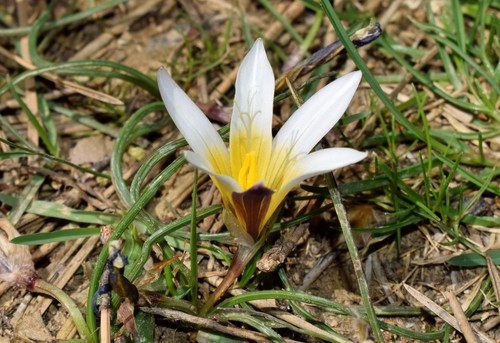
(c) Σάββας Ζαφειρίου (Savvas Zafeiriou), some rights reserved (CC BY-NC), uploaded by Σάββας Ζαφειρίου (Savvas Zafeiriou)
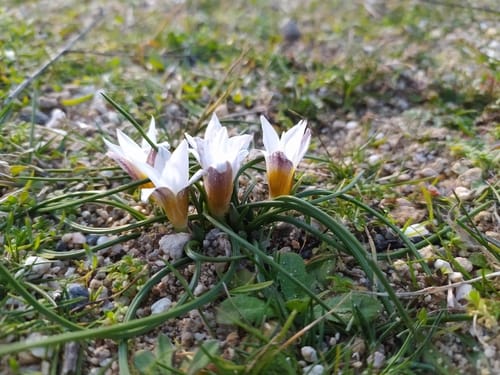
(c) Georgia Avgerinou, some rights reserved (CC BY-NC)
What to Eat
Edible parts: Root, Bulbs, Fruit
The root is reportedly eaten by shepherds, though no further details are given.
Where to Find It
It is a temperate plant. It grows in rocky and grassy habitats. It can grow in the lowlands or mountains near the Mediterranean. It suits hardiness zone 6-9.
Africa, Australia, Balkans, Bulgaria, Europe, France, Greece, Italy, Mediterranean, North Africa, Portugal, Spain,
How to Identify
A low plant which forms a corm. It often forms large colonies. The leaves are near the base and are narrow. There are usually 3-7 leaves. They are deep green. They can be curved or straight. The flowers are large and white to lilac. They can be green on the outside and striped with violet. They are yellow in the throat. The tepals are narrowly oval and pointed. They are 20-35 mm long.
How to Grow
Propagation: Sow seed in spring in a greenhouse. Prick seedlings out into individual pots when large enough to handle and grow on in the greenhouse for at least their first winter, then plant out in late spring or early summer after the last expected frosts. Divide in late summer when the plants are dormant.
Medicinal Uses
None known
Other Uses
None known
Wikipedia
Source ↗Romulea bulbocodium is one of the best-known species from the genus Romulea. The plant, a member of the family Iridaceae, is native to the Mediterranean region (southern Europe, northern Africa, the Middle East) and Sudan. It has many varieties and is occasionally used as ornamental plant. The species has a small rootstock - a corm which can be found in sandy and rocky soils. It produces long and slender leaves. The plant looks much like the popular Crocus. The blooms are small and with six tepals. Most varieties have purple or violet blooms, but white or yellow also occur. The ovary is 3-locular and the seeds are brown, pellet-like, circular grains.
Other Information
The bulbs are especially eaten by children.
Notes
There are about 80-90 Romulea species.
Names & Synonyms
Anodeas, Calabacilla, Curcubilla, Leza
References (9)
- Blamey, M and Grey-Wilson, C., 2005, Wild flowers of the Mediterranean. A & C Black London. p 497
- Fl. roman. prodr. 17. 1818
- Gonzalez, J. A., et al, 2011, The consumption of wild and semi-domesticated edible plants in the Arribes del Duero (Salamanca-Zamora, Spain): an ananalysis of traditional knowledge. Genetic. Resour Crop Evolution 58:991-1006
- Hibbert, M., 2002, The Aussie Plant Finder 2002, Florilegium. p 252
- Lim, T. K., 2015, Edible Medicinal and Non Medicinal Plants. Volume 9, Modified Stems, Roots, Bulbs. Springer p 74
- Pardo-de-Santayana, M., et al, 2005, The gathering and consumption of wild edible plants in the Campoo (Cantabria, Spain). International Journal of Food Sciences and Nutrition. 56(7): 529-542
- Pardo-de-Santayana, M., et al, 2007, Traditional knowledge of wild edible plants used in the northwest of the Iberian Peninsula (Spain and Portugal): a comparative study. Journal of Ethnobiology and Ethnomedicine 2007, 3:27
- Plants for a Future database, The Field, Penpol, Lostwithiel, Cornwall, PL22 0NG, UK. http://www.scs.leeds.ac.uk/pfaf/
- Tardio, J., et al, Ethnobotanical review of wild edible plants in Spain. Botanical J. Linnean Soc. 152 (2006), 27-71


