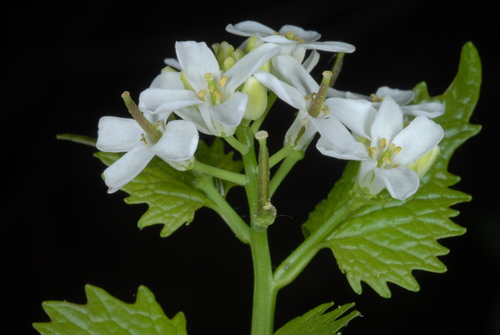
Rorippa palustris
(L.) Besser
Marsh watercress

(c) eyeweed, some rights reserved (CC BY-NC-ND)

(c) --Tico--, some rights reserved (CC BY-NC-ND)

(c) Нурхайдарова Татьяна, some rights reserved (CC BY), uploaded by Нурхайдарова Татьяна
What to Eat
Edible parts: Leaves
Young leaves, stems, and seedlings can be eaten raw in salads or cooked, making a good substitute for watercress.
Where to Find It
It is a temperate plant. It grows in marshlands, pastures, meadows, roadsides, shores of lakes and ponds, streamsides, thickets, grasslands; near sea level to 4000 m in China. In Papua New Guinea it grows from 2000 to 2700 m altitude. In Argentina it grows between 100-1,600 m above sea level. It is more common in ditches and near swamps and creeks. Tasmania Herbarium. In Sichuan and Yunnan.
Afghanistan, Alaska, Argentina, Asia, Australia, Bangladesh, Bhutan, Brazil, Canada, Central Asia, Chile, China, Denmark, Europe, Guianas, Himalayas, India, Japan, Kazakhstan, Korea, Luxembourg, Manchuria, Mongolia, Nepal, New Zealand, North America, Northeastern India, Norway, Pacific, Pakistan, Papua New Guinea, PNG, Russia, Scandinavia, Sikkim, South America, Suriname, Tajikistan, Tasmania, Turkmenistan, Uzbekistan, South America, USA, Tibet,
How to Identify
A cabbage family herb. It is a small cress plant. It can grow from seed each year or or take 2 years to complete its life cycle. It is a herb up to 1 m high. The leaves are crinkled and have deep lobes. The flowers are yellow. The pods are short and less than 1 cm.
How to Grow
It is mostly self sown from seed. Seed can be sown onto waterlogged and nurtient-rich soil.
Propagation: Seed — no specific information is available for this species, but sowing in situ is suggested, either as soon as the seed is ripe in late summer or in early spring.
Medicinal Uses
The leaves are antiscorbutic.
Other Uses
None known.
Wikipedia
Source ↗Rorippa palustris, marsh yellow-cress, bog yellow-cress or common yellow-cress, is a species of flowering plant in the family Brassicaceae. It is widespread and native to parts of Africa, and much of Asia, Europe and Eurasia, North America and the Caribbean. It can also be found in other parts of the world as an introduced species and a common weed, for example, in Australia and South America. It is an adaptable plant which grows in many types of damp, wet, and aquatic habitat. It may be an annual, biennial, or perennial plant, and is variable in appearance as well.
Production
Leaves are available all year round.
Other Information
A self sown plant in high altitude areas of Papua New Guinea and used as a minor edible green.
Notes
There are about 70 Rorippa species.
Names & Synonyms
Bronnkarse, Poniu, Yellow cress, Yellow marsh grass, Zhao sheng han cai
References (31)
- Ambasta S.P. (Ed.), 2000, The Useful Plants of India. CSIR India. p 528 (As Rorippa islandica)
- BARANOV,
- Beckstrom-Sternberg, Stephen M., and James A. Duke. "The Foodplant Database." http://probe.nalusda.gov:8300/cgi-bin/browse/foodplantdb.(ACEDB version 4.0 - data version July 1994) (As Radicula palustris)
- Bodkin, F., 1991, Encyclopedia Botanica. Cornstalk publishing, p 887 (As Rorippa islandica)
- Bourke, R. M., Altitudinal limits of 230 economic crop species in Papua New Guinea. Terra australis 32. (As Rorippa islandica)
- Cribb, A.B. & J.W., 1976, Wild Food in Australia, Fontana. p 127 (As Rorippa islandica)
- Crowe, A., 1997, A Field Guide to the Native Edible Plants of New Zealand. Penguin. p 85
- Curtis, W.M., 1956, The Students Flora of Tasmania Vol 1 p 32 (As Rorippa islandica)
- Enum. pl. 27. 1821
- Facciola, S., 1998, Cornucopia 2: a Source Book of Edible Plants. Kampong Publications, p 60 (As Rorippa islandica)
- Flora of Australia, Volume 8, Lecythidales to Batales, Australian Government Publishing Service, Canberra (1982) p 323
- Flora of China @ efloras.org Volume 8
- Flora of Pakistan. (As Rorippa islandica)
- French, B.R., 1986, Food Plants of Papua New Guinea, A Compendium. Asia Pacific Science Foundation p 92 (As Rorippa islandica)
- Girard, N. J., 2020, Sustainable Foraging of Wild Edible Plants in Norway. A Biocultural Approach. M. Sc. thesis Norwegian University. p 129
- Hedrick, U.P., 1919, (Ed.), Sturtevant's edible plants of the world. p 433
- Hwang, H., et al, 2013, A Study on the Flora of 15 Islands in the Western Sea of Jeollanamdo Province, Korea. Journal of Asia-Pacific Biodiversity Vol. 6, No. 2 281-310
- Hwang, HS, et al, 2014, Distribution characteristics of plant in the Ungseokbong Mountain, Gyeongsangnam-do, Korea. Journal of Asia-Pacific Biodiversity. 7(2014) e164-e178
- Lazarides, M. & Hince, B., 1993, Handbook of Economic Plants of Australia, CSIRO. p 206
- Low, T., 1991, Wild Herbs of Australia and New Zealand. Angus & Robertson. p 58 (Drawing)
- Low, T., 1991, Wild Food Plants of Australia. Australian Nature FieldGuide, Angus & Robertson. p 47
- Low, T., 1992, Bush Tucker. Australia’s Wild Food Harvest. Angus & Robertson. p 141
- MacKinnon, A., et al, 2009, Edible & Medicinal Plants of Canada. Lone Pine. p 210
- Plants for a Future database, The Field, Penpol, Lostwithiel, Cornwall, PL22 0NG, UK. http://www.scs.leeds.ac.uk/pfaf/
- READ, (As Nasturtium palustre)
- Romanowski, N., 2007, Edible Water Gardens. Hyland House. p 113
- Tasmanian Herbarium Vascular Plants list p 18
- Urgamal, M., Oyuntsetseg, B., Nyambayar, D. & Dulamsuren, Ch. 2014. Conspectus of the vascular plants of Mongolia. (Editors: Sanchir, Ch. & Jamsran, Ts.). Ulaanbaatar, Mongolia. “Admon“ Press. 334pp. (p. 79-90).
- World Checklist of Useful Plant Species 2020. Royal Botanic Gardens, Kew
- Xu, You-Kai, et al, 2004, Wild Vegetable Resources and Market Survey in Xishuangbanna, Southwest China. Economic Botany. 58(4): 647-667.
- Zhou Taiyan, Lu Lianli, Yang Guang; Ihsan A. Al-Shehbaz, BRASSICACEAE (CRUCIFERAE), Flora of China.