Apium prostratum
Labill. ex Vent.
Sea celery, Sea parsley, Australian celery, Slender sea celery
no rights reserved, uploaded by Vale Jenny Conolly

(c) Tony Wills, some rights reserved (CC BY-SA), uploaded by Tony Wills

(c) Richie Southerton, some rights reserved (CC BY-NC), uploaded by Richie Southerton
What to Eat
Edible parts: Stalks, Seeds, Leaves
Edible Parts: Leaves Root Seed Edible Uses: Leaves - a salty taste, it is used as a flavouring in soups etc or as a garnish in a similar way to parsley. The leaves can also be eaten raw but have a very strong flavour. The stems can be blanched and used like celery, but they are small and fibrous so are not very worthwhile. Root. No further details. Seed - used as a flavouring in soups etc.
Known Hazards
Where to Find It
It is a temperate plant. It grows in coastal regions. It grows on rocky shores and swamps. It needs light well-drained soils. It is damaged by drought and frost. It often grows in limestone cliffs and dunes. It occurs on wet sandy shores. It grows along salty rivers. In Argentina it grows from sea level to 100 m above sea level. Tasmania Herbarium.
Antarctic, Argentina, Australia*, Brazil, Chile, Easter Island, New Zealand*, South America, Tasmania*, Uruguay,
How to Identify
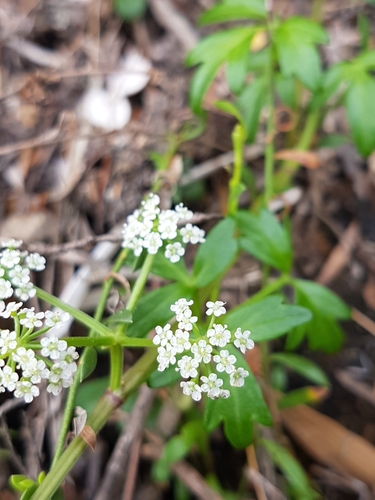
A small herb. It is a creeping plant which grows close to the ground. It keeps growing from year to year. It has hollow stems. The plant is succulent. The stems are 15-60 cm long. The leaves are similar to garden celery. They are light yellow-green in colour. They are divided and lobed. They vary in size. The flowers are white and in a flat topped arrangement with the flowers all coming out from one point. There are 6-12 flowers in the cluster. These heads can be 1.5 cm across. The seeds are small and shiny. It smells of celery when crushed.
How to Grow
Prefers a rich moist soil with some shade in summer. The crushed leaves smell strongly of celery. This plant used to be known as A. australe, along with a New Zealand form and a S. American form. Most botanists now only apply that name to the S. American form, the New Zealand form has been moved to A. filiforme (syn A, prostratum filiforme) whilst this Australian form is now known as A. prostratum. This plant has been suggested as having the potential to be bred as a cultivated vegetable.
Propagation: Seed - sow spring in a greenhouse. Germination can be a bit slow, taking a month or more. When large enough to handle, prick the seedlings out into individual pots and plant them out in the summer. Division in spring.
Medicinal Uses
None known
Other Uses
Waterproofing Used for pads to make canoes watertight. Special Uses Scented Plants
Wikipedia
Source ↗Apium prostratum, commonly known as sea celery, is a variable herb native to coastal Australia and New Zealand. The leaves are variable, with toothed leaflets, and a celery like aroma. The tiny white flowers occur in clusters. There are two varieties: Apium prostratum var. filiforme – headland sea celery, squat with broad leaves (2-3 times longer than wide)and grows on coastal dunes and headlands. Apium prostratum var. prostratum – mangrove sea celery, upright with fine leaves (6-15 times longer than wide) and grows in swamps. The subspecies Apium prostratum subsp. howense is endemic to Lord Howe Island.
Notes
There are about 20 Apium species.
Names & Synonyms
References (37)
- Alice, L. & O'Quinn, T., Australian Bush Superfoods. Explore Australia p 154
- Altschul, S.V.R., 1973, Drugs and Foods from Little-known Plants. Notes in Harvard University Herbaria. Harvard Univ. Press. Massachusetts. no. 3149 (As Apium australe)
- Bodkin, F., 1991, Encyclopedia Botanica. Cornstalk publishing, p 91
- Bonney, N., 1997, Economic Native Trees and Shrubs for South Australia. Greening Australia (SA) inc. Campbelltown SA 5074 p 32
- Bonney, N., 2012, Edible Wild Native Plants for Southern Australia. p 18
- Breidahl H., 1997, Australian Southern Shores. Lothian. p 58
- Caton, J.M. & Hardwick, R. J., 2016, Field Guide to Useful Native Plants from Temperate Australia. Harbour Publishing House. p 74
- Cherikoff V. & Isaacs, J., The Bush Food Handbook. How to gather, grow, process and cook Australian Wild Foods. Ti Tree Press, Australia p 194 (As Apium australe)
- Crowe, A., 1997, A Field Guide to the Native Edible Plants of New Zealand. Penguin. p 74
- Cribb, A.B. & J.W., 1976, Wild Food in Australia, Fontana. p 115
- Curtis, W.M., 1963, The Students Flora of Tasmania Vol 2 p 255
- Edible and Useful Native Plants (off internet)
- Elliot, W.R., & Jones, D.L., 1982, Encyclopedia of Australian Plants suitable for cultivation. Vol 2. Lothian. p 214
- Facciola, S., 1998, Cornucopia 2: a Source Book of Edible Plants. Kampong Publications, p 16
- Hardwick, R.J., 2000, Nature's Larder. A Field Guide to the Native Food Plants of the NSW South Coast. Homosapien Books. p 43
- Harris, S., Buchanan, A., Connolly, A., 2001, One Hundred Islands: The Flora of the Outer Furneaux. Tas Govt. p 108
- Hastings Advance Community College, 2017, Uses for Native Plants of the Mornington Peninsula. 86pp. p 17
- Hedrick, U.P., 1919, (Ed.), Sturtevant's edible plants of the world. p 64
- Hibbert, M., 2002, The Aussie Plant Finder 2002, Florilegium. p 30
- King Island Natural Resource Management Group, 2002, King Island Flora: A Field Guide. p 22
- Lazarides, M. & Hince, B., 1993, Handbook of Economic Plants of Australia, CSIRO. p 22
- Leon-Lobos, P., et al, 2022, Patterns of Traditional and Modern Uses of Wild Edible Native Plants of Chile: Challenges and Future Perspectives. Plants (Basel) v 11 (6) Table S1
- Low, T., 1991, Wild Herbs of Australia and New Zealand. Angus & Robertson. p 63 (Drawing)
- Low, T., 1991, Wild Food Plants of Australia. Australian Nature FieldGuide, Angus & Robertson. p 28
- Low, T., 1992, Bush Tucker. Australia’s Wild Food Harvest. Angus & Robertson. p 20, 136
- Morley, B.D., & Toelken, H.R., (Eds), 1983, Flowering Plants in Australia. Rigby. p 221
- Paczkowska, G. & Chapman, A.R., 2000, The Western Australian Flora. A Descriptive Catalogue. Western Australian Herbarium. p 145
- Plants for a Future database, The Field, Penpol, Lostwithiel, Cornwall, PL22 0NG, UK. http://www.scs.leeds.ac.uk/pfaf/
- Plants for a Future database, The Field, Penpol, Lostwithiel, Cornwall, PL22 0NG, UK. http://www.scs.leeds.ac.uk/pfaf/ (As Apium australe)
- Potts, B.M., Kantvilas, G., and Jarman, S.J. (eds), 2006, Janet Somerville's Botanical History of Tasmania. Univ. of Tas. & Tas Museum. p 67, 177
- Skinner, G. & Brown, 1981, C., Simply Living. A gatherer's guide to New Zealand's fields, forests and shores. Reed. p 26
- Tasmanian Herbarium Vascular Plants list p 3
- Vent., Jardin de la Malmaison 81;(Nov. holland. pl. sp. 1:76. 1804). 1804
- Whiting, J. et al, 2004, Tasmania's Natural Flora. Tasmania's Natural Flora Editorial Committee PO Box 194, Ulverstone, Tasmania, Australia 7315 p 17
- Woolmore, E et al, 2002, King Island Flora: A Field Guide. p 22
- www.fsd.monash.edu.au/files/bethgottpamphley_po.pdf
- Zizka, G., 1991, Flowering Plants of Easter Island. Palmarum Hortus Francofurtensis