Rothmannia globosa
(Hochst.) Keay
September bells, Small-flowered rothmannia

(c) Brian du Preez, some rights reserved (CC BY-SA), uploaded by Brian du Preez
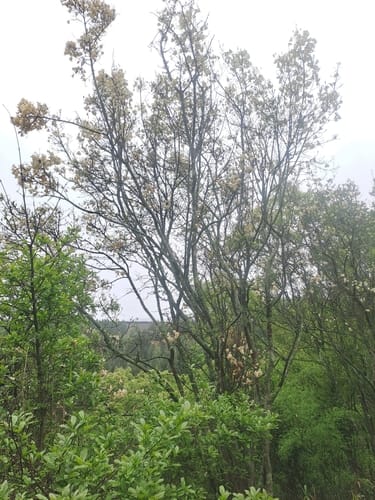
(c) mooiplaasmondintonjanenimark, some rights reserved (CC BY-NC)
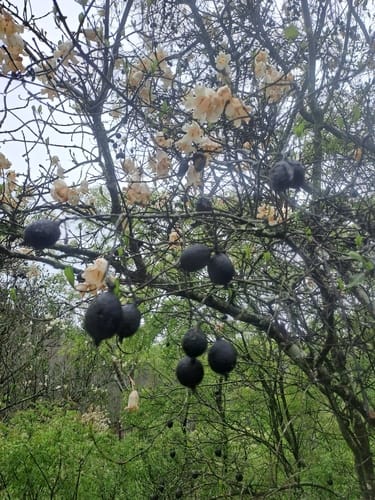
(c) mooiplaasmondintonjanenimark, some rights reserved (CC BY-NC)
What to Eat
Edible parts: Fruit
The fruit are eaten raw.
Where to Find It
It is a tropical plant. It grows in coastal and inland forest. It can tolerate some frost. It suits hardiness zones 9-11.
Africa, Australia, East Africa, Eswatini, South Africa, Southern Africa, Swaziland, Zambia,
How to Identify
A small tree. It grows 4-7 m high but can be 15 m high. Leaves are shiny. They are simple and opposite. They are 3.8-10 cm long. They are often sword shaped. The base is narrow. The leaves are dark green above and paler underneath. It has bell-shaped flowers. These occur singly or in clusters on short side branches. The flowers are 3.8 cm across. They are white and can have pink marks. They have a sweet scent. The fruit are round and 1.9-2.5 cm across. The shell is soft and corky but becomes hard later. The seeds are flat and imbedded in the pulp. The fruit are edible.
Wikipedia
Source ↗Rothmannia globosa is a small but highly decorative South African tree of the family Rubiaceae. It occurs in evergreen forest and along forest margins in the Eastern Cape and north to Limpopo Province and Eswatini. Bark is greyish-brown with rectangular markings. Leaves are glossy, often with yellowish to maroon veins on the underside with acarodomatia in the axils – acarodomatia are common in this family and are a useful diagnostic character. The specific name refers to the spherical fruits of about 25mm diameter.
Production
It is fairly fast growing.
Notes
There are about 20-30 Rothmannia species.
Names & Synonyms
Bell flowered gardenia, Bell Gardenia, Cape Jasmine, Muulwi, Sikoba, Tree gardenia
References (15)
- Bull. Jard. Bot. Etat. 28:56. 1958
- Cundall, P., (ed.), 2004, Gardening Australia: flora: the gardener's bible. ABC Books. p 1282
- Fowler, D. G., 2007, Zambian Plants: Their Vernacular Names and Uses. Kew. p 57
- Fox, F. W. & Young, M. E. N., 1982, Food from the Veld. Delta Books. p 329
- Hibbert, M., 2002, The Aussie Plant Finder 2002, Florilegium. p 282
- Long, C., 2005, Swaziland's Flora - siSwati names and Uses http://www.sntc.org.sz/flora/
- Lord, E.E., & Willis, J.H., 1999, Shrubs and Trees for Australian gardens. Lothian. p 260
- Palgrave, K.C., 1996, Trees of Southern Africa. Struik Publishers. p 859
- Palmer, E and Pitman, N., 1972, Trees of Southern Africa. Vol. 2. A.A. Balkema, Cape Town p 2062
- Peters, C. R., O'Brien, E. M., and Drummond, R.B., 1992, Edible Wild plants of Sub-saharan Africa. Kew. p 175
- Ruiters-Welcome, A. K., 2019, Food plants of southern Africa. Ph.D. thesis. Univ. of Johannesburg p 97
- Schatz, G.E., 2001, Generic Tree Flora of Madagascar. Royal Botanical Gardens, Kew and Missouri Botanical Garden. p 338 (Genus)
- Swaziland's Flora Database http://www.sntc.org.sz/flora
- Welcome, A. K. & Van Wyk, B.-E., 2019, An inventory and analysis of the food plants of southern Africa. South African Journal of Botany 122 (2019) 136–179
- Wilson, A. L. & Downs, C. T., 2012, Fruit nutritional composition and non-nutritive traits of indigenous South African tree species. South African Journal of Botany. 78:30-36


