Rubia argyi
(H. Lev. & Vaniot) Hara ex Lauener
Akane
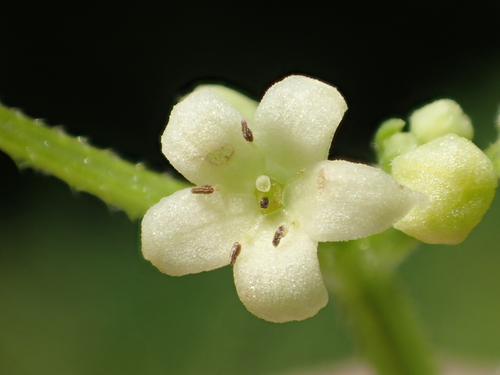
no rights reserved, uploaded by 葉子

(c) MP Zhou, some rights reserved (CC BY-NC)

(c) MP Zhou, some rights reserved (CC BY-NC)
What to Eat
Edible parts: Fruit, Leaves
The fruit and leaves are eaten.
Where to Find It
It is a temperate plant. It grows in thickets and hedges. In China it grows between 300-3,400 m above sea level. In Sichuan.
Asia, China, Japan, Korea, Taiwan,
How to Identify
A climber or vine. It keeps growing from year to year. The stems are 2 m or more long and 4 angled. The leaves are mostly in rings of four. The leaves are broadly oval to heart shaped. They are 2-5 cm long by 2-4 cm wide. The flowers are in groups. The fruit are black.
Wikipedia
Source ↗Rubia argyi is a species of flowering plant of the family Rubiaceae. Its common names may include East Asian madder. It occurs in southern and eastern China, Taiwan, Japan, and Korea. Rubia argyi is a herbaceous, perennial vine. The stem can grow to a length of 2 m (6 ft 7 in) or more.
Production
In China plants flower July to October and fruit August to November.
Notes
There are about 60 Rubia species. It has anticancer properties.
Names & Synonyms
References (4)
- Kim, H. & Song, M., 2013, Ethnobotanical analysis for traditional knowledge of wild edible plants in North Jeolla Province (Korea). Genetic. Resour. Crop Evol. (2013) 60:1571-1585 (As Rubia akane)
- Kintzios, S. E., 2006, Terrestrial Plant-Derived Anticancer Agents and Plant Species Used in Anticancer research. Critical Reviews in Plant Sciences. 25: pp 79-113 (As Rubia akane)
- J. Jap. Bot. 13:781. 1937 (As Rubia akane)
- Plants for a Future database, The Field, Penpol, Lostwithiel, Cornwall, PL22 0NG, UK. http://www.scs.leeds.ac.uk/pfaf/ (As Rubia akane)


