Rubia manjith
Roxb. ex Fleming
East Indian madder
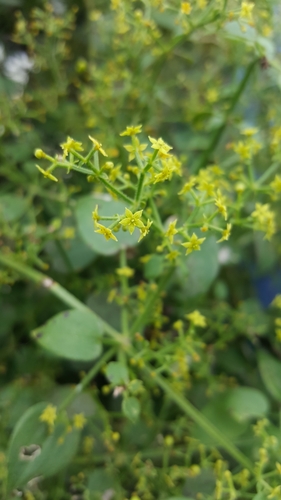
(c) T. Abe Lloyd, some rights reserved (CC BY-NC), uploaded by T. Abe Lloyd

(c) 小铖/Smalltown, some rights reserved (CC BY-NC)

(c) 小铖/Smalltown, some rights reserved (CC BY-NC)
What to Eat
Edible parts: Fruit, Leaves
The following uses have been recorded for R. cordifolia and may also apply here. Leaves are edible when cooked and are used as a side dish with rice, being highly regarded as a lab-lab by the Javanese. The fruit can be eaten raw.
Where to Find It
It is a temperate to subtropical plant. It grows up to 3000 m altitude in Uttar Pradesh in India. In the Indian Himalayas it grows between 1,300-3,000 m above sea level. In Sichuan and Yunnan.
Africa, Asia, Bhutan, China, Himalayas, India, Lesotho, Nepal, Pakistan, Sikkim, Southern Africa, Tibet,
How to Identify
A climber. It keeps growing from year to year. The stems can be 3 m long. They are angular. The leaves are in rings of four. They are 4-6 cm long by 2-3 cm wide. The flowers are cream-yellow or red. They forms large groups in the axils of leaves. The fruit is a dark red berry 4-5 mm across.
How to Grow
We have very little information on this species and do not know if it will be hardy in Britain, though judging by its native range it should succeed outdoors at least in the milder parts of the country. It is possible that many if not all the useful attributes of R. cordifolia also belong here since there is some confusion over the names. All the attributes of both species are listed here and it is noted where they have been applied to R. cordifolia rather than this species. The following notes are based on the general needs of the genus. Prefers a loose moist leafy soil in some shade. Tolerates dry soils but quickly becomes scorched when growing in full sun.
Propagation: Seed is best sown as soon as it is ripe in a cold frame, as stored seed can be very slow to germinate. Prick out seedlings when large enough to handle and grow on in light shade in the greenhouse for the first year, then plant out into permanent positions in early summer. Divide in spring or at any point during the growing season, keeping divisions well watered until established. Larger divisions can go straight into permanent positions; smaller ones are best potted up and grown on in a lightly shaded cold frame, then planted out once well established in summer.
Medicinal Uses
The following notes are based on the related R. cordifolia and may also apply here. The roots are alterative, anodyne, antiphlogistic, antitussive, astringent, diuretic, emmenagogue, expectorant, styptic, tonic, and vulnerary. They are used to lower blood pressure and are taken internally to treat abnormal uterine bleeding, internal and external haemorrhage, bronchitis, rheumatism, and stones in the kidney, bladder, and gall, as well as dysentery. Roots are harvested in autumn from plants at least 3 years old, then peeled and dried. In Tibetan medicine, the stems are considered to have a bitter taste and cooling potency; they are used as a febrifuge and in the treatment of blood disorders and spreading fever of the kidneys and intestines.
Other Uses
A valuable red dye is obtained from the roots and stems.
Wikipedia
A perennial climbing plant with hermaphroditic flowers. Grows in light sandy, medium loamy, or heavy clay soils with mildly acidic to basic pH. Tolerates semi-shaded conditions in light woodland and adapts to both dry and moist soil.
Names & Synonyms
Kajistha, Liichkura, Majeetha, Majeithi, Majhito, Majitho
References (4)
- Aryal, K. P., et al, 2018, Diversity and use of wild and non-cultivated edible plants in the Western Himalaya. Journal of Ethnobiology and Ethnomedicine (2018) 14:10
- Negi, K.S., 1988, Some little known wild edible plants of U.P. Hills. J. Econ. Tax. Bot. Vol. 12 No. 2 pp 345-360
- Plants for a Future database, The Field, Penpol, Lostwithiel, Cornwall, PL22 0NG, UK. http://www.scs.leeds.ac.uk/pfaf/
- Radha, B., et al, 2013, Wild Edible Plant Resources of the Lohba Range of Kedarnath Forest Division (KFD), Garhwal Himalaya, India. Int. Res J. Biological Sci. Vol. 2 (11), 65-73


