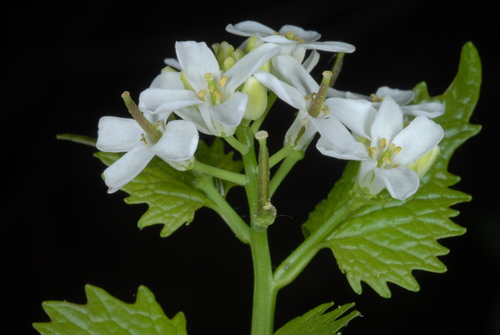
Arabis alpina
L.
Alpine rock cress, Mountain rock-cress

(c) Guido Tellini Florenzano, some rights reserved (CC BY-NC), uploaded by Guido Tellini Florenzano

(c) Wolfgang Bacher, some rights reserved (CC BY-NC), uploaded by Wolfgang Bacher

(c) Martin A. Prinz, some rights reserved (CC BY-NC), uploaded by Martin A. Prinz
What to Eat
Edible parts: Flowers, Leaves
Edible Parts: Flowers Leaves Edible Uses: Young leaves - cooked or raw. An agreeable cress-like flavour. Flowers - raw or cooked. A cress-like flavour.
Where to Find It
It is a temperate plant. It grows in the mountains in Europe. Hobart Botanical Gardens. It suits hardiness zones 5-9.
TEMPERATE ASIA: Iran, Iraq, Lebanon, Syria, Turkey, Armenia, Azerbaijan, Georgia, Russian Federation-Western Siberia (Western Siberia), Turkmenistan, Russian Federation-Far East (Far East), Russian Federation (Kamcatskij kraj) NORTHERN AMERICA: Canada (Northwest Territories, Québec, Newfoundland and Labrador), Greenland EUROPE: Finland, United Kingdom, Iceland, Norway, Svalbard and Jan Mayen, Sweden, Austria, Switzerland, Germany, Hungary, Poland, Slovakia, Moldova, Ukraine (incl. Krym), Albania, Bulgaria, Bosnia and Herzegovina, Greece (incl. Crete), Croatia, Italy (incl. Sicily), North Macedonia, Montenegro, Romania, Serbia, Slovenia, Spain, France (incl. Corsica) AFRICA: Algeria (north), Morocco
How to Identify
A cabbage family herb. It is a small plant which keeps growing from year to year. It grows 10-30 cm high and spreads 20-50 cm wide. The leaves are simple. They have fine silver hairs. The flowers are downy and white.
How to Grow
Easily grown in ordinary well-drained soil. Prefers a sandy loam and a sunny position. Another report says that it prefers partial shade. Plants resent root disturbance and are best put in their final positions whilst still small. The flowers are attractive to bees.
Propagation: Seed - it is best to surface sow the seed as soon as it is ripe in a light position in a cold frame. Seed can also be sown in spring. It usually germinates in 2 - 3 weeks at 21°c. When large enough to handle, prick the seedlings out into individual pots and plant them out in the summer. Division after flowering. Very easy, the divisions can be planted out straight into their permanent positions if required. Cuttings in a shady border in summer.
Medicinal Uses
None known
Other Uses
None known Special Uses
Wikipedia
Source ↗Arabis alpina, the Alpine rock-cress, is a flowering plant in the family Brassicaceae, native to mountainous areas of Europe, North and East Africa, Central and Eastern Asia and parts of North America. In the British Isles, it is only known to occur in a few locations in the Cuillin Ridge of the Isle of Skye. It inhabits damp gravels and screes, often over limestone.
Production
There are about 120 Arabis species. They are temperate plants.
Names & Synonyms
Alpski repnjak
References (9)
- Bircher, A. G. & Bircher, W. H., 2000, Encyclopedia of Fruit Trees and Edible Flowering Plants in Egypt and the Subtropics. AUC Press. p 36
- Cundall, P., (ed.), 2004, Gardening Australia: flora: the gardener's bible. ABC Books. p 169
- Esperanca, M. J., 1988. Surviving in the wild. A glance at the wild plants and their uses. Vol. 1. p 36
- Facciola, S., 1998, Cornucopia 2: a Source Book of Edible Plants. Kampong Publications, p 52
- Hibbert, M., 2002, The Aussie Plant Finder 2002, Florilegium. p 31
- Ojelel, S., et al, 2019, Wild edible plants used by communities in and around selected forest reserves of Teso-Karamoja region, Uganda. Journal of Ethnobiology and Ethnomedicine (2019) 15:3
- Plants for a Future database, The Field, Penpol, Lostwithiel, Cornwall, PL22 0NG, UK. http://www.scs.leeds.ac.uk/pfaf/
- Sp. pl. 2:664. 1753
- Tozer, F., 2007, The Uses of Wild Plants. Green Man Publishing. p 30