Catolobus pendulus
(L.) Al-Shehbaz
Chui guo nan jie
BrassicaceaeLeaves
iNaturalist · cc-by-nc
(c) V.S. Volkotrub, some rights reserved (CC BY-NC), uploaded by V.S. Volkotrub
(c) V.S. Volkotrub, some rights reserved (CC BY-NC), uploaded by V.S. Volkotrub
iNaturalist · cc-by-nc
(c) MP Zhou, some rights reserved (CC BY-NC)
(c) MP Zhou, some rights reserved (CC BY-NC)

iNaturalist · cc-by-nc
(c) MP Zhou, some rights reserved (CC BY-NC)
(c) MP Zhou, some rights reserved (CC BY-NC)
What to Eat
Edible parts: Leaves
The leaves are eaten.
Where to Find It
It grows on rocky slopes, roadsides, woodlands, meadows, limestone cliffs, hillsides, waste places, thickets, forest margins, valleys, river banks, grassy areas, deserts; near sea level to 4300 m altitude in China. It can grow in arid places. In Sichuan and Yunnan.
Asia, Central Asia, China, Europe, Japan, Kazakhstan, Korea, Mongolia, North America, Russia, USA,
Countries: Andorra, United Arab Emirates, Afghanistan, Antigua & Barbuda, Albania, Armenia, Austria, Azerbaijan, Bosnia & Herzegovina, Barbados, Bangladesh, Belgium, Bulgaria, Bahrain, Brunei, Bahamas, Bhutan, Belarus, Belize, Canada, Switzerland, China, Costa Rica, Cuba, Cyprus, Czechia, Germany, Denmark, Dominica, Dominican Republic, Estonia, Spain, Finland, France, United Kingdom, Grenada, Georgia, Greece, Guatemala, Honduras, Croatia, Haiti, Hungary, Indonesia, Ireland, Israel, India, Iraq, Iran, Iceland, Italy, Jamaica, Jordan, Japan, Kyrgyzstan, Cambodia, St Kitts & Nevis, North Korea, South Korea, Kuwait, Kazakhstan, Laos, Lebanon, St Lucia, Liechtenstein, Sri Lanka, Lithuania, Luxembourg, Latvia, Monaco, Moldova, Montenegro, North Macedonia, Myanmar, Mongolia, Malta, Maldives, Mexico, Malaysia, Nicaragua, Netherlands, Norway, Nepal, Oman, Panama, Philippines, Pakistan, Poland, Puerto Rico, Portugal, Qatar, Romania, Serbia, Russia, Saudi Arabia, Sweden, Singapore, Slovenia, Slovakia, San Marino, El Salvador, Syria, Thailand, Tajikistan, Timor-Leste, Turkmenistan, Turkey, Trinidad & Tobago, Taiwan, Ukraine, United States, Uzbekistan, St Vincent, Vietnam, Yemen
How to Identify
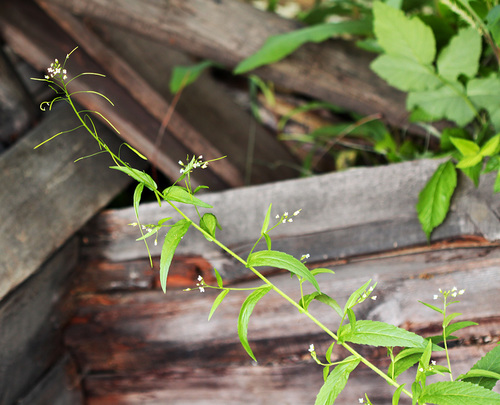
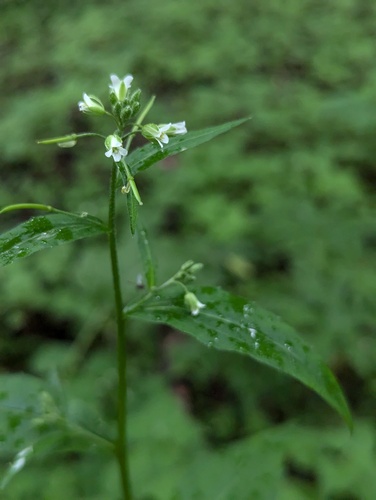
A cabbage family herb. It grows up to 110 cm tall. The stems are erect and not branched. The lower leaves have leaf stalks and those on the stem do not. The leaves are oblong or sword shaped and 3-10 cm long by 1-3 cm wide.
Notes
There are about 120 Arabis species. They are temperate plants.
Names & Synonyms
Arabis pendula var. glabrescens FranchetArabis pendula var. hebecarpa Y. C. Lan & T. Y. CheoArabis pendula var. hypo-glauca FranchetArabis subpendula Ohwiand others
References (3)
- Flora of China @ efloras.org Volume 8 (As Arabis pendula)
- Plants for a Future database, The Field, Penpol, Lostwithiel, Cornwall, PL22 0NG, UK. http://www.scs.leeds.ac.uk/pfaf/ (As Arabis pendula)
- Zhou Taiyan, Lu Lianli, Yang Guang; Ihsan A. Al-Shehbaz, BRASSICACEAE (CRUCIFERAE), Flora of China. (As Arabis pendula)