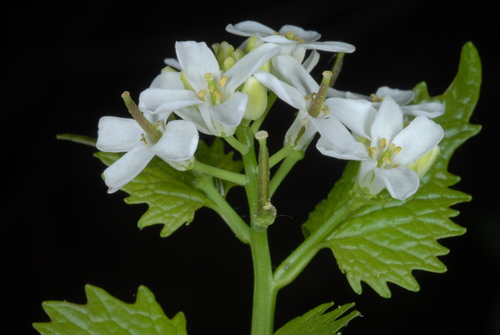
Arabis serrata
Franch. & Sav.
Chi ye nan jie
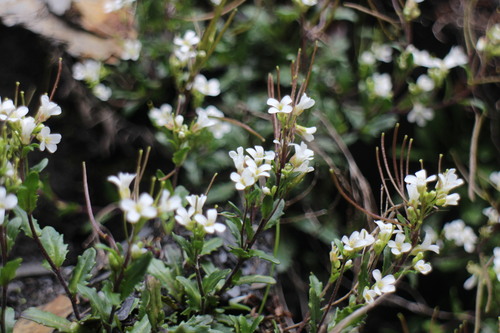
(c) 羅元甫, some rights reserved (CC BY-NC)
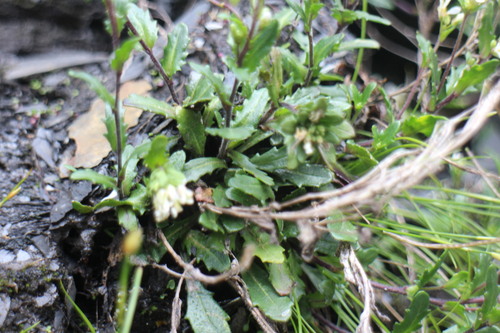
(c) 羅元甫, some rights reserved (CC BY-NC)
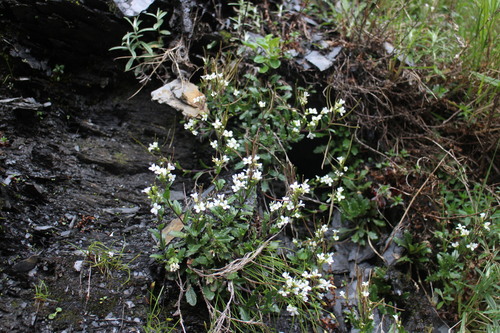
(c) 羅元甫, some rights reserved (CC BY-NC)
What to Eat
Edible parts: Leaves
Edible Parts: Leaves Edible Uses: Young leaves - cooked.
Where to Find It
It grows in rocky crevices, along streams, mountain slopes, deciduous forest between 100–3200 m altitude in China.
Asia, China, Japan, Korea, Taiwan,
How to Identify
A cabbage family herb. It is an annual herb with runners. It is densely covered with hairs. It grows up to 35 cm tall. The leaves near the base are simple and entire. They are 2-3 cm long by 3-5 mm wide. The leaves on the stems are smaller and without leaf stalks. The flowers are in compound groups at the top of the plant. The dry elongated fruit has about 20 very small seeds.
How to Grow
Easily grown in ordinary well-drained soil. A polymorphic species. Plants are stoloniferous.
Propagation: Seed - it is best to surface sow the seed as soon as it is ripe in a light position in a cold frame. Seed can also be sown in spring. It usually germinates in 2 - 3 weeks at 21°c. When large enough to handle, prick the seedlings out into individual pots and plant them out in the summer. Division after flowering. Very easy, the divisions can be planted out straight into their permanent positions if required. Cuttings in a shady border in summer.
Medicinal Uses
None known
Other Uses
None known Special Uses
Wikipedia
A hardy perennial growing to 0.3 m (1 ft) tall, hardy to UK zone 7. Flowers from July to August with hermaphroditic blooms visited by bees and butterflies. Tolerates light sandy, medium loamy, and heavy clay soils with good drainage. Prefers mildly acidic, neutral, and basic soils in semi-shade or full sun, favoring moist conditions.
Notes
There are about 120 Arabis species. They are temperate plants.
Names & Synonyms
References (3)
- Flora of China @ efloras.org Volume 8
- Plants for a Future database, The Field, Penpol, Lostwithiel, Cornwall, PL22 0NG, UK. http://www.scs.leeds.ac.uk/pfaf/
- Zhou Taiyan, Lu Lianli, Yang Guang; Ihsan A. Al-Shehbaz, BRASSICACEAE (CRUCIFERAE), Flora of China.