Salix appendiculata
Vill.
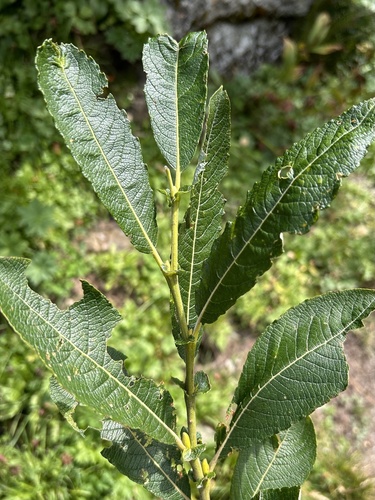
(c) Oliver Stöhr, some rights reserved (CC BY-NC), uploaded by Oliver Stöhr
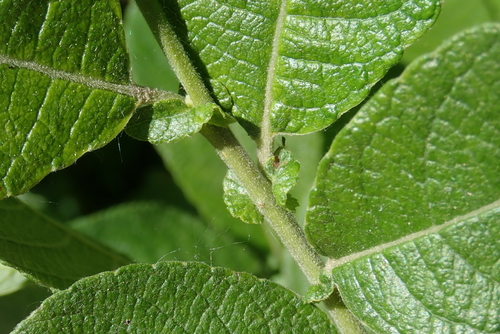
(c) Christian Berg, some rights reserved (CC BY), uploaded by Christian Berg
What to Eat
Edible parts: Inner bark, Leaves
The inner bark can be eaten raw or cooked. It is also dried, ground into a powder, and mixed with cereal flour for making bread. The flavour is very bitter, and it is considered a famine food used only as a last resort. Young shoots are edible but not very palatable.
Where to Find It
It is a temperate plant.
Balkans,
How to Identify
A deciduous shrub growing to 6 m tall, hardy to UK zone 7. Flowers April to May. Dioecious species requiring both male and female plants for seed production, pollinated by bees and noted for attracting wildlife. Grows in light sandy, medium loamy, or heavy clay soils in mildly acid, neutral, or mildly alkaline pH. Requires full sun and prefers moist or wet conditions.
How to Grow
Succeeds in most soils, including wet, ill-drained or intermittently flooded soils, but prefers a damp, heavy soil in a sunny position. Hybridizes freely with other members of this genus. Although the flowers are produced in catkins early in the year, they are pollinated by bees and other insects rather than by the wind. Plants in this genus are notably susceptible to honey fungus. Dioecious. Male and female plants must be grown if seed is required.
Propagation: Seed must be surface sown as soon as it ripens in late spring, as viability is very short — perhaps only a few days. Cuttings of mature wood from the current year's growth can be taken November to February, either in a sheltered outdoor bed or planted straight into their permanent position with a weed-suppressing mulch; these root very easily. Plant out permanently in autumn. Half-ripe cuttings taken June to August in a frame also root very easily.
Medicinal Uses
The fresh bark contains salicin, which probably decomposes into salicylic acid (closely related to aspirin) in the human body, and is used as an anodyne and febrifuge.
Other Uses
A pioneer plant suited to difficult sites, it is often found colonising landslides and similar disturbed ground, particularly on calcareous formations. It functions as a dynamic accumulator and attracts wildlife.
Wikipedia
Source ↗Salix appendiculata is a plant from the willow genus (Salix). They can be found in France, Italy, Central and Eastern Europe, and on the Balkan Peninsula.
Notes
There are about 300 Salix species.
Names & Synonyms
References (2)
- Hist. pl. Dauphine 3:775. 1789
- Plants for a Future database, The Field, Penpol, Lostwithiel, Cornwall, PL22 0NG, UK. http://www.scs.leeds.ac.uk/pfaf/