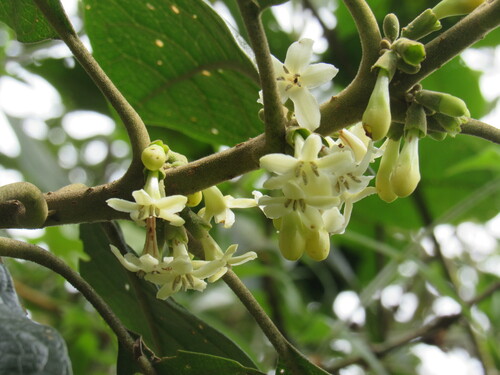
Salvia carnosa
Douglas
Purple Sage

Wikimedia Commons - Alex Abair

Wikimedia Commons - Alex Abair

Wikimedia Commons
What to Eat
Edible parts: Seeds
The seed can be cooked, ground into a powder, and used to thicken soups or added to cereal flours when making bread.
Where to Find It
It is a temperate plant.
North America, USA,
How to Identify
Evergreen shrub reaching 0.8 m (2 ft 7 in) tall. Hardy to UK zone 7. In leaf all year; flowers July to August. Hermaphroditic, bee-pollinated. Prefers light sandy to medium loamy well-drained soils with mildly acid to basic pH. Requires full sun and tolerates dry or moist soil.
How to Grow
Requires a very well-drained light sandy soil in a sunny position. Prefers a rich soil. Soils rich in nitrogen encourage excessive leaf growth at the expense of flowering. Plants can be killed by excessive winter wet. Members of this genus are rarely if ever troubled by browsing deer.
Propagation: Sow seed in March or April in a greenhouse; germination typically occurs within 2 weeks. Prick out seedlings into individual pots when large enough to handle and plant out in early summer. Where the plant is near the edge of its hardiness range, overwinter young plants under glass and plant out in late spring of the following year. Cuttings of half-ripe wood can be taken at almost any point during the growing season.
Medicinal Uses
A decoction of the seeds and stems is used to treat colds. A decoction or infusion of the leaves treats fevers, coughs, colds, and stomach aches. A poultice of crushed leaves can be applied to the chest to relieve congestion. A decoction of the leaves and stems can be drunk, applied as a wash, or used as a steam bath to treat headaches. A decoction of the flowering stems has been used as both a poultice and a wash to treat swollen leg veins. The plant is highly regarded as a treatment for epilepsy or fainting — it can be administered as a drink or prepared like tobacco with the smoke blown into the patient's face.
Other Uses
None known Special Uses
Wikipedia
Source ↗Evergreen shrub reaching 0.8 m (2 ft 7 in) tall. Hardy to UK zone 7. In leaf all year; flowers July to August. Hermaphroditic, bee-pollinated. Prefers light sandy to medium loamy well-drained soils with mildly acid to basic pH. Requires full sun and tolerates dry or moist soil.
Notes
There are about 900 Salvia species.
Names & Synonyms
References (1)
- Plants for a Future database, The Field, Penpol, Lostwithiel, Cornwall, PL22 0NG, UK. http://www.scs.leeds.ac.uk/pfaf/