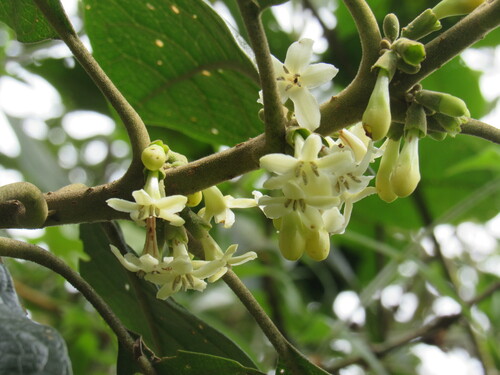
Salvia elegans
Vahl
Pineapple-scented sage
(c) Daniel Hernández, some rights reserved (CC BY-NC)
(c) Daniel Hernández, some rights reserved (CC BY-NC)
(c) Rafael Luna Reyes, some rights reserved (CC BY-NC)
What to Eat
Edible parts: Leaves, Herb, Flowers
The leaves have a pleasant pineapple scent and can be used fresh or dried as a flavouring. They are added to cold drinks and fruit salads, placed fresh under sponge cake mixtures to impart a subtle scent, and added fresh or dried to savoury dishes to give a sausage-like flavour. The flowers are also edible.
Where to Find It
It is a warm temperate to subtropical plant. It grows naturally in mountainous places in Mexico. There it grows between 1800-2700 m altitude. It needs well drained soil. It suits hardiness zones 8-11. In Hobart Botanical gardens. Melbourne Botanical Gardens.
Australia, Canada, Central America, Guatemala, Japan, Mexico, North America, Tasmania,
How to Identify
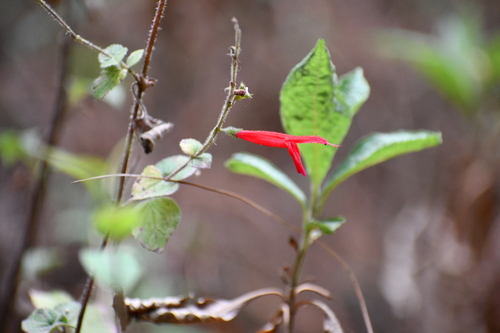
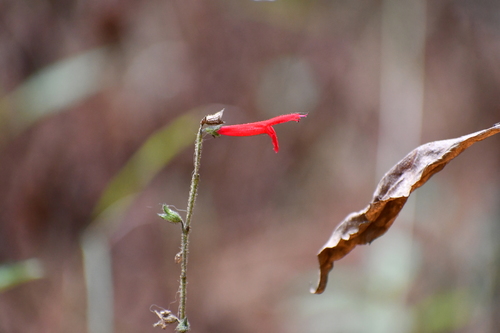
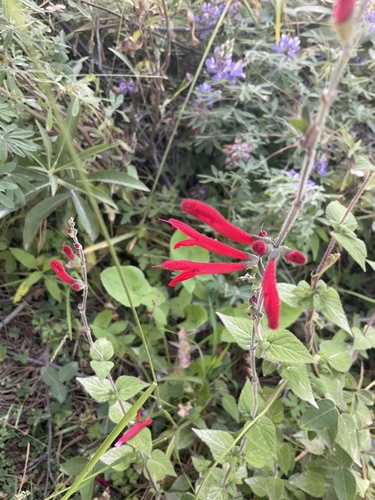
A shrubby plant. It keeps growing from year to year. It is grown as an annual in cooler places. It grows 120 cm high. The leaves are oval and bright green. They are pointed and have teeth along the edge. The leaves have a pineapple scent. The leaves are hairy and 7.5 cm long by 5 cm wide. The flowers are red. Six to 8 flowers occur on 20 cm long spikes.
How to Grow
Requires a very well-drained light sandy soil in a warm sunny position. Prefers a rich soil. Plants can be killed by excessive winter wet. This species is not hardy in the colder areas of the country, it tolerates temperatures down to between -5 and -10°c. The top growth will be cut back to the ground in cold winters but, if the roots are given a good mulch in the autumn, plants will often survive the winter outdoors and resprout freely from the base in the spring. There are some named varieties. 'Scarlet Pineapple' has leaves with a pineapple-like scent. The flowers are very attractive to bees, providing a good source of nectar. Members of this genus are rarely if ever troubled by browsing deer. Sage leaves can be harvested throughout the growing season, with the best flavor typically from spring to early summer, just before flowering. Sage usually flowers in late spring to early summer, generally between May and June (Northern Hemisphere), depending on the specific species and growing conditions. Sage is a moderately fast-growing herb, often reaching maturity in about 1 to 2 years under optimal conditions.
Propagation: Sow seed in March or April in a greenhouse; germination typically occurs within 2 weeks. Prick out seedlings into individual pots when large enough to handle and plant out in early summer. Where the plant is near the edge of its hardiness range, overwinter young plants under glass and plant out in late spring of the following year. Cuttings of half-ripe wood can be taken at almost any point during the growing season.
Medicinal Uses
Pineapple sage tea has been used to calm nerves and aid digestion.
Other Uses
Grown as an ornamental and used in borders, containers, massed plantings, and seaside gardens. The plant attracts hummingbirds and butterflies and is tolerant of deer. Dried leaves can be added to potpourris.
Wikipedia
Source ↗Salvia elegans is a perennial shrub native to Mexico. It has a number of variants, including pineapple sage and tangerine sage.
Notes
There are about 900 Salvia species.
Names & Synonyms
Pineapple sage
References (13)
- Bremness, L., 1994, Herbs. Collins Eyewitness Handbooks. Harper Collins. p 126
- Brickell, C. (Ed.), 1999, The Royal Horticultural Society A-Z Encyclopedia of Garden Plants. Convent Garden Books. p 927
- Burnie, G & Fenton-Smith, J., 1999, A Grower's Guide to Herbs. Murdoch Books. p 61
- Cheifetz, A., (ed), 1999, 500 popular vegetables, herbs, fruits and nuts for Australian Gardeners. Random House p 154
- Cundall, P., (ed.), 2004, Gardening Australia: flora: the gardener's bible. ABC Books. p 1302
- Facciola, S., 1998, Cornucopia 2: a Source Book of Edible Plants. Kampong Publications, p 134 (As Salvia rutilans)
- Hibbert, M., 2002, The Aussie Plant Finder 2002, Florilegium. p 284
- Kermath, B. M., et al, 2014, Food Plants in the Americas: A survey of the domesticated, cultivated and wild plants used for Human food in North, Central and South America and the Caribbean. On line draft. p 780 (As Salvia rutilans)
- Lawton, B.P., 2002, Mints. A Family of Herbs and Ornamentals. Timber Press, Portland, Oregon. p 77, 183
- Morley, B. & Everard, B., 1970, Wild Flowers of the World. Ebury press. Plate 163
- Niwano, Y. et al., 2009, Extensive Screening for Plant Foodstuffs in Okinawa, Japan with Anti-Obese Activity on Adipocytes, in vitro. Plant Foods in Human Nutrition 64:6-10
- Staples, G.W. and Herbst, D.R., 2005, A tropical Garden Flora. Bishop Museum Press, Honolulu, Hawaii. p 363
- World Checklist of Useful Plant Species 2020. Royal Botanic Gardens, Kew