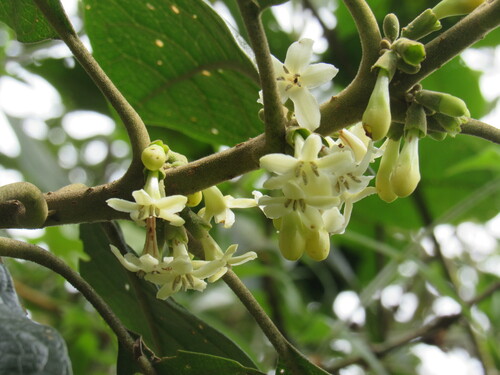
Salvia reflexa
Hornem.
Mintweed, Lanceleaf sage, White chia

(c) Lee Hoy, some rights reserved (CC BY-NC-ND), uploaded by Lee Hoy

(c) Colorado College Field Botany, some rights reserved (CC BY-NC), uploaded by Colorado College Field Botany

(c) Bryan, some rights reserved (CC BY-NC), uploaded by Bryan
What to Eat
Edible parts: Seeds
The seeds are used to prepare a cooling drink. When soaked in water they form a gelatinous mass that is flavoured with fruit juices and consumed as a refreshing beverage. The gelled seeds can also be prepared as a gruel or pudding. Sprouted seeds are eaten in salads, sandwiches, soups, and stews; their mucilaginous quality makes them well suited to sprouting on clay or other porous materials. The seed can also be ground into a meal and used to make bread, biscuits, and cakes. Note: these details are recorded for S. hispanica and are considered likely to apply to this species as well.
Known Hazards
Where to Find It
It is a temperate plant. In Argentina it grows from sea level to 1,000 m above sea level. It suits hardiness zones 4-9.
Argentina, Australia, Central America, Mexico, North America, South America, USA,
How to Identify
An annual herb. It grows 60-100 cm high. It is erect and branched. The stems are square. The leaves are 5 cm long and narrowly sword shaped. The flowers are lilac or blue. They are 7-8 mm long. The fruit is a nut. It is cream to brown. It is about 2 mm long.
How to Grow
Requires a very well-drained light sandy soil in a sunny position. Prefers a rich soil. Plants can be killed by excessive winter wet. Members of this genus are rarely if ever troubled by browsing deer.
Propagation: Sow seed in March/April in a greenhouse. Seedlings dislike root disturbance, so prick them out carefully into individual pots as soon as they are large enough. Plant out in late spring or early summer. Seed can also be sown directly in situ during April/May, though in cool summers this sowing may not ripen its seed.
Medicinal Uses
None known.
Other Uses
None known.
Wikipedia
Source ↗Salvia reflexa, the lanceleaf sage, Rocky Mountain sage, blue sage, lambsleaf sage, sage mint or mintweed, is an annual subshrub native to the United States and Mexico and introduced to Argentina, Australia, Canada, South Africa and New Zealand. It reaches 4-28 inches (10–71 cm) in height with small, opposite, lanceolate to narrowly elliptic leaves up to two inches (5 cm) long. The flowers grow in whorls, and are pale blue to dark blue and bloom from Summer to Autumn. Salvia reflexa is found in pastures and prairies and can be toxic to cattle, sheep and goats due to its accumulation of nitrates. Poisoning is not common, and reported cases are limited to animals eating contaminated hay. Symptoms of toxicity are muscular weakness, diarrhea, and colic.
Notes
There are about 900 Salvia species.
Names & Synonyms
Narrow-leafed sage
References (6)
- Cooper, W. and Cooper, W., 2004, Fruits of the Australian Tropical Rainforest. Nokomis Editions, Victoria, Australia. p 240
- Hussey, B.M.J., Keighery, G.J., Cousens, R.D., Dodd, J., Lloyd, S.G., 1997, Western Weeds. A guide to the weeds of Western Australia. Plant Protection Society of Western Australia. p 170
- Kermath, B. M., et al, 2014, Food Plants in the Americas: A survey of the domesticated, cultivated and wild plants used for Human food in North, Central and South America and the Caribbean. On line draft. p 780
- Lawton, B.P., 2002, Mints. A Family of Herbs and Ornamentals. Timber Press, Portland, Oregon. p 188
- Paczkowska, G. & Chapman, A.R., 2000, The Western Australian Flora. A Descriptive Catalogue. Western Australian Herbarium. p 276
- Plants for a Future database, The Field, Penpol, Lostwithiel, Cornwall, PL22 0NG, UK. http://www.scs.leeds.ac.uk/pfaf/