Samolus parviflorus
Raf.
Seaside Brookweed
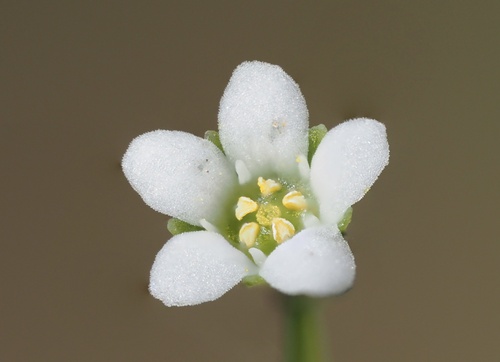
(c) nathantay, some rights reserved (CC BY-NC)

(c) Douglas Goldman, some rights reserved (CC BY-SA), uploaded by Douglas Goldman

(c) Alex Abair, some rights reserved (CC BY), uploaded by Alex Abair
What to Eat
Edible parts: Leaves
The plant's leaves, when cut and agitated in water, produce a lather, for which reason in Palestine it has been used by the local Arab population, in former times, to launder clothes and was called by them sabūn 'arab (= Arab soap).
Where to Find It
It flowers when daylength is over 10-12 hours.
Central America*, Cuba*, Dominican Republic*, Haiti, Mexico*, North America, Puerto Rico, South America*, USA, West Indies*,
How to Identify
A small fragile plant. It grows 10 cm high. The plant forms a ring of oval leaves. There are 7-14 leaves in the ring. The leaves are 6-10 cm long with a narrow base and 2.5-4 cm wide. They are bright green.
Notes
There are about 15 Samolus species. These have previously been in the Samolaceae family. They grow in water in temperate and subtropical places.
Names & Synonyms
Water rose, Water cabbage
References (2)
- Plants for a Future database, The Field, Penpol, Lostwithiel, Cornwall, PL22 0NG, UK. http://www.scs.leeds.ac.uk/pfaf/
- Plants of Haiti Smithsonian Institute http://botany.si.edu/antilles/West Indies