Sarcotheca griffithii
(Hk. f.) Hall. f.
Pupoi
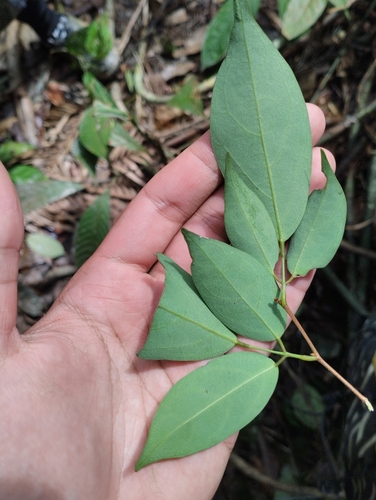
(c) Akmal Idham, some rights reserved (CC BY-NC), uploaded by Akmal Idham

President and Fellows of Harvard College

President and Fellows of Harvard College
What to Eat
Edible parts: Fruit
The very sour acidic fruit are used in curries, eaten fresh with sugar, and made into preserves. The fruit is sold commercially (approximately $4 per kg in Brunei markets).
Known Hazards
Where to Find It
A tropical plant. It grows in primary forest on sandy clay soils in dry or temporarily flooded land.
Asia, Brunei, Indonesia, Malaysia, SE Asia, Singapore,
How to Identify
A tree. It grows 5 m high but can be 42 m tall. The trunk has white patchy bark and is 15-100 cm across. There can be buttresses up to 4 m high. The leaves have 3 leaflets. The fruit is yellow-green and crisp. It is 2-3 cm long by 1-2 cm wide.
Production
It flowers are fruit throughout the year.
Other Information
Edible fruit-very sour, sold for $4 per kg in Brunei market. The plants are cultivated.
Names & Synonyms
Asam pupoi, Belimbing hutan, Jintek-jintek, Kupoi, Pupoi
References (5)
- Burkill, I. H., 1966,
- Milow, P., et al, 2013, Malaysian species of plants with edible fruits or seeds and their evaluation. International Journal of Fruit Science. 14:1, 1-27
- PROSEA No. 2
- Saw, L.G., LaFrankie, J. V. Kochummen, K. M., Yap S. K., 1991, Fruit Trees in a Malaysian Rain Forest. Economic Botany, Vol. 45, No. 1, pp. 120-136
- World Checklist of Useful Plant Species 2020. Royal Botanic Gardens, Kew


