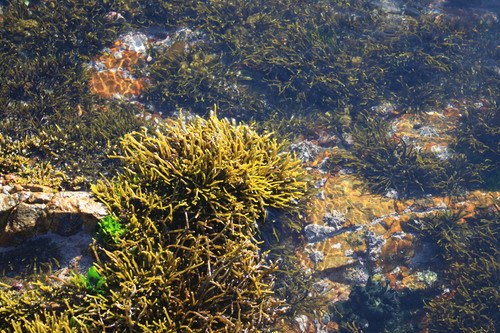
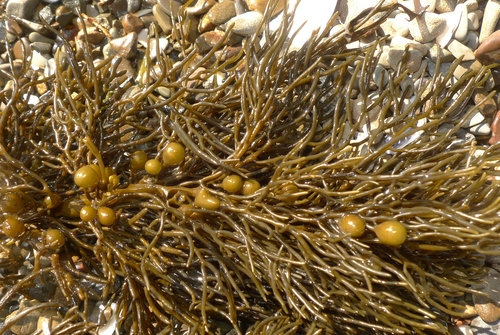
Sargassum polycystum
C. Agardh
Brown algae, Arien harulu
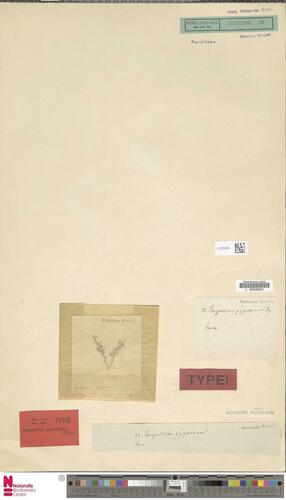
C.Agardh, no known copyright restrictions (public domain)

(c) Jonathan Lavan, underpressurephotog.com, some rights reserved (CC BY-NC), uploaded by Jonathan Lavan, underpressurephotog.com

(c) obscurus, some rights reserved (CC BY-NC), uploaded by obscurus
What to Eat
Edible parts: Algae, Seaweed, Frond
The fronds and seaweed are eaten.
Where to Find It
It is a tropical plant. It grows on coral reefs. It grows in the lower tidal zone and on sheltered shores.
Africa, Andaman Islands, Asia, Australia, Canary Islands, China, East Africa, FSM, Guam, India, Indochina, Indonesia, Japan, Kenya, Madagascar, Malaysia, Mauritius, Micronesia, Myanmar, New Caledonia, Pacific, Pakistan, Palau, Papua New Guinea, PNG, Philippines, Reunion, SE Asia, Seychelles, Singapore, Solomon Islands, Sri Lanka, Taiwan, Tanzania, Thailand, Tonga, Vanuatu, Vietnam, Wallis & Futuna,
How to Identify
A brown seaweed. It produces runners from the base. Then erect branches arise from these. These erect stems are 30 cm long. They are warted and have deeply toothed leaves.
Nutrition Score: 1/100
| Part | Moisture | kJ | kcal | Protein | Vit A | Vit C | Iron | Zinc |
|---|---|---|---|---|---|---|---|---|
| Seaweed | — | — | 5.4 | — | — | — | — | — |
Names & Synonyms
Agar-agar koepan, Boto-boto, Lusay-lusay
References (10)
- Cherry, P., et al, 2019, Risks and benefits of consuming edible seaweeds. Nutrition ReviewsVR Vol. 77(5):307–329
- Cribb, A.B., 1996, Seaweeds of Queensland A Naturalist's Guide. The Queensland Naturalists' Club Handbook No. 2. p 59
- http://www.seavegetables.com
- Kiple, K.F. & Ornelas, K.C., (eds), 2000, The Cambridge World History of Food. CUP p 236
- Wang, Wei-Lung and Chiang, Young-Meng, 1994, Potential Economic Seaweeds of Hengchun Peninsula, Taiwan, Economic Botany, Vol. 48, No. 2, pp. 182-189
- Womersley, H.B. S. & Bailey, A., 1970, Marine algae of the Solomon Islands. Philosophical Transactions of the Royal Society of London. B. Biological Sciences 259:257-352
- World Checklist of Useful Plant Species 2020. Royal Botanic Gardens, Kew
- Xia, B., and Abbott, I.A., 1987, Edible seaweeds of China and their place in the Chinese diet. Economic Botany 41:341-53
- Zaneveld, J.S., 1955, Economic marine algae of tropical South and East Asia and their utilization. Indo-Pacific Special Publications, No 3 Bangkok.
- Zemke-White, W. L. & Ohno, M., 1999, World seaweed utilisation: An end-of-century summary. Journal of Applied Phycology 11: 369-376