Saururus chinensis
(Lour.) Baill.
Ham-ech, Chinese lizard's tail
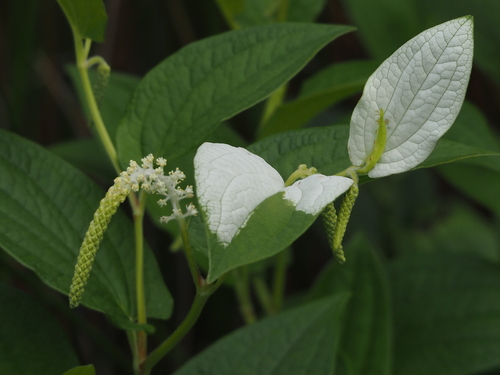
no rights reserved, uploaded by 葉子
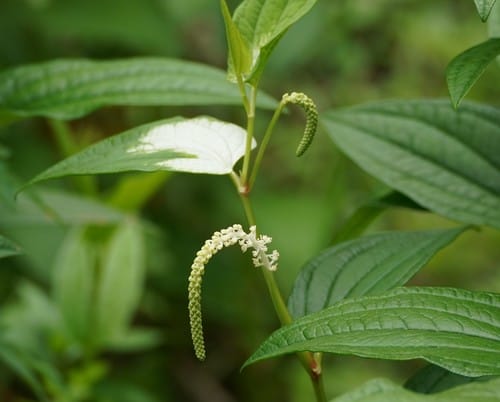
(c) Ryan Yue Wah Chan, some rights reserved (CC BY-NC)

(c) Martin Lowry, some rights reserved (CC BY-NC), uploaded by Martin Lowry
What to Eat
Edible parts: Rhizomes, Root
None known.
Where to Find It
It grows in bogs. In China it grows between 100-1,700 m altitude.
Asia, China, India, Indochina, Japan, Korea, Philippines, SE Asia, Vietnam,
How to Identify
A herb. It grows up to 1 m tall. It is often 30-40 cm high. The leaves are oval and pale green. They are 10-13 cm long. The flowers are naked and along a stalk. They are creamy white.
Nutrition Score: 32/100
| Part | Moisture | kJ | kcal | Protein | Vit A | Vit C | Iron | Zinc |
|---|---|---|---|---|---|---|---|---|
| Leaves | 89.7 | 84 | 20 | 2.7 | — | 68 | — | — |
How to Grow
Plants can be grown by seed or division.
Propagation: Seed is best sown in a cold frame as soon as it is ripe in early autumn; stored seed can be sown in late winter or early spring. Keep pots moist by standing them in shallow water. Prick seedlings into individual pots when large enough to handle and plant out in summer. Division in spring is straightforward — the plants spread freely and can be divided at almost any point during the growing season. Divisions taken in mid to late summer should be overwintered in pots in a cold frame before being planted out in late spring. Regular division helps maintain the vigour of the plant.
Medicinal Uses
The plant has antiperiodic and parasiticide properties. The flowers are antimalarial, diuretic, eliminative, laxative, and parasiticide. The root is antimalarial, depurative, eliminative, and parasiticide. The whole plant is antiphlogistic, depurative, diuretic, febrifuge, and refrigerant. A decoction is used in the treatment of oedema, nephritis-associated oedema, nutritional oedema, inflammatory conditions, urinary calculus, rheumatoid arthritis, boils, abscesses, rashes, and fungal skin infections. The leaves are applied as a poultice to clean abscesses and boils.
Other Uses
None known.
Wikipedia
Source ↗Saururus chinensis is a species of flowering plant in the family Saururaceae. It is sometimes referred to by the common name Asian lizard's tail,
Notes
There are 2 Saururus species.
Names & Synonyms
References (8)
- Adansonia 10:71. 1871
- Fl. cochinch. 1:217. 1790 (As Spathium chinense)
- Heywood, V.H., Brummitt, R.K., Culham, A., and Seberg, O., 2007, Flowering Plant Families of the World. Royal Botanical Gardens, Kew. p 298
- Lim, T. K., 2015, Edible Medicinal and Non Medicinal Plants. Volume 9, Modified Stems, Roots, Bulbs. Springer p 79
- Mot So Rau Dai an Duoc O Vietnam. Wild edible Vegetables. Ha Noi 1994, p 232
- Pham-Hoang Ho, 1999, An Illustrated Flora of Vietnam. Nha Xuat Ban Tre. p 288
- Slocum, P.D. & Robinson, P., 1999, Water Gardening. Water Lilies and Lotuses. Timber Press. p 101
- WATT, (As Spathium chinense)

