Schoenoplectus litoralis
(Schrader) Palla
River club-rushes
(c) יאיר אור, some rights reserved (CC BY-NC-SA), uploaded by יאיר אור
(c) Еlena, some rights reserved (CC BY-NC), uploaded by Еlena

(c) Alexey P. Seregin, some rights reserved (CC BY-NC), uploaded by Alexey P. Seregin
What to Eat
Edible parts: Rhizome, Root, Stem
The underground stems (rhizomes) are traditionally roasted and crushed, then eaten.
Where to Find It
A tropical plant. It grows on the edge of swamps. Often it is in brackish water. It is often on coastal regions. It can grow on the edges of mangroves.
Afghanistan, Africa, Asia, Australia, Burkina Faso, Central Asia, China, Egypt, Europe, Guinea, Guinée, Guinea-Bissau, India, Indochina, Iran, Kazakhstan, Mediterranean, Middle East, Mongolia, North Africa, Oman, Pacific, Pakistan, Papua New Guinea, PNG, Philippines, SE Asia, Sierra Leone, Sri Lanka, Thailand, Turkey, Türkiye, West Africa,
How to Identify
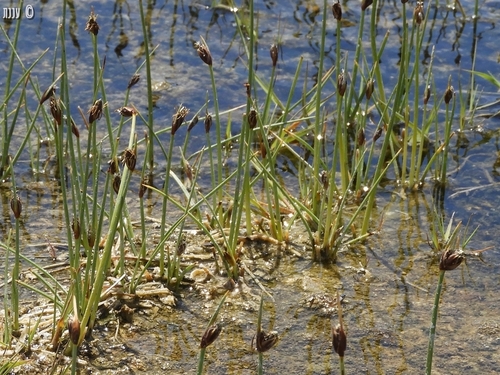
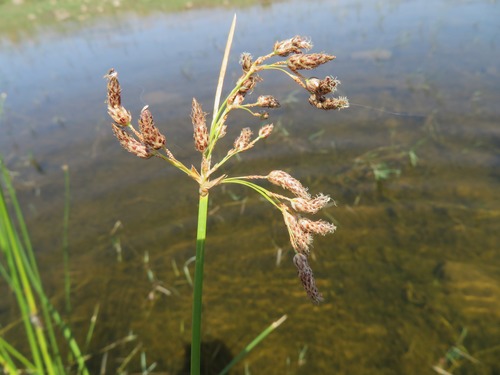
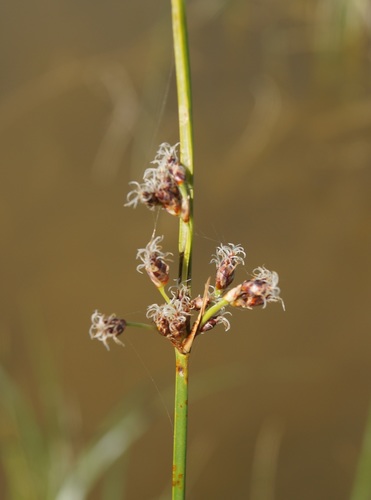
A sedge which keeps growing from year to year. It is 1.5 m high. It forms tufts and has long stout rhizomes. The stems are 3 angled near the flower but are rounded lower down. The stems are hollow. There are 3-4 leaves per stem. They are pale grey and mostly with just a sheath but the top leaf is 50 cm long. The flower head is brown and is a compound arrangement of many spikes. The spikelets are 0.5-2 cm long. The nut is curved on both sides and 2 mm long. It is smooth.
Notes
There are about 60 Schoenoplectus species.
Names & Synonyms
Enguemae, Inthue
References (19)
- Ambasta S.P. (Ed.), 2000, The Useful Plants of India. CSIR India. p 560 (As Scirpus littoralis)
- Bodkin, F., 1991, Encyclopedia Botanica. Cornstalk publishing, p 918 (As Scirpus littoralis)
- Calvert, G. & Liessmann, L., 2014, Wetland Plants of the Townsville - Burdekin Flood Plain. Lower Burdekin Landcare (As Schoenoplectus subulatus)
- Cherikoff V. & Isaacs, J., The Bush Food Handbook. How to gather, grow, process and cook Australian Wild Foods. Ti Tree Press, Australia p 190, 196 (As Scirpus littoralis)
- Cribb, A.B. & J.W., 1976, Wild Food in Australia, Fontana. p 158 (As Scirpus littoralis)
- Dashorst, G.R.M., and Jessop, J.P., 1998, Plants of the Adelaide Plains & Hills. Botanic Gardens of Adelaide and State Herbarium. p 192
- Flora of Pakistan. www.eFloras.org
- Hardwick, R.J., 2000, Nature's Larder. A Field Guide to the Native Food Plants of the NSW South Coast. Homosapien Books. p 119
- Hibbert, M., 2002, The Aussie Plant Finder 2002, Florilegium. p 288
- Kenneally, K.E., Edinger, D. C., and Willing T., 1996, Broome and Beyond, Plants and People of the Dampier Peninsula, Kimberley, Western Australia. Department of Conservation and Land Management. p 209
- Leach, G.J., & Osborne, P.L., 1985, Freshwater Plants of Papua New Guinea. UPNG Press, p 120 (As Scirpus littoralis)
- Lim, T. K., 2015, Edible Medicinal and Non Medicinal Plants. Volume 9, Modified Stems, Roots, Bulbs. Springer p 75
- Low, T., 1991, Wild Food Plants of Australia. Australian Nature FieldGuide, Angus & Robertson. p 51 (Photo)
- Miller, A. G., Morris, M. & Stuart-Smith, S., 1988, Plants of Dhofar. The Southern Region of Oman, Traditional, Economic and Medicinal Uses. Sultanate of Oman. p 124
- Paczkowska, G. & Chapman, A.R., 2000, The Western Australian Flora. A Descriptive Catalogue. Western Australian Herbarium. p 54
- Simpson, D. A. & Inglis, C. A., 2001, Cyperaceae of Economic, Ethnobotanical and Horticultural Importance: A checklist. Kew Bulletin Vol. 56, No. 2 (2001), p. 336
- Verh. K.K. Zool.-Bot. Ges. Wien 38:49. 1888 - although this epithet is almost universally accepted, Schrader's basionym was published the year after Scirpus subulatus Vahl (1805), so Vahl's epithet must be adopted for the combined taxon
- Wheeler, J.R.(ed.), 1992, Flora of the Kimberley Region. CALM, Western Australian Herbarium, p 1102 (Drawing)
- World Checklist of Useful Plant Species 2020. Royal Botanic Gardens, Kew
More from Cyperaceae