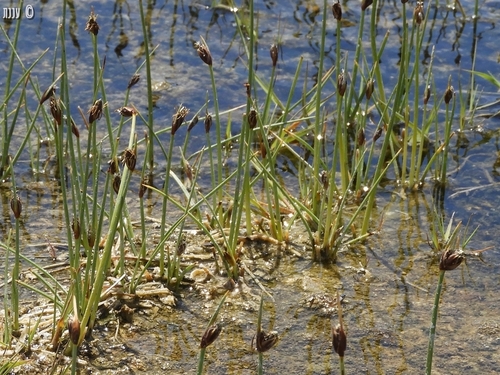
Scirpus cyperinus
(L.) Kunth
Wool grass, Cottongrass Bulrush

(c) Nina, some rights reserved (CC BY-NC), uploaded by Nina

(c) Grant Fessler, some rights reserved (CC BY-NC), uploaded by Grant Fessler

no rights reserved, uploaded by 葉子
What to Eat
Edible parts: Seeds
The seeds can be cooked and used as a substitute for rice.
Where to Find It
It grows in moist and boggy soils.
Canada, North America, USA,
How to Identify
A sedge. These grow in clumps and have grass like leaves and solid stalks. It is a tall rush. It grows 2 m high. It has large fluffy brown heads.
How to Grow
Propagation: Seed: sow in a cold frame as soon as ripe in a pot standing in 3cm of water, barely covering the seed. Germination is usually fairly quick. Prick out seedlings when large enough to handle and plant into permanent positions in early summer. Division in spring is very easy. Larger divisions can go directly into permanent positions; smaller ones are best potted up and grown on in a lightly shaded cold frame, then planted out once well established in summer.
Medicinal Uses
None known.
Other Uses
The stems are woven into matting and ropes, and have been used to make woven mats and storage bags. The fruiting tops provide a resilient stuffing material suitable for making pillows.
Wikipedia
Source ↗Scirpus cyperinus, commonly known as woolgrass, is an emergent wetland herb that is native to the eastern United States and eastern Canada. Other common names include cottongrass bulrush and brown woolly sedge. Woolgrass is not a true grass, despite its common name; it is a type of bulrush (Scirpus). Bulrushes furthermore are not true rushes; they are types of sedges. This sedge is very variable in appearance. In general, it produces short, tough rhizomes and grows in dense clumps. The fertile stems grow upright. There are five to ten leaves per stem. They are up to 80 centimeters long by 1 centimeter wide. The proximal ones have green or reddish sheaths. The inflorescence has upright or spreading branches bearing cymes of up to 15 spikelets each. The spikelet is cylindrical or oval and measures up to 0.8 centimeters in length. It is covered in reddish, brownish, or black scales. The flowers have six long bristles each, making the inflorescence look woolly. This plant grows in many types of wet habitat, such as marshes and ponds. It can be found in disturbed habitat, such as ditches. This plant often hybridizes with its relatives Scirpus atrocinctus and S. pedicellatus. Native Americans used this plant for a number of purposes. The Ojibwa people used it to make bags and mats, and the Potawatomi people used it to stuff pillows.
Names & Synonyms
References (4)
- Enum. pl. 2:170. 1837
- Plants for a Future database, The Field, Penpol, Lostwithiel, Cornwall, PL22 0NG, UK. http://www.scs.leeds.ac.uk/pfaf/
- Simpson, D. A. & Inglis, C. A., 2001, Cyperaceae of Economic, Ethnobotanical and Horticultural Importance: A checklist. Kew Bulletin Vol. 56, No. 2 (2001), p. 338
- Slocum, P.D. & Robinson, P., 1999, Water Gardening. Water Lilies and Lotuses. Timber Press. p 101
More from Cyperaceae