Scolopia spinosa
(Roxb.) Warb.
White rukem tree

Royal Botanic Gardens, Kew

Royal Botanic Gardens, Kew

Royal Botanic Gardens, Kew
What to Eat
Edible parts: Fruit
The ripe fruit are eaten.
Where to Find It
A tropical plant. It grows in secondary rainforest often on limestone soils. It occurs up to 1,100 m altitude.
Asia, Cambodia, India, Indochina, Indonesia, Laos, Malaysia, Myanmar, SE Asia, Thailand, Vietnam,
How to Identify
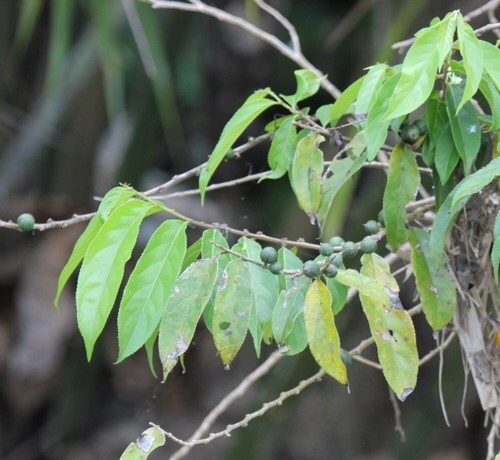
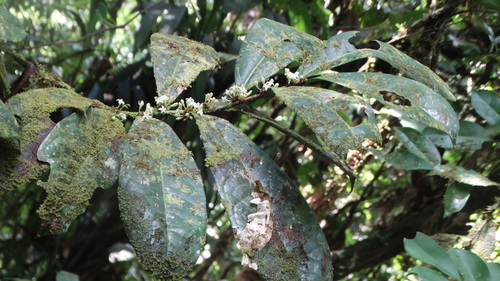
A tree. It grows to 10-15 m high. Occasionally it grows to 27 m high or can be a shrub 6 m tall. The trunk becomes grey, smooth and unarmed but young plants have branched spines. The leaves are broadly wedge shaped. They are rose-red coloured when young. They are 8-18 cm long by 3.5-8 cm wide. They have slight indentations around the edge. The flower cluster is 2-5 cm long with white flowers. The fruit is a berry 1.5-2.5 cm long with a small tip at the end. The fruit is green or purple. It contains 6 or up to 20 bitter seeds.
How to Grow
Plants can be grown from seeds.
Production
Flowers are produced throughout the year.
Notes
Also put in the Flacourtiaceae family.
Names & Synonyms
Bom gai, Krakhob prei, Pohon rukem putih
References (6)
- Ambasta S.P. (Ed.), 2000, The Useful Plants of India. CSIR India. p 562
- Cengel, D. J. & Dany, C., (Eds), 2016, Integrating Forest Biodiversity Resource Management and Sustainable Community Livelihood Development in the Preah Vihear Protected Forest. International Tropical Timber Organization p 121
- Phon, P., 2000, Plants used in Cambodia. © Pauline Dy Phon, Phnom Penh, Cambodia. p 552
- Sleumer, H., 1954, Flacourtiaceae in Flora Malesiana, Ser 1 Vol 5(1) p10
- Sukarya, D. G., (Ed.) 2013, 3,500 Plant Species of the Botanic Gardens of Indonesia. LIPI p 502
- World Checklist of Useful Plant Species 2020. Royal Botanic Gardens, Kew