Secale cereale
L.
Rye

(c) Matt Lavin, some rights reserved (CC BY)
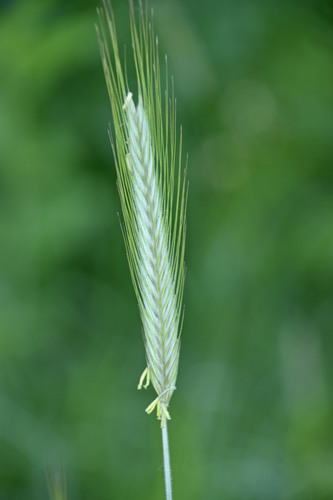
(c) Tara Bauman, some rights reserved (CC BY-NC), uploaded by Tara Bauman
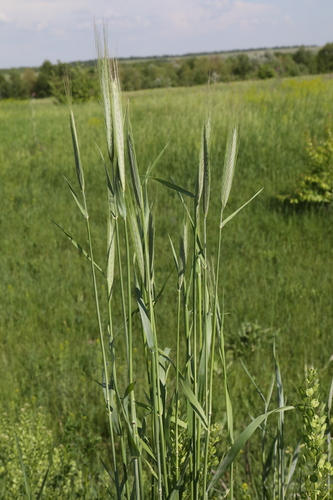
(c) Kulakov Vitalii G., some rights reserved (CC BY-NC), uploaded by Kulakov Vitalii G.
What to Eat
Edible parts: Seeds, Cereal, Sprouts, Seeds - coffee
The seed is a widely used cereal, particularly in northern Europe for making bread. It contains around 13% protein and some gluten, though less than wheat, producing a denser loaf. It can also be used in cakes and similar baked goods, and sprouted seeds can be added to salads. Germinated seed is used to produce malt — a sweet substance extracted after roasting — which serves as a sweetening agent and is used in brewing beer. The roasted ungerminated seed can be used as a coffee substitute. Nutritional composition per 100g (dry weight, 380 calories): water 0%, protein 13.2g, fat 2.5g, carbohydrate 82.5g, fibre 2.2g, ash 2g; calcium 44mg, phosphorus 400mg, iron 4mg, sodium 4mg, potassium 524mg; thiamine (B1) 0.4mg, riboflavin (B2) 0.24mg, niacin 1.8mg. (Figures are the median of a reported range.)
Where to Find It
A temperate plant. It needs an open sunny position. It is resistant to frost but damaged by drought. It produces well in areas with cold winters and hot dry summers. It has value in cold places. It can grow in poorer soils. It germinates are 4-5°C. Seedlings can endure frost. The average temperature should not exceed 20°C when grain is being produced.
Afghanistan, Africa, Albania, Algeria, Andorra, Argentina, Armenia, Asia, Australia, Azerbaijan, Balkans, Belarus, Canada, Caucasus, Central Asia, Chile, China, Czech Republic, East Africa, Ecuador, Egypt, Estonia, Ethiopia, Europe, Finland, France, Georgia, Germany, Hungary, India, Iran, Iraq, Kazakhstan, Kenya, Korea, Kyrgyzstan, Lithuania, Macedonia, Malawi, Mediterranean, Middle East, Morocco, Mozambique, Netherlands, North Africa, North America, Norway, Pacific, Pakistan, Papua New Guinea, PNG, Poland, Russia, Scandinavia, Serbia, Slovakia, Slovenia, South Africa, Southern Africa, Spain, Sweden, Switzerland, Taiwan, Tajikistan, Tasmania, Turkey, Türkiye, Ukraine, Uruguay, USA, USSR,
How to Identify
An annual plant. It is a cereal grass. It grows to 60-200 cm high. It spreads to 30 cm across. It produces tufts. The stem is erect and bluish green. The leaves are rough and narrow. They are 30 cm long and 8 mm wide. The leaves are smooth on the lower surface. The flowers are dense, slender spikelets. They are 20 cm long. The spikelets are 2-flowered and strongly awned.
Nutrition Score: 63/100
| Part | Moisture | kJ | kcal | Protein | Vit A | Vit C | Iron | Zinc |
|---|---|---|---|---|---|---|---|---|
| Seeds | 12.5 | 1396 | 334 | 12.8 | 0 | 0 | 3 | 5.6 |
How to Grow
An easily grown plant, it succeeds in most soils but prefers a well-drained light soil in a sunny position. It thrives on infertile, submarginal areas and is renouned for its ability to grow on sandy soils. Established plants are drought tolerant. The plant is reported to tolerate an annual precipitation in the range of of 22 to 176cm, an annual temperature in the range of of 4.3 to 21.3°C and a pH of 4.5 to 8.2. Rye is a widely cultivated temperate zone cereal crop. It is able to withstand severe climatic conditions and can be grown much further north and at higher altitudes than wheat. Average yields vary widely from country to country, the world average is around 1.6 tonnes per hectare with yields of almost 7 tonnes per hectare achieved in Norway. There are many named varieties. Rye is a rather variable species and botanists have divided it into a number of sub-species, all of which could be of value in breeding programmes. These sub-species are briefly listed below:- S. cereale afghanicum (Vavilov.)K.Hammer. Native to the Caucasus, western Asia and India. S. cereale ancestrale Zhuk. Native to western Asia. S. cereale dighoricum Vavilov. Native to the Caucasus and eastern europe. S. cereale segetale Zhuk. Native to temperate Asia. Rye grows well with cornflowers and pansies, though it inhibits the growth of poppies and couch grass. In garden design, as well as the above-ground architecture of a plant, root structure considerations help in choosing plants that work together for their optimal soil requirements including nutrients and water.
Propagation: Sow seed in March or October in situ, barely covering the seed. Germination should occur within two weeks.
Medicinal Uses
The seed can be made into a poultice and applied to tumours. It also acts as an effective laxative due to its fibrous seed coat.
Other Uses
The straw can be used as a fuel or industrial biomass. It is strong enough for thatching, paper making, and weaving mats and hats, and also serves as packing material for nursery stock, bricks, and tiles, as well as bedding, archery targets, and mushroom compost. Rye is a good green manure crop — fast growing with an extensive, deep root system. Sown in late autumn, it prevents soil erosion and nutrient leaching over winter and can be incorporated into the soil in spring. The root system also makes it useful for soil stabilisation, especially on sandy soils.
Wikipedia
An annual grass reaching 1.8 m (6 ft) tall and 0.1 m (4 in) wide. Hardy to UK zone 3, not frost tender. Flowers May to July; seeds ripen August to September. Hermaphroditic, wind-pollinated. Grows in light sandy, medium loamy, and heavy clay soils, preferring well-drained conditions across mildly acidic to mildly alkaline pH. Requires full sun, prefers moist soil, and tolerates drought. Withstands strong winds but not maritime exposure.
Other Information
It has occasionally been planted in trials in Papua New Guinea. It is a cultivated food plant.
Notes
There are 6-8 Secale species.
Names & Synonyms
Ashora, Centeno, Gandum hitam, Maanash, Mukhudo, Roggen, Rukis, Ryecorn, Segale, Seigle
References (39)
- Ambasta, S.P. (Ed.), 2000, The Useful Plants of India. CSIR India. p 563
- Bianchini, F., Corbetta, F., and Pistoia, M., 1975, Fruits of the Earth. Cassell. p 18
- Bodkin, F., 1991, Encyclopedia Botanica. Cornstalk publishing, p 920
- Brink, M., 2006. Secale cereale L. [Internet] Record from Protabase. Brink, M. & Belay, G. (Editors). PROTA (Plant Resources of Tropical Africa), Wageningen, Netherlands. < http://database.prota.org/search.htm>. Accessed 22 October 2009
- Bussman, R. W., et al, 2016, A comparative ethnobotany of Khevsureti, Samtskhe-Javakheti, Tusheti, Svaneti, and Racha-Lechkhumi, Republic of Georgia (Sakartvelo), Caucasus. Journal of Ethnobiology and Ethnomedicine.
- Bussman, R. W., et al, 2021, Unity in diversity—food plants and fungi of Sakartvelo (Republic of Georgia), Caucasus. Journal of Ethnobiology and Ethnomedicine (2021) 17:72 p 13
- Curtis, W.M., & Morris, D.I., 1994, The Student's Flora of Tasmania. Part 4B St David's Park Publishing, Tasmania, p 302
- Evans, G.M., 1979, Rye, in Simmonds N.W.,(ed), Crop Plant Evolution. Longmans. London. p 108
- Facciola, S., 1998, Cornucopia 2: a Source Book of Edible Plants. Kampong Publications, p 179
- Flora of Pakistan. www.eFloras.org
- Gabrielian, E. & Zohary, D.: Wild relatives of food crops native to Armenia and Nakhichevan. — Fl. Medit. 14: 5-80. 2004. — ISSN 1120-4052.
- Harris, S., Buchanan, A., Connolly, A., 2001, One Hundred Islands: The Flora of the Outer Furneaux. Tas Govt. p 223
- Hedrick, U.P., 1919, (Ed.), Sturtevant's edible plants of the world. p 601
- Heywood, V.H., Brummitt, R.K., Culham, A., and Seberg, O., 2007, Flowering Plant Families of the World. Royal Botanical Gardens, Kew. p 394
- http://www.botanic-gardens-ljubljana.com/en/plants
- Hu, Shiu-ying, 2005, Food Plants of China. The Chinese University Press. p 296
- Jackes, D. A., 2007, Edible Forest Gardens
- Jardin, C., 1970, List of Foods Used In Africa, FAO Nutrition Information Document Series No 2.p 7
- Kalle, R. & Soukand, R., 2012, Historical ethnobotanical review of wild edible plants of Estonia (1770s-1960s) Acta Societatis Botanicorum Poloniae 81(4):271-281
- Kiple, K.F. & Ornelas, K.C., (eds), 2000, The Cambridge World History of Food. CUP p 1846
- Lamp, C.A., Forbes, S.J. and Cade, J.W., 1990, Grasses of Temperate Australia. Inkata Press. p 256
- Lazarides, M. & Hince, B., 1993, Handbook of Economic Plants of Australia, CSIRO. p 215
- Menninger, E.A., 1977, Edible Nuts of the World. Horticultural Books. Florida p 150
- Molla, A., Ethiopian Plant Names. http://www.ethiopic.com/aplants.htm
- Paczkowska, G. & Chapman, A.R., 2000, The Western Australian Flora. A Descriptive Catalogue. Western Australian Herbarium. p 116
- Plants for a Future database, The Field, Penpol, Lostwithiel, Cornwall, PL22 0NG, UK. http://www.scs.leeds.ac.uk/pfaf/
- PROSEA (Plant Resources of South East Asia) handbook Volume 10 Cereals. p 123
- Purseglove, J.W., 1972, Tropical Crops. Monocotyledons. Longmans p 123
- Small, E., 2009, Top 100 Food Plants. The world's most important culinary crops. NRC Research Press. p 464
- Sp. pl. 1:84. 1753
- Tasmanian Herbarium Vascular Plants list p 89
- Torre, de la, L., et al, 2008, Enciclopedia de las Plantas Útiles del Ecuador. Herbario QCA. Pontificia Universidad Católica del Ecuador. p 520
- USDA, ARS, National Genetic Resources Program. Germplasm Resources Information Network - (GRIN). [Online Database] National Germplasm Resources Laboratory, Beltsville, Maryland. Available: www.ars-grin.gov/cgi-bin/npgs/html/econ.pl (10 April 2000)
- van Wyk, B., 2005, Food Plants of the World. An illustrated guide. Timber press. p 342
- Vaughan, J. C. & Geissler, C. A., 2009, The new Oxford Book of Food Plants. Oxford University Press. p 6
- Wiersema, J. H. & Leon, B., 2013, World Economic Plants. A Standard Reference CRC Press. 2nd Ed. p 622
- Williamson, J., 2005, Useful Plants of Malawi. 3rd. Edition. Mdadzi Book Trust. p 222
- World Checklist of Useful Plant Species 2020. Royal Botanic Gardens, Kew
- Zeven, A. C. & de West, J. M. J., 1982, Dictionary of cultivated plants and their regions of diversity. Wageningen. p 83


