Setaria pumila
(Poir.) Roem. & Schult.
Yellow bristle grass, Annual timothy
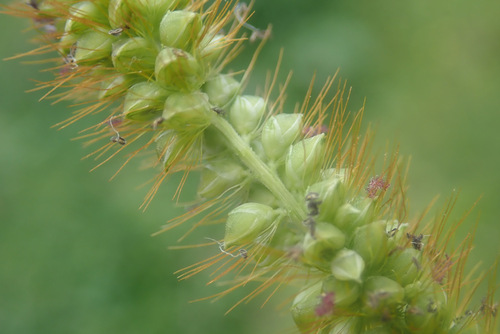
(c) Thomas Gyselinck, some rights reserved (CC BY), uploaded by Thomas Gyselinck
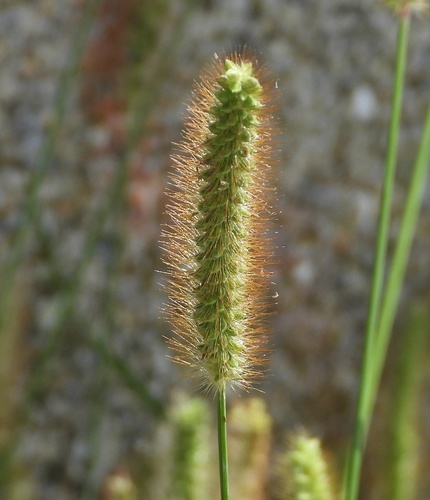
(c) Elio Giacone, some rights reserved (CC BY-NC), uploaded by Elio Giacone

(c) Jeff Skrentny, some rights reserved (CC BY-NC), uploaded by Jeff Skrentny
What to Eat
Edible parts: Seeds, Cereal, Seeds - drink
The seeds can be cooked and eaten as sweet or savoury dishes in all the same ways as rice, or ground into a powder for porridge, cakes, and puddings. The seed contains approximately 11.5% protein, 6% fat, and 40.7% carbohydrate, with 8.2% fat also recorded. A dust produced by fungal infection of plants is also eaten.
Where to Find It
It grows in tropical and warm temperate places. It is cultivated by hill tribes in southern India. In the Mediterranean is often grows in damp places like ditches. In Africa it grows from sea level to 1,500 m above sea level. In Sichuan and Yunnan.
Africa, Argentina, Asia, Australia, Botswana, Brazil, Britain, Burkina Faso, Canada, Caribbean, Central America, Central Asia, Chile, China, East Africa, Ethiopia, Europe, France, Gambia, Ghana, Greece, Guinea, Guinée, Guinea-Bissau, Haiti, India, Indochina, Italy, Jamaica, Japan, Haiti, Korea, Laos, Lesotho, Lesser Antilles*, Luxembourg, Madagascar, Malawi, Mali, Mediterranean, Mexico*, Mozambique, Myanmar, Nepal, New Zealand, North Africa, North America, Pakistan, Paraguay, Portugal, SE Asia, Senegal, Sierra Leone, South Africa, Southern Africa, South America*, Spain, St Helena, Taiwan, Tajikistan, Tibet, Uganda, USA, USSR, West Africa, West Indies*, Zambia, Zimbabwe,
How to Identify
A millet grass. It is an annual grass. It grows 20-90 cm tall. The leaf blades are linear and 5-40 cm long by 0.2-1 cm wide. The flowering head is like a "fox tail". The flowering head is cylinder shaped. The bristles are orange.
How to Grow
A world-wide weed, found from the temperate zone to the tropics. In the tropics, it is found in areas where the mean annual rainfall is 500mm or more. Succeeds in any well-drained soil in full sun. The plant is especially well suited to dry soil conditions. The plant photosynthesizes by a more efficient method than most plants. Called the 'C4 carbon-fixation pathway', this process is particularly efficient at high temperatures, in bright sunlight and under dry conditions.
Propagation: Sow seed in early spring in a greenhouse, barely covering it. Germination is usually quick and good. Prick out seedlings into individual pots as soon as they are large enough to handle and grow them on quickly. Plant out in late spring after the last expected frosts. For larger quantities, seed can be sown in situ in mid-spring, though plants may flower later and may not ripen seed in a cool summer.
Medicinal Uses
None known.
Other Uses
None known.
Wikipedia
Source ↗Setaria pumila is a species of grass known by many common names, including yellow foxtail, yellow bristle-grass, pigeon grass, and cattail grass. It is native to Europe, but it is known throughout the world as a common weed. It grows in lawns, sidewalks, roadsides, cultivated fields, and many other places. This annual grass grows 20 centimetres (8 inches) to well over 1 metre (1 yard) in height, its mostly hairless stems ranging from green to purple-tinged in color. The leaf blades are hairless on the upper surfaces, twisting, and up to 30 centimetres (12 inches) long. The inflorescence is a stiff, cylindrical bundle of spikelets 2 to 15 centimetres (3⁄4 to 6 inches) long with short, blunt bristles. The panicle may appear yellow or yellow-tinged. In New Zealand S. pumila can cover 20–40% of otherwise productive dairy farming pasture causing a loss in milk production.
Other Information
It is harvested as a wild cereal in times of scarcity.
Notes
There are about 130 Setaria species. They are mainly in the tropics and subtropics.
Names & Synonyms
Bulo-faro, Bulude, Chigerequete, Difim-difim, Jin se guo wei cao, Kasinda kambwa, Khwemi-ani, Khwemi-apyu, Khwemi-pok, Korali, Kyaugmi, Nchaacha, Pale pigeon grass, Taya, Yon-sa
References (22)
- Blamey, M and Grey-Wilson, C., 2005, Wild flowers of the Mediterranean. A & C Black London. p 527
- Dalziel, J. M., 1937, The Useful plants of west tropical Africa. Crown Agents for the Colonies London.
- Dobriyal, M. J. R. & Dobriyal, R., 2014, Non Wood Forest Produce an Option for Ethnic Food and Nutritional Security in India. Int. J. of Usuf. Mngt. 15(1):17-37
- Flora of Pakistan. www.eFloras.org
- Gallagher, D. E., 2010, Farming beyond the escarpment: Society, Environment, and Mobility in Precolonial Southeastern Burkina Faso. PhD University of Michigan.
- Goode, P., 1989, Edible Plants of Uganda. FAO p 30 (As Setaria pallide-fusca)
- Hussey, B.M.J., Keighery, G.J., Cousens, R.D., Dodd, J., Lloyd, S.G., 1997, Western Weeds. A guide to the weeds of Western Australia. Plant Protection Society of Western Australia. p 70
- JSTOR Global Plants edible
- Kiple, K.F. & Ornelas, K.C., (eds), 2000, The Cambridge World History of Food. CUP p 118
- Paczkowska, G. & Chapman, A.R., 2000, The Western Australian Flora. A Descriptive Catalogue. Western Australian Herbarium. p 116
- Patil, M. V. & Patil, D. A., 2000, Some More Wild Edible Plants of Nasik District (Maharashtra). Ancient Science of Life Vol. X1X (3&4): 102-104
- Peters, C. R., O'Brien, E. M., and Drummond, R.B., 1992, Edible Wild plants of Sub-saharan Africa. Kew. p 27
- Plants for a Future database, The Field, Penpol, Lostwithiel, Cornwall, PL22 0NG, UK. http://www.scs.leeds.ac.uk/pfaf/
- Plants of Haiti Smithsonian Institute http://botany.si.edu/antilles/West Indies
- Ruiters-Welcome, A. K., 2019, Food plants of southern Africa. Ph.D. thesis. Univ. of Johannesburg p 89
- Srivastava, R. C., 2010, Traditional knowledge of Nyishi (Daffla) tribe of Arunachal Pradesh. Indian Journal of Traditional Knowledge. 9(1):26-37(As Setaria pallide-fusca)
- Syst. veg. 2:891. 1817
- van Wyk, B., 2005, Food Plants of the World. An illustrated guide. Timber press. p 345
- Vernon, R., 1983, Field Guide to Important Arable Weeds of Zambia. Dept of Agriculture, Chilanga, Zambia. p 128
- Welcome, A. K. & Van Wyk, B.-E., 2019, An inventory and analysis of the food plants of southern Africa. South African Journal of Botany 122 (2019) 136–179
- Wiersema, J. H. & Leon, B., 2013, World Economic Plants. A Standard Reference CRC Press. 2nd Ed. p 633
- World Checklist of Useful Plant Species 2020. Royal Botanic Gardens, Kew


