Setaria viridis
(L.) P. Beauv.
Green Foxtail, Green Pigeon grass
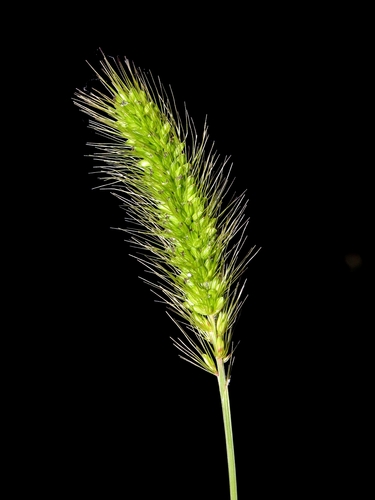
(c) eugenezakharov, some rights reserved (CC BY-NC), uploaded by eugenezakharov
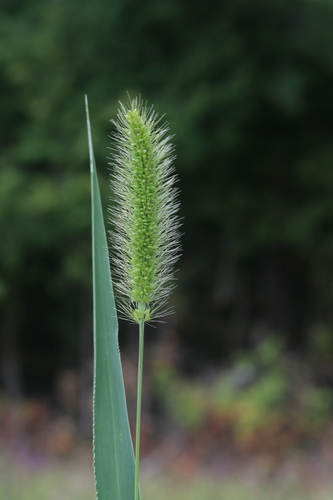
(c) Don Sutherland, some rights reserved (CC BY-NC), uploaded by Don Sutherland
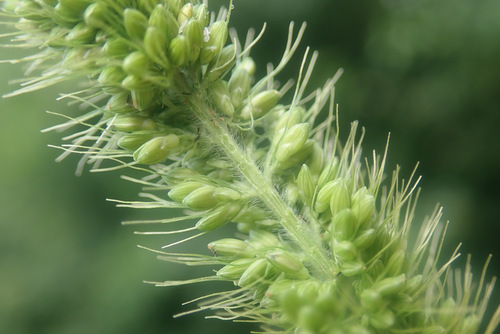
(c) Thomas Gyselinck, some rights reserved (CC BY), uploaded by Thomas Gyselinck
What to Eat
Edible parts: Seeds, Cereal
The small seeds can be used in the same ways as rice or millet — boiled, roasted, or ground into flour. Roasted seed is also said to serve as a coffee substitute.
Where to Find It
It is a temperate plant. It is drought resistant. It can grow in arid places. In Argentina it grows from sea level to 1,000 m above sea level. In Sichuan. In Yunnan.
Afghanistan, Africa, Andorra, Argentina, Asia, Australia, Austria, Balkans, Belgium, Bermuda, Brazil, Bulgaria, Canada, Central Asia, Chile, China, Cyprus, Czech Republic, Egypt, Estonia, Europe, France, Germany, Greece, Guyana, Himalayas, Hungary, India, Indochina, Iran, Iraq, Israel, Italy, Japan, Jordan, Korea, Kuwait, Kyrgyzstan, Lebanon, Luxembourg, Mediterranean, Middle East, Mongolia, Myanmar, Nepal, Netherlands, Niger, North Africa, Oman, Pakistan, Papua New Guinea, PNG, Qatar, Romania, Saudi Arabia, Scandinavia, SE Asia, Slovenia, Socotra, Somalia, South America, Spain, Sweden, Switzerland, Taiwan, Tajikistan, Tasmania, Thailand, Tibet, Turkmenistan, Ukraine, United Arab Emirates, UAE, Uruguay, USA, West Africa, Yemen, Yugoslavia,
How to Identify
An annual millet grass. It forms tufts. It can be 70-150 cm tall. The culms are usually bent at the lower nodes. The leaf blades are thin and flat in cross section. They are 5-30 cm long and 3-12 mm wide. The taper to a fine point. The flowers are bristly. The teeth of the bristles point upwards. It is similar to Setaria verticillata except for some flower details.
How to Grow
Propagation: Sow seed in early spring in a greenhouse, barely covering it. Germination is usually quick and good. Prick out seedlings into individual pots as soon as they are large enough to handle and grow them on quickly. Plant out in late spring after the last expected frosts. For larger quantities, seed can be sown in situ in mid-spring, though plants may flower later and may not ripen seed in a cool summer.
Medicinal Uses
The seed is diuretic, emollient, febrifuge, refrigerant, and tonic. The plant can be crushed and mixed with water to make an external application for treating bruises.
Other Uses
None known.
Wikipedia
Source ↗Setaria viridis is a species of grass known by many common names, including green foxtail, green bristlegrass, and wild foxtail millet. It is sometimes considered a subspecies of Setaria italica. It is native to Eurasia, but it is known on most continents as an introduced species and is closely related to Setaria faberi, a noxious weed. It is a hardy grass which grows in many types of urban, cultivated, and disturbed habitat, including vacant lots, sidewalks, railroads, lawns, and at the margins of fields. It is the wild antecedent of the crop foxtail millet. This is an annual grass with decumbent or erect stems growing up to a meter long, and known to reach two meters or more at times. The leaf blades are up to 40 centimeters long and 2.5 wide and glabrous. The inflorescence is a dense, compact, spikelike panicle up to 20 centimeters long, growing erect or sometimes nodding at the tip only. Spikelets are 1.8–2.2 mm long. Each is subtended by up to three stiff bristles. Its fertile lemmas are finely cross-wrinkled. Setaria viridis is often confused with S. faberi, (Chinese or Giant Foxtail), which has sparse, soft hairs on the leaves and a nodding inflorescence. Setaria viridis is closely related to S. italica (Foxtail Millet), which has larger spikelets about 3 mm long and usually smooth, shiny upper lemmas. Foxtail Millet was cultivated in China by 2700 BC and during the Stone Age in Europe. Setaria viridis has been proposed as a model to study C4 photosynthesis and related bioenergy grasses. It has a short life cycle (6–8 weeks), is transformable and is currently being sequenced. Genetic resources are currently being developed by a number of groups. A method to break the prolonged seed dormancy has been discovered recently and all these could contribute towards making S. viridis a choice monocot genetic model system.
Notes
There are about 130 Setaria species. They are mainly in the tropics and subtropics. It is a widespread weedy plant.
Names & Synonyms
Almorejo, Capimverde, Cola de zorro, Green Bristle-grass, Guo wei cao, Kucuzii, Lagartera, Rabo-de-raposa, Setaria verde, Urin suul, Zeleni muhvič
References (24)
- Al-Sodany, Y. M., et al, 2013, Medicinal Plants in Saudi Arabia: I. Sarrwat Mountains at Taif, KSA. Academic Journal of Plant Sciences 6 (4): 134-145
- Ambasta, S.P. (Ed.), 2000, The Useful Plants of India. CSIR India. p 571
- Curtis, W.M., & Morris, D.I., 1994, The Student's Flora of Tasmania. Part 4B St David's Park Publishing, Tasmania, p 343
- Duke, J.A., 1992, Handbook of Edible Weeds. CRC Press. p 180
- Ess. Agrostogr. 51, 171, 178. 1812
- Facciola, S., 1998, Cornucopia 2: a Source Book of Edible Plants. Kampong Publications, p 179 (As Setaria viridis)
- Flora of China. Poaceae
- Flora of Pakistan. www.eFloras.org
- Geng, Y., et al, 2016, Traditional knowledge and its transmission of wild edibles used by the Naxi in Baidi Village, northwest Yunnan province. Journal of Ethnobiology and Ethnomedicine. 12:10
- http://www.botanic-gardens-ljubljana.com/en/plants
- Hussey, B.M.J., Keighery, G.J., Cousens, R.D., Dodd, J., Lloyd, S.G., 1997, Western Weeds. A guide to the weeds of Western Australia. Plant Protection Society of Western Australia. p 70
- Kermath, B. M., et al, 2014, Food Plants in the Americas: A survey of the domesticated, cultivated and wild plants used for Human food in North, Central and South America and the Caribbean. On line draft. p 800
- Khasbagan, Hu-Yin Huai, and Sheng-Ji pei, 2000, Wild Plants in the Diet of Athorchin Mongol Herdsmen in Inner Mongolia. Economic Botany 54(4): 528-536
- Kunkel,
- Lamp, C.A., Forbes, S.J. and Cade, J.W., 1990, Grasses of Temperate Australia. Inkata Press. p 259
- Lazarides, M. & Hince, B., 1993, Handbook of Economic Plants of Australia, CSIRO. p 218
- Malezas Comestibles del Cono Sur, INTA, 2009, Buernos Aires
- Plants for a Future database, The Field, Penpol, Lostwithiel, Cornwall, PL22 0NG, UK. http://www.scs.leeds.ac.uk/pfaf/
- Royal Botanic Gardens, Kew (1999). Survey of Economic Plants for Arid and Semi-Arid Lands (SEPASAL) database. Published on the Internet; http://www.rbgkew.org.uk/ceb/sepasal/internet [Accessed 4th June 2011]
- Sharma, L. et al, 2018, Diversity, distribution pattern, endemism and indigenous uses of wild edible plants in Cold Desert Biosphere Reserve of Indian Trans Himalaya. Indian Journal of Traditional Knowledge. Vol 17(1) January 2018 pp 122-131
- Simkova, K. et al, 2014, Ethnobotanical review of wild edible plants used in the Czech Republic. Journal of Applied Botany and Food Quality 88, 49-67
- Tanaka,
- Tasmanian Herbarium Vascular Plants list p 89
- World Checklist of Useful Plant Species 2020. Royal Botanic Gardens, Kew


