Shepherdia argentea
(Pursh) Nutt.
Silver Buffalo-berry
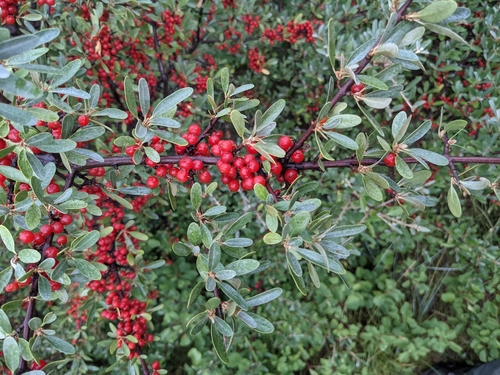
(c) Wren Coxson, some rights reserved (CC BY-NC), uploaded by Wren Coxson
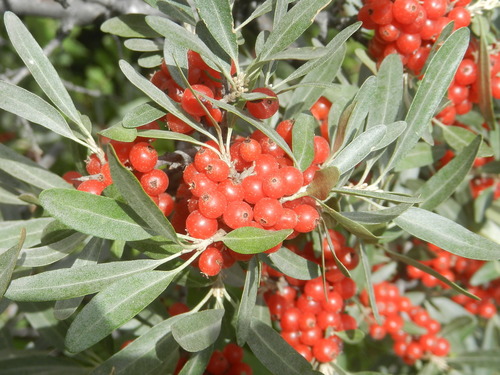
(c) Charles Thomas Hash, Jr., some rights reserved (CC BY-NC-ND), uploaded by Charles Thomas Hash, Jr.

(c) Mary Krieger, some rights reserved (CC BY), uploaded by Mary Krieger
What to Eat
Edible parts: Fruit, Leaves
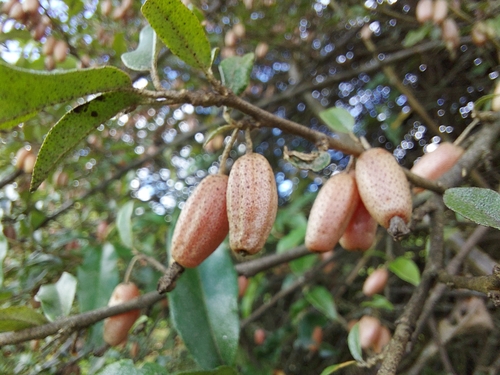
The fruit can be eaten raw or cooked, or dried and used like currants. The flavour is tart but pleasant even before frost, becoming sweeter after a frost. It is also used for preserves, pies, and similar preparations. The fruit should be consumed in moderation due to its saponin content. Fruits are produced singly or in clusters, are up to 9mm long, and each contains a single seed.
Where to Find It
It is a temperate plant. It is drought tolerant and sun loving. It suits hardiness zones 3-9.
Australia, Canada, Caucasus, Georgia, North America, USA,
How to Identify
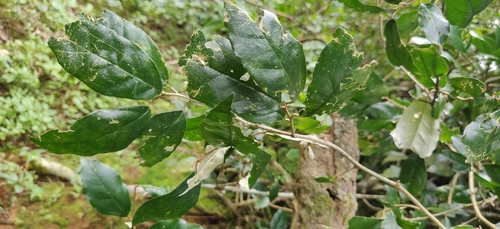
A thorny shrub. It can be a small tree. It grows 3.5 m high and spreads 3.5 m wide. Plants sucker readily. There are silvery brown scales on the leaves and twigs. The twigs are thorny. The leaves fall off during the year. They are opposite and simple. Leaves are 2-6 cm long and oblong. The flowers are white. They occur in small clusters on the previous year's twigs. Male and female flowers are on separate trees. The fruit are orange or red. They are berry like and 4-6 mm across. They are red, sour and edible.
How to Grow
The plant can be grown from seed. It can also be grown from root suckers. It can be planted as a hedge.
Propagation: Seed must not be allowed to dry out. It is best harvested in autumn and sown immediately in a cold frame. Stored seed requires 2–3 months of cold stratification. Prick out seedlings into individual pots once large enough to handle. If sufficient growth is made, they can be planted out during summer; otherwise overwinter in a cold frame and plant out the following spring or early summer. Cuttings of half-ripe wood taken in July or August and placed in a frame sometimes succeed.
Medicinal Uses
The berries are febrifuge, laxative, and stomachic. They have been eaten to treat stomach complaints, constipation, and fevers.
Other Uses
Buffaloberry is useful for erosion control and soil stabilization thanks to its wide-ranging root system, thicket-forming habit, and wind tolerance. The plants can be grown as a hedge and windbreak. A red dye is obtained from the fruit. The dense, thorny shrubs provide important food and shelter for birds and mammals, and the rough bark and leaf litter offer overwintering sites for insects and ground-dwelling invertebrates.
Wikipedia
Source ↗Shepherdia argentea, commonly called silver buffaloberry, bull berry, or thorny buffaloberry, is a species of Shepherdia in the oleaster family. It is native to central and western North America.
Production
The fruit become more sweet after a frost.
Other Information
It is cultivated.
Notes
There are 3 Shepherdia species. They grow in North America.
Names & Synonyms
Neraska currant, Rabbit berry, Thorny buffalo berry, Wiapui
References (26)
- Anderson, B. A., (Rev.) 1996, Desert Plants of Utah. Utah State University Extension p
- Beckstrom-Sternberg, Stephen M., and James A. Duke. "The Foodplant Database." http://probe.nalusda.gov:8300/cgi-bin/browse/foodplantdb.(ACEDB version 4.0 - data version July 1994) (As Lepargyrea argentea)
- Brickell, C. (Ed.), 1999, The Royal Horticultural Society A-Z Encyclopedia of Garden Plants. Convent Garden Books. p 958
- Bussman, R. W., et al, 2021, Unity in diversity—food plants and fungi of Sakartvelo (Republic of Georgia), Caucasus. Journal of Ethnobiology and Ethnomedicine (2021) 17:72 p 9
- Cormack, R. G. H., 1967, Wild Flowers of Alberta. Commercial Printers Edmonton, Canada. p 211
- Couture, M. D., 1978, Recent and Contemporary Foraging Practices of the Harney Valley Paiute. Thesis, Portland State University
- Cundall, P., (ed.), 2004, Gardening Australia: flora: the gardener's bible. ABC Books. p 1338
- Elias, T.S. & Dykeman P.A., 1990, Edible Wild Plants. A North American Field guide. Sterling, New York p 179
- Farrar, J.L., 1995, Trees of the Northern United States and Canada. Iowa State University press/Ames p 194
- Fisk, J. R. & Hoover, E., 2015, Wild Fruits of Minnesota. A Field Guide. University of Minnesota p 20
- Gen. N. Amer. pl. 2:240. 1818
- Glowinski, L., 1999, The Complete Book of Fruit Growing in Australia. Lothian. p178
- Grandtner, M. M., 2008, World Dictionary of Trees. Wood and Forest Science Department. Laval University, Quebec, Qc Canada. (Internet database http://www.wdt.qc.ca)
- Hedrick, U.P., 1919, (Ed.), Sturtevant's edible plants of the world. p 606
- Heywood, V.H., Brummitt, R.K., Culham, A., and Seberg, O. 2007, Flowering Plant Families of the World. Royal Botanical Gardens, Kew. p 136
- Jackes, D. A., 2007, Edible Forest Gardens
- John, L., & Stevenson, V., 1979, The Complete Book of Fruit. Angus & Robertson p 91
- Kermath, B. M., et al, 2014, Food Plants in the Americas: A survey of the domesticated, cultivated and wild plants used for Human food in North, Central and South America and the Caribbean. On line draft. p 800
- Kiple, K.F. & Ornelas, K.C., (eds), 2000, The Cambridge World History of Food. CUP p 1739
- MacKinnon, A., et al, 2009, Edible & Medicinal Plants of Canada. Lone Pine. p 129
- Moerman, D. F., 2010, Native American Ethnobotany. Timber Press. p 528
- Pittonia 2:122. 1892 (As Lepargyrea argentea)
- Plants for a Future database, The Field, Penpol, Lostwithiel, Cornwall, PL22 0NG, UK. http://www.scs.leeds.ac.uk/pfaf/
- Saunders, C.F., 1948, Edible and Useful Wild Plants. Dover. New York. p 84
- Wiersema, J. H. & Leon, B., 2013, World Economic Plants. A Standard Reference CRC Press. 2nd Ed. p 634
- World Checklist of Useful Plant Species 2020. Royal Botanic Gardens, Kew