Sherbournia bignoniiflora
(Welw.) Hua
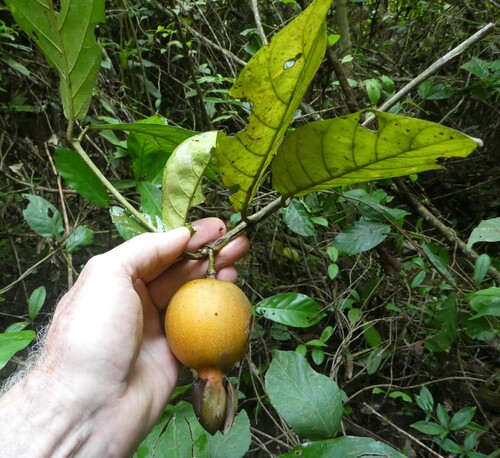
(c) Carel Jongkind, some rights reserved (CC BY-NC), uploaded by Carel Jongkind
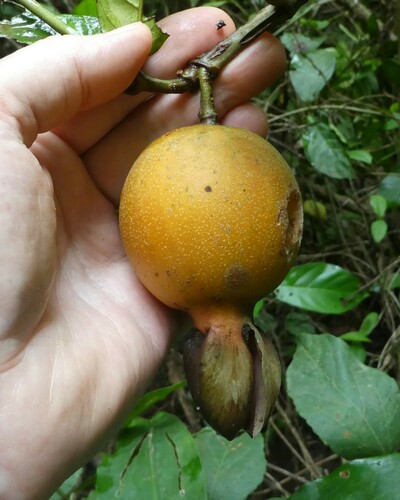
(c) Carel Jongkind, some rights reserved (CC BY-NC), uploaded by Carel Jongkind
What to Eat
Edible parts: Fruit
The fruit pulp is eaten raw, and the leaves are cooked as a substitute tea drink. The fruit are especially popular with children.
Where to Find It
A tropical plant. It grows in the forest in West Africa.
Africa, Angola, Benin, Cameroon, Central Africa, Congo DR, Côte d'Ivoire, Ghana, Ivory Coast, Nigeria, Sierra Leone, Sudan, West Africa,
How to Identify
A tropical shrub or creeper in the Rubiaceae family found in West African forests, bearing distinctive bell-shaped flowers with green petals marked in red. The plant produces fleshy fruit.
Medicinal Uses
Besides its ornamental value the species' leaves and bark are used in decoctions and infusions for a variety of ailments and conditions - the seed-coat mucilage as a pain-killer, the bark and leaves against pulmonary problems, stomach ailments, roots to combat cutaneous and subcutaneous parasitic infections, and the bark for aphrodisiacs and febrifuges. The stems produce tough fibres used as general purpose binding material.
Wikipedia
Source ↗Sherbournia bignoniiflora is an African scandent shrub or liane with large, showy, bell-shaped flowers belonging to the family Rubiaceae and found in equatorial West African evergreen forests in Cameroun, Benin, Gabon, Sudan, Uganda, Democratic Republic of the Congo, Nigeria, Sierra Leone, Ivory Coast, Zambia and Angola. It is one of some 14 species in the genus Sherbournia.
Production
In Congo fruit are available August to September.
Other Information
The fruit are especially eaten by children.
Names & Synonyms
Ayamaysene, Beteni, Kyere, Losabola, Losawola, Tepe'eba, Tepeuebubu, Yabobu, Yekayesenga
References (12)
- Abbiw, D.K., 1990, Useful Plants of Ghana. West African uses of wild and cultivated plants. Intermediate Technology Publications and the Royal Botanic Gardens, Kew. p 46
- Burkill, H. M., 1985, The useful plants of west tropical Africa, Vol. 4. Kew.
- Dalziel, J. M., 1937, The Useful plants of west tropical Africa. Crown Agents for the Colonies London.
- Bull. Soc. Hist. Nat. Autun 14:396. 1901
- Codjia, J. T. C., et al, 2003, Diversity and local valorisation of vegetal edible products in Benin. Cahiers Agricultures 12:1-12
- Jardin, C., 1970, List of Foods Used In Africa, FAO Nutrition Information Document Series No 2.p 161
- Liengola, I. B., 2001, A contribution to the study of native edible plants by the Turumbu and Lokele of the Tshopo District, Province Orientale, D. R. Congo. Syst. Geogr. Pl. 71:687-698
- Peters, C. R., O'Brien, E. M., and Drummond, R.B., 1992, Edible Wild plants of Sub-saharan Africa. Kew. p 175
- Terashima, H., & Ichikawa, M., 2003, A comparative ethnobotany of the Mbuti and Efe hunter-gatherers in the Ituri Forest, Democratic Republic of Congo. African Study Monographs, 24 (1, 2): 1-168, March 2003
- Termote, C., et al, 2011, Eating from the wild: Turumbu, Mbole and Bali traditional knowledge of non-cultivated edible plants, District Tshopo, DRCongo, Gen Resourc Crop Evol. 58:585-618
- Vivien, J., & Faure, J.J., 1996, Fruitiers Sauvages d'Afrique. Especes du Cameroun. CTA p 290
- World Checklist of Useful Plant Species 2020. Royal Botanic Gardens, Kew


