Sideritis syriaca
L.
Mountain tea, Tsai, Tsailopita

(c) Dmitry Svobodin, some rights reserved (CC BY-NC)
(c) fotis-samaritakis, some rights reserved (CC BY-NC), uploaded by fotis-samaritakis

(c) Dmitry Svobodin, some rights reserved (CC BY-NC)
What to Eat
Edible parts: Leaves - tea
An aromatic herbal tea is made from the plant.
Where to Find It
It is a temperate or Mediterranean climate plant. It suits plant hardiness zone 8.
Australia, Crete, Europe, Greece, Mediterranean, Middle East, Slovenia, Syria, Turkey, Türkiye,
How to Identify
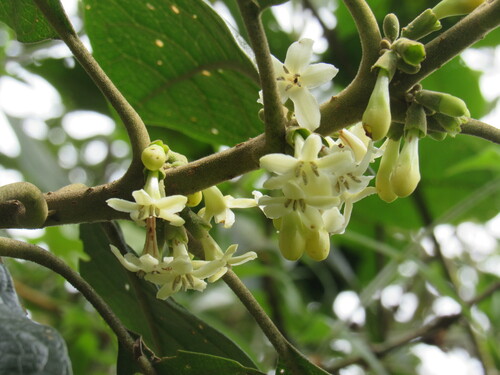
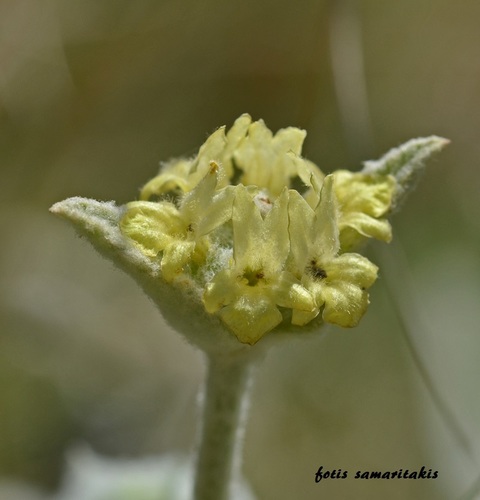
A herb with woolly leaves. It keeps growing from year to year. It grows 50 cm high. The leaves are oval or long and narrow. They can have teeth. The flowers are yellow with brown stripes on the inside. They grow in spikes at the top of the plant.
How to Grow
Requires a perfectly drained gritty humus-rich soil, preferably slightly alkaline, in full sun. Once established, this is a very drought-tolerant plant, it grows well in a hot dry position. This species is not hardy in the colder areas of the country. It tolerates temperatures down to between -5 and -10°c but is intolerant of winter cold if this is accompanied by wet conditions. The leaves and flowering tops are sold for tea in local markets.
Propagation: Sow seed in spring in a greenhouse. When large enough to handle, prick seedlings out into individual pots and grow them on in the greenhouse through their first winter. Plant out into permanent positions in late spring or early summer, after the last expected frosts. Can also be propagated by division in spring.
Medicinal Uses
None known
Other Uses
None known
Wikipedia
Source ↗Sideritis syriaca, commonly known as ironwort, is a species of perennial flowering plant native to Crete, Turkey, and Syria in the eastern Mediterranean. It grows at high elevations in the mountains. It is commonly found on wet grounds, on the high pastures, above 1,500 metres (4,900 ft). It is similar to chamomile and used in the Balkans (where it is known as "mountain tea") to make a tisane. In Bulgaria, Sideritis syriaca is a critically endangered species inscribed in the Red Data Book of the Republic of Bulgaria. It's only found in the wild in the Malko Tarnovo area of Strandzha Nature Park, but it's also cultivated locally elsewhere in Strandzha. The Bulgarian Strandzha herbal tea (Странджански билков чай, Strandzhanski bilkov chay) made of dried Sideritis has protected designation of origin status in the EU.
Other Information
It is sold in health food shops and local markets.
Notes
There are about 100 Sideritis species. The grow near the Mediterranean. Several species are dried and used for herbal teas.
Names & Synonyms
Amanos cayi
References (11)
- Dogan, Y., et al, 2004, The Use of Wild Edible Plants in Western and Central Anatolia (Turkey). Economic Botany 58(4) pp. 684-690
- Ertug, F, Yenen Bitkiler. Resimli Türkiye Florası -I- Flora of Turkey - Ethnobotany supplement
- Facciola, S., 1998, Cornucopia 2: a Source Book of Edible Plants. Kampong Publications, p 136
- Heywood, V.H., Brummitt, R.K., Culham, A., and Seberg, O. 2007, Flowering Plant Families of the World. Royal Botanical Gardens, Kew. p 181
- Hibbert, M., 2002, The Aussie Plant Finder 2002, Florilegium. p 291
- http://www.botanic-gardens-ljubljana.com/en/plants
- Lawton, B.P., 2002, Mints. A Family of Herbs and Ornamentals. Timber Press, Portland, Oregon. p 200
- Libiad, M., et al., 2021 Agro-Alimentary Potential of the Neglected and Underutilized Local Endemic Plants of Crete (Greece), Rif-Mediterranean Coast of Morocco and Tunisia: Perspectives and Challenges. Plants 2021,10,1770.
- Sp. pl. 2:574. 1753
- Wiersema, J. H. & Leon, B., 2013, World Economic Plants. A Standard Reference CRC Press. 2nd Ed. p 636
- World Checklist of Useful Plant Species 2020. Royal Botanic Gardens, Kew