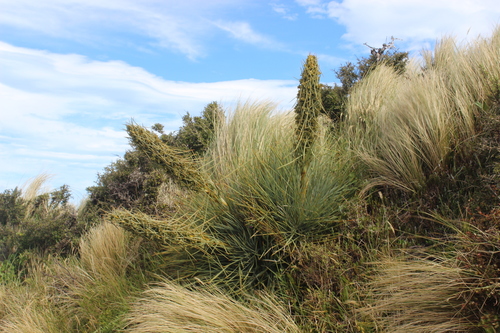
Ledebouriella divaricata
(Turcz.) Hiroe
Bofu

wikimedia · cc-by
Urgamal Magsar https://www.inaturalist.org/people/urgamal (via Wikimedia Commons)
Urgamal Magsar https://www.inaturalist.org/people/urgamal (via Wikimedia Commons)
What to Eat
Edible parts: Shoots, Leaves
The shoots and leaves are eaten.
Where to Find It
It is a temperate plant.
Asia, China,
Countries: United Arab Emirates, Afghanistan, Armenia, Azerbaijan, Bangladesh, Bahrain, Brunei, Bhutan, China, Georgia, Indonesia, Israel, India, Iraq, Iran, Jordan, Japan, Kyrgyzstan, Cambodia, North Korea, South Korea, Kuwait, Kazakhstan, Laos, Lebanon, Sri Lanka, Myanmar, Mongolia, Maldives, Malaysia, Nepal, Oman, Philippines, Pakistan, Qatar, Saudi Arabia, Singapore, Syria, Thailand, Tajikistan, Timor-Leste, Turkmenistan, Turkey, Taiwan, Uzbekistan, Vietnam, Yemen
How to Identify
A temperate herb in the Apiaceae family.
Medicinal Uses
The roots and seeds of Saposhnikovia divaricata contain a variety of phytochemicals under basic research, including furocoumarins, furanochromones, polyacetylenes, hyperosides, and terpenes. The major components of the essential oil from roots of S. divaricata are caryophyllene oxide, sabinene, α- and β-pinene, myrtenal, myrtenol, α-terpineol, p-cymene, and nonanoic acid.
Names & Synonyms
Siler divaricatum Benth. & Hook.f.
References (3)
- Facciola, S., 1998, Cornucopia 2: a Source Book of Edible Plants. Kampong Publications, p 21
- READ (As Siler divaricutum)
- Umbellif. Asia 1:92. 1958