Simmondsia chinensis
(Link) C. K. Schneid.
Jojoba

(c) Jeny Davis, some rights reserved (CC BY-NC-ND), uploaded by Jeny Davis
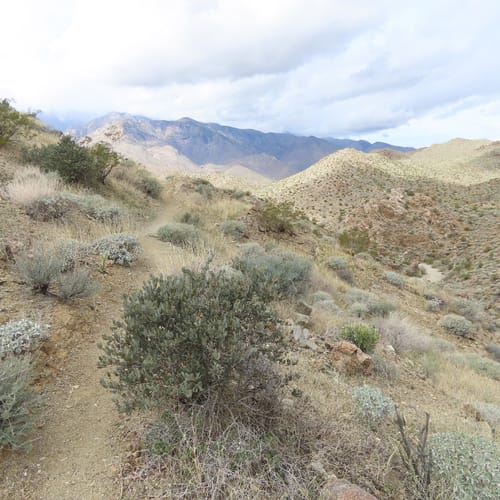
(c) quandary, some rights reserved (CC BY-NC)
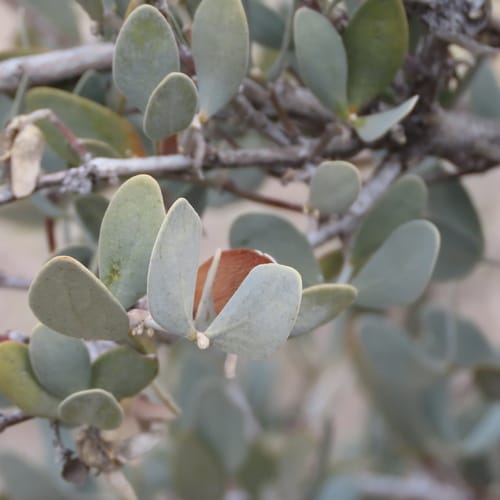
(c) quandary, some rights reserved (CC BY-NC)
What to Eat
Edible parts: Seeds, Seeds - coffee
The seeds can be eaten raw or cooked, and are often parched before eating. They have also been made into a well-flavoured drink similar to coffee.
Where to Find It
It grows in desert regions. It needs a hot climate and well-drained dry soil. It needs full sun. It is very drought tolerant. It can tolerate frost. It grows in areas with an annual rainfall between 100-500 mm. It can grow in alkaline soils. It can grow in arid places. It grows in deserts. It grows in places with high heat and low moisture. It suits hardiness zones 9-12.
Africa, Argentina, Australia, Brazil, Britain, Canada, Central America, Costa Rica, East Africa, Egypt, Europe, Ghana, Haiti, Indochina, Iran, Israel, Jordan, Kenya, Mediterranean, Mexico*, Middle East, North Africa, North America, Paraguay, Peru, Saudi Arabia, SE Asia, South Africa, Southern Africa, South America, Sudan, Tanzania, Thailand, USA, West Africa, West Indies,
How to Identify
An evergreen thorny shrub. It grows 2.4 m high and spreads 1.8 m wide. It often has several stems. The young stems are hairy. The leaves are small and leathery. They are oblong and grey-green. The male and female flowers are on separate plants. The male flowers are cup shaped and yellow. They occur in clusters. The female flowers are bell shaped and greenish. They are in the axils of leaves. The fruit is a capsule with one seed. The seed or nut is about the size of an acorn. The seed is 12-19 mm long. The kernel is triangle shaped.
How to Grow
Plants can be grown from seed.
Propagation: Sow seed in a sunny position in situ or in a nursery seedbed, preferably in slightly alkaline sand or vermiculite at temperatures of 27–38°c. After germination the plant forms a deeply penetrating taproot — which can reach 10 metres or more in mature plants — that may be 60 cm long before the shoot emerges. Seed stores reasonably well, with good germination after 6 months, though viability drops to below 40% after 10 years of storage at ambient conditions. Softwood cuttings from selected shrubs treated with IBA can also be used, best rooted in a nursery under mist. Cuttings take 25–40 days to strike root. Five-node cuttings taken from actively growing plants produce a strongly growing root system.
Medicinal Uses
The wax obtained from the seed is applied to the skin to help alleviate psoriasis, sores, wounds and other skin complaints. It has been used traditionally as a medicine for cancer, kidney disorders, colds, dysuria, obesity, parturition, aching eyes and warts, and to treat baldness.
Other Uses
Jojoba is used in agroforestry systems as a drought-tolerant crop. Its deep root system helps prevent soil erosion and improves soil structure, and it can be planted as a windbreak. The plant also makes an attractive clipped hedge. A liquid wax extracted from the seed gives a yield of around 50% by weight after crushing. This wax — commonly called jojoba oil — is a unique unsaturated oil made up of non-glyceride esters of straight-chain acids and alcohols, compounds that are difficult to synthesise commercially and otherwise found only in the sperm whale. The waxes are indigestible, odourless and clear. Through isomerisation, hydrogenation and sulphur-chloride treatments, a range of products can be produced from thick creams to crystalline waxes, oils and rubbers. Jojoba wax and its sulphur-containing derivatives are stable at high temperatures, making them suitable as components of industrial oils, additives in high-pressure and high-temperature lubricants for transformers and gear systems, and cutting and drawing oils in metalworking. The oil has potential as a motor fuel — jojoba methyl-ester fuel runs more quietly than conventional diesel and releases no sulphur. The liquid wax can also be converted to a hard wax for use in candle manufacture, and has applications in linoleum and printing ink production. The wax has a flash point of 295°c, a fire point of 338°c and low volatility, allowing it to withstand temperatures up to 300°c. Its composition is similar to the oil secreted by human skin, making it useful for lubricating skin and hair and offering protection against ultraviolet radiation. The wax is relatively non-toxic, biodegradable and resistant to rancidity. Jojoba seeds are eaten by various wildlife including small mammals and birds, and the plant provides shelter through its dense branches and leaves. It can also offer overwintering sites for insects.
Wikipedia
Jojoba is an evergreen shrub growing 2m tall and 2m wide at a slow rate. Hardy to UK zone 10, it is dioecious—both male and female plants required for seed production—and wind-pollinated with non-self-fertile flowers. The plant attracts wildlife and suits light sandy and medium loamy well-drained soils, tolerating mildly acid to very alkaline and saline pH. It requires full sun, prefers moist soil, and tolerates drought well.
Notes
There is only one Simmondsia species. There is only one genus in the Simmondsiaceae family.
Names & Synonyms
Goat-nut, Pignut
References (21)
- Beckstrom-Sternberg, Stephen M., and James A. Duke. "The Foodplant Database." http://probe.nalusda.gov:8300/cgi-bin/browse/foodplantdb.(ACEDB version 4.0 - data version July 1994)
- Bremness, L., 1994, Herbs. Collins Eyewitness Handbooks. Harper Collins. p 129 (As Simmondsia californica)
- Cundall, P., (ed.), 2004, Gardening Australia: flora: the gardener's bible. ABC Books. p 1341
- Facciola, S., 1998, Cornucopia 2: a Source Book of Edible Plants. Kampong Publications, p 230
- FAO, 2012, Forest Genetic Resources Situation in Mexico. Final Report of Project TCP/ 3301 p 289
- Gouldstone, S., 1983, Growing your own Food-bearing Plants in Australia. Macmillan p 170 (As Jojoba simmondsia)
- Grandtner, M. M., 2008, World Dictionary of Trees. Wood and Forest Science Department. Laval University, Quebec, Qc Canada. (Internet database http://www.wdt.qc.ca)
- Heywood, V.H., Brummitt, R.K., Culham, A., and Seberg, O., 2007, Flowering Plant Families of the World. Royal Botanical Gardens, Kew. p 304
- Ill. Handb. Laubholzk. 2:141. 1907
- Kermath, B. M., et al, 2014, Food Plants in the Americas: A survey of the domesticated, cultivated and wild plants used for Human food in North, Central and South America and the Caribbean. On line draft. p 806
- Kiple, K.F. & Ornelas, K.C., (eds), 2000, The Cambridge World History of Food. CUP p 1793
- Lazarides, M. & Hince, B., 1993, Handbook of Economic Plants of Australia, CSIRO. p 220
- Lord, E.E., & Willis, J.H., 1999, Shrubs and Trees for Australian gardens. Lothian. p 262
- Menninger, E.A., 1977, Edible Nuts of the World. Horticultural Books. Florida p 121
- Moerman, D. F., 2010, Native American Ethnobotany. Timber Press. p 532
- Royal Botanic Gardens, Kew (1999). Survey of Economic Plants for Arid and Semi-Arid Lands (SEPASAL) database. Published on the Internet; http://www.rbgkew.org.uk/ceb/sepasal/internet [Accessed 11th June 2011]
- Saunders, C.F., 1948, Edible and Useful Wild Plants. Dover. New York. p 78, 160
- Segura, S., et al, 2018, The edible fruit species in Mexico. Genet Resour Crop Evol (2018) 65:1767–1793
- Wickens, G.E., 1995, Edible Nuts. FAO Non-wood forest products. FAO, Rome. p153
- World Checklist of Useful Plant Species 2020. Royal Botanic Gardens, Kew
- www.worldagroforestrycentre.org/treedb/