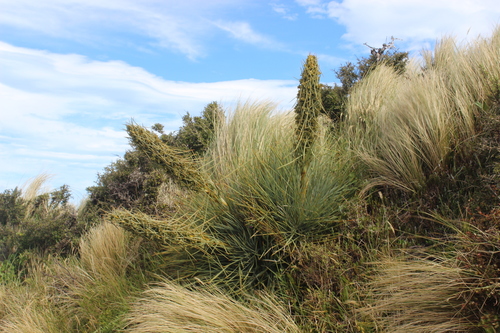
Sison amomum
L.
Honeywort, Stone Parsley, Breakstone Parsley, Rock
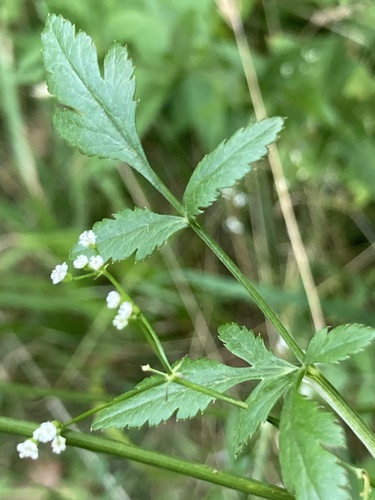
(c) Nick Butcher, some rights reserved (CC BY), uploaded by Nick Butcher
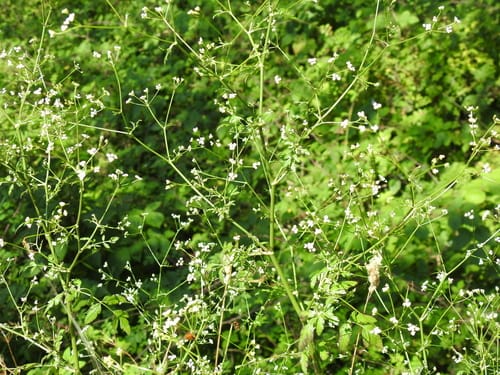
(c) Neil Shepherd, some rights reserved (CC BY-NC)

(c) k yamada, some rights reserved (CC BY-SA)
What to Eat
Edible parts: Root, Seeds, Leaves, Spice
The root can be eaten cooked and is said to taste like celery. The aromatic leaves and seeds are both used as a condiment, though the fresh seeds have a nauseous smell.
Where to Find It
It is a temperate plant. It grows on neutral or limestone soils.
Africa, Algeria, Britain, Caucasus, Europe, France, Mediterranean, North Africa, Turkey, Türkiye,
How to Identify
A biennial reaching 1 m tall. Flowers from July to September. Hermaphroditic, self-fertile flowers pollinated by insects. Grows in light sandy to heavy clay soils and tolerates very alkaline pH. Tolerates semi-shade or full sun and prefers moist soil.
How to Grow
See the plants native habitat for ideas on cultivation details. The whole plant gives off the rather unusual smell of petrol.
Propagation: Seed - sow late spring or early autumn in situ.
Medicinal Uses
Carminative, diaphoretic, and diuretic.
Other Uses
Scented plant.
Wikipedia
Source ↗Sison amomum is one of several species of plant in the genus of Sison, its common name is stone parsley and it is native to Western and Southern Europe, North Africa and Turkey. The species and genus are flowering plants in the family Apiaceae, both of which were first described by Carl Linnaeus, in his book Species Plantarum, originally published in 1753. The plant has many synonyms, having also subsequently been described by other botanists, after Linnaeus, including Jean-Baptiste Lamarck, Richard Anthony Salisbury, Conrad Moench, Emanuel Mendes da Costa, and Albert Thellung among others. Stone parsley is an erect hairless plant, and produces a foul odour if crushed. The species usually reaches between 30 and 70 cm (12 and 28 in) in height, although it can grow up to 1 m (3.3 ft). The plant has thin, solid and striated stems which branch profusely and it produces small globular fruit around in 3 mm (0.12 in) diametre. Stone parsley has tiny white flowers, usually 1 to 3 mm (0.039 to 0.118 in) in size, with a green patch in the centre. The flowers grow on long stalks of different lengths, in umbels up to 4 cm (1.6 in) wide. The flowers usually have five irregular, notched petals, five stamen, and two short styles but do not grow sepals, they usually come to bloom between July and September. The species has between two and four short linear bracts, which emerge from below the umbels and up to four bracteole. The roots, leaves, and seeds of the plant are edible, and have historically been used for food, the seeds can be used to produce condiments. The larva of several insect species, mostly moths, are parasites to the plant, often in the form of leaf miners. Stone parsley is found in rough grassland, grassy banks, beside roads, railways, paths and hedgerows, often in waste grounds, disturbed ground and on heavy soil. The species was originally from Southern France, near the Mediterranean Sea, then spread across France and in into Great Britain by the late eighteenth century, and into Spain and Belgium by the nineteenth century. By the twentieth century it was recorded in Italy, Germany, Algeria the Balkans, the Caucasus, Mediterranean islands of Sicily, Corsica, Sardinia and the Balearics and had been introduced into New Zealand, in the twenty-first century it has also been found in Switzerland and Norway.
References (9)
- Facciola, S., 1998, Cornucopia 2: a Source Book of Edible Plants. Kampong Publications, p 22
- Hedrick, U.P., 1919, (Ed.), Sturtevant's edible plants of the world. p 607
- Lim, T. K., 2015, Edible Medicinal and Non Medicinal Plants. Volume 9, Modified Stems, Roots, Bulbs. Springer p 77
- Menninger, E.A., 1977, Edible Nuts of the World. Horticultural Books. Florida p 85
- Plants for a Future database, The Field, Penpol, Lostwithiel, Cornwall, PL22 0NG, UK. http://www.scs.leeds.ac.uk/pfaf/
- Sp. pl. 1:252. 1753
- Uphof,
- Wiersema, J. H. & Leon, B., 2013, World Economic Plants. A Standard Reference CRC Press. 2nd Ed. p 639
- World Checklist of Useful Plant Species 2020. Royal Botanic Gardens, Kew