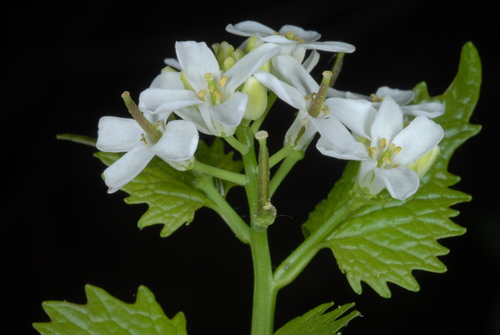
Sisymbrium irio
L.
London rocket
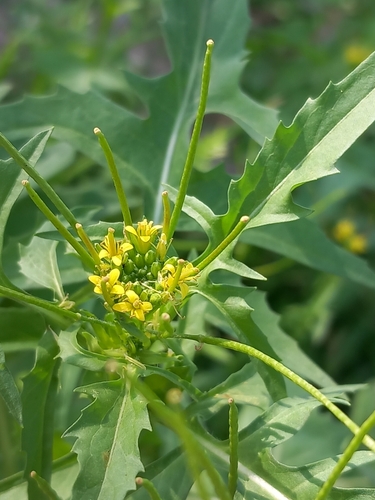
(c) sigalgeva, some rights reserved (CC BY-NC), uploaded by sigalgeva
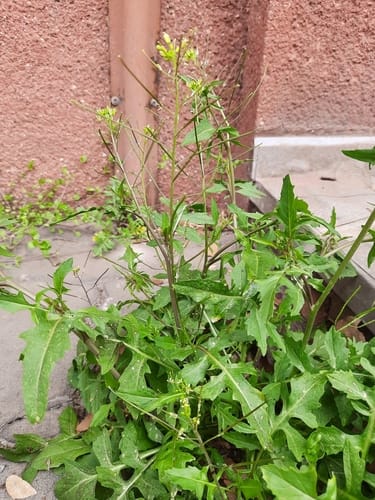
no rights reserved

(c) Юрий Данилевский (Yuriy Danilevsky), some rights reserved (CC BY), uploaded by Юрий Данилевский (Yuriy Danilevsky)
What to Eat
Edible parts: Flowers, Leaves, Seeds, Stems
Immature leaves can be eaten raw or cooked as greens, though this is regarded as a famine food, consumed only when better options are unavailable. The seed can be eaten raw or cooked as piñole, dried and ground into a powder then mixed with water as a gruel, or mixed with water to make a drink. The flowers can be eaten raw.
Where to Find It
It is a temperate plant. It grows in rocky slopes, orchards, roadsides, fields, pastures, waste grounds, prairies, disturbed sites near sea level to 1700 m altitude in China. In Argentina it grows from sea level to 3,500 m above sea level. It can grow in arid places. Tasmania Herbarium.
Afghanistan, Africa, Algeria, Argentina, Asia, Australia, Austria, Azores, Balkans, Belgium, Bolivia, Britain, Bulgaria, Canary Islands, Central America, Central Asia, Chile, Cyprus, Czech Republic, Denmark, East Africa, Egypt, Ethiopia, Europe, France, Germany, Greece, Hawaii, Himalayas, Hungary, India, Iran, Iraq, Ireland, Israel, Italy, Jordan, Kashmir, Kuwait, Lebanon, Libya, Mediterranean, Mexico, Middle East, Nepal, Netherlands, Niger, North Africa, North America, Mexico, Middle East, Morocco, North America, Oman, Pacific, Pakistan, Poland, Portugal, Qatar, Saudi Arabia, Scandinavia, Sicily, Sinai, Slovakia, South America, Spain, Sweden, Switzerland, Syria, Tajikistan, Tasmania, Tunisia, Turkey, Türkiye, Turkmenistan, United Arab Emirates, UAE, Uruguay, USA, Uzbekistan, W Asia, West Africa, Yemen, Yugoslavia,
How to Identify
A cabbage family herb. It is an annual plant. It grows up to 70 cm tall. It is almost hairless. The leaves are oblong to sword shaped. The flowers are pale yellow. The seed pod stalk is slender. The fruit are narrow and 3-4 cm long by 1 mm wide. The seeds are oblong and 1 mm long by 0.5 mm wide.
Nutrition Score: 44/100
| Part | Moisture | kJ | kcal | Protein | Vit A | Vit C | Iron | Zinc |
|---|---|---|---|---|---|---|---|---|
| Leaves | 81.5 | 229 | 55 | 7 | — | 176 | — | — |
| Leaves | 89 | 92 | 22 | 3.4 | — | — | — | — |
How to Grow
Succeeds in most soils.
Propagation: Seed - sow spring or autumn in situ.
Medicinal Uses
The seeds are expectorant, restorative, and stimulant, and are used in the treatment of asthma. Externally, the seeds are applied as a stimulating poultice. They have also been placed under the eyelids to cause weeping and flush foreign matter from sore eyes. An infusion of the leaves is used to treat affections of the throat and chest.
Other Uses
None known Special Uses
Wikipedia
Source ↗Sisymbrium irio, London rocket, is a flowering plant in the cabbage family. Its English common name originated when it flourished after the Great Fire of London in 1666, although it is not native to Britain and it does not tend to persist there. It is native to the Middle East, north Africa and southern Europe, and which has spread widely around the world as an invasive plant of dry, disturbed land in towns, deserts and farmland. It has traditionally been used as a medicinal herb for a variety of ailments.
Other Information
It is a famine food.
Notes
There are about 80 Sisymbrium species.
Names & Synonyms
Approcchiu, Asalio, Chamarak, Demet, Hakseer, Hoob sublan, Janglisarson, Jaramago, Jaya keachi, Jenjar, Jhenjer, Khakasi, Khakshi, Kharkasai, Khashi, Khubkalan, Khubkata, Khud-e-kalan, Kibs, Kuchila, Maktrusa, Matacandil, Mostacilla, Nabillo, Parjan, Peeli booti, Pisciacani, Rabaniza, Ran-tiki, Shersham, Velar, Woraki
References (37)
- Al-Qura'n, S. A., 2010, Ethnobotanical and Ecological Studies of Wild Edible Plants in Jordan. Libyan Agriculture Research Center Journal International 1(4):231-243
- Al-Sodany, Y. M., et al, 2013, Medicinal Plants in Saudi Arabia: I. Sarrwat Mountains at Taif, KSA. Academic Journal of Plant Sciences 6 (4): 134-145
- Ambasta, S.P. (Ed.), 2000, The Useful Plants of India. CSIR India. p 576
- Asfaw, Z., Conservation and use of traditional vegetables in Ethiopia. FAO
- Asfaw, Z. and Tadesse, M., 2001, Prospects for Sustainable Use and Development of Wild Food Plants in Ethiopia. Economic Botany, Vol. 55, No. 1, pp. 47-62
- Bailey, C. and Danin, A., 1981, Bedouin Plant Utilization in Sinai and the Negev. Economic Botany 35(2): 145-162
- Blanco-Salas, J., et al, 2019, Wild Plants Potentially Used in Human Food in the Protected Area “Sierra Grande de Hornachos” of Extremadura (Spain). Sustainability 2019, 11, 456
- CASTETTER,
- Davis, S.D., Heywood, V.H., & Hamilton, A.C. (eds), 1994, Centres of plant Diversity. WWF. Vol 2. p 340
- Dashorst, G.R.M., and Jessop, J.P., 1998, Plants of the Adelaide Plains & Hills. Botanic Gardens of Adelaide and State Herbarium. p 70
- Duke, J.A., 1992, Handbook of Edible Weeds. CRC Press. p 182
- Farooq, S., et al, 2012, Ethnobotanical Studies of the Flora of Tehsil Birmal in South Waziristan Agency, Pakistan. Pak. J. Weed Sci. Res. 18(3): 277-291
- Flora of Australia, Volume 8, Lecythidales to Batales, Australian Government Publishing Service, Canberra (1982) p 334
- Flora of China @ efloras.org Volume 8
- Geraci, A., et al, 2018, The wild taxa utilized as vegetables in Sicily (Italy): a traditional component of the Mediterranean diet. Journal of Ethnobiology and Ethnomedicine (2018) 14:14
- Guil-Guerrero, J. L., et al, 2001, Edible Wild Plants. in Recent Progress in Medicinal Plants Vol. 8 Sci. Tech publishing, Texas
- https://www.fireflyforest.com/flowers/category/edible-plants/ Edible Plants – Southeastern Arizona Wildflowers and Plants
- Hussey, B.M.J., Keighery, G.J., Cousens, R.D., Dodd, J., Lloyd, S.G., 1997, Western Weeds. A guide to the weeds of Western Australia. Plant Protection Society of Western Australia. p 120
- Irving, M., 2009, The Forager Handbook, A Guide to the Edible Plants of Britain. Ebury Press p 101
- Khan, A. H., et al, 2023, Traditional foraging for ecological transition? Wild food ethnobotany among three ethnic groups in the highlands of the eastern Hindukush, North Pakistan. Journal of Ethnobiology and Ethnomedicine 19:9
- Lamp, C & Collet F., 1989, Field Guide to Weeds in Australia. Inkata Press. p 273
- Lentini, F. and Venza, F., 2007, Wild food plants of popular use in Sicily. J Ethnobiol Ethnomedicine. 3: 15
- Mahklouf, M. H., 2019, Ethnobotanical Study of Edible Wild Plants in Libya. European Journal of Ecology. 5(2): 30-40
- Majeed, M., et al, 2021, Gathered Wild Food Plants among Diverse Religious Groups in Jhelum District, Punjab, Pakistan. Foods 2021, 10, 594.
- Malezas Comestibles del Cono Sur, INTA, 2009, Buernos Aires
- MINNIS,
- Moerman, D. F., 2010, Native American Ethnobotany. Timber Press. p 532
- Paczkowska, G. & Chapman, A.R., 2000, The Western Australian Flora. A Descriptive Catalogue. Western Australian Herbarium. p 188
- Plants for a Future database, The Field, Penpol, Lostwithiel, Cornwall, PL22 0NG, UK. http://www.scs.leeds.ac.uk/pfaf/
- Royal Botanic Gardens, Kew (1999). Survey of Economic Plants for Arid and Semi-Arid Lands (SEPASAL) database. Published on the Internet; http://www.rbgkew.org.uk/ceb/sepasal/internet [Accessed 15th April 2011]
- SAXENA,
- Sp. pl. 2:659. 1753
- Tareen, N. M., et al, 2016, Ethnomedicinal Utilization of Wild Edible Vegetables in District Harnai of Balochistan Province - Pakistan. Pakistan Journal of Botany 48(3): 1159-1171
- Tasmanian Herbarium Vascular Plants list p 18
- Wild edible plants of Himachal Pradesh
- World Checklist of Useful Plant Species 2020. Royal Botanic Gardens, Kew
- Zhou Taiyan, Lu Lianli, Yang Guang; Ihsan A. Al-Shehbaz, BRASSICACEAE (CRUCIFERAE), Flora of China.