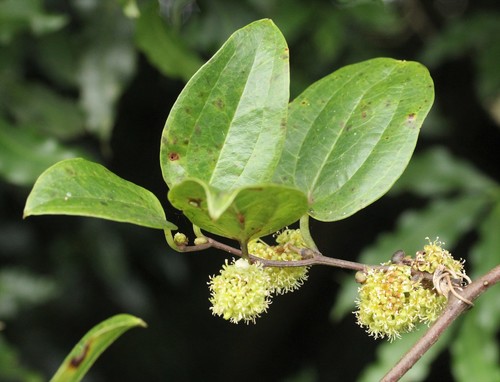
Smilax aspera
L.
Wild sarsaparilla, Italian smilax

(c) monima65, some rights reserved (CC BY-NC)

(c) monima65, some rights reserved (CC BY-NC)

(c) zebedeugalinha, some rights reserved (CC BY)
What to Eat
Edible parts: Leaves, Root, Stems, Fruit
Young shoots can be eaten raw or cooked as a vegetable, and make a reasonable asparagus substitute when cooked. The tendrils are also edible. The plant — most likely the root — is an ingredient in soft drinks.
Where to Find It
It grows in temperate and tropical locations. In Nepal it grows between 1200-2900 m altitude. It grows on forest trees in moist places. It suits hardiness zones 8-10. In Yunnan.
Africa, Asia, Australia, Balkans, Bhutan, Bosnia, Brazil, Britain, Central Africa, China, Congo, Croatia, Cyprus, East Africa, Europe, France, Gibraltar, Greece, Himalayas, India, Indochina, Indonesia, Italy, Libya, Malawi, Mediterranean, Mexico, Middle East, Myanmar, Nepal, North Africa, Pakistan, Peru, SE Asia, Sicily, Slovenia, Spain, Sri Lanka, Syria, Tibet, Turkey, Türkiye,
How to Identify
A twining shrub or climbing vine. It grows 3 m high and spreads 60 cm wide. The stems have branches and are ridged and angled. They usually have a few prickles. The leaves have stalks. The stalks are often curved and twisted. The leaves are alternate. The leaves are 5-9 cm long by 4-7 cm wide or larger. They are oval or sword shaped and have a sharp tip. The stalk bears a pair of long slender tendrils near the base. The flowers have stalks. They are white and have a scent. There are 5-25 umbels each with 3-6 flowers in a spike.
How to Grow
Succeeds in most soils in sun or semi-shade. A very ornamental plant, it is only hardy in the mildest areas of Britain, tolerating temperatures down to about -10°c. The flowers have a heavy sweet perfume. Dioecious. Male and female plants must be grown if seed is required.
Propagation: Sow seed in March in a warm greenhouse — though this guidance likely applies to tropical members of the genus. Seeds from plants of cooler regions appear to need a period of cold stratification, and some species can take two or more years to germinate. For temperate species, sow in a cold frame as soon as seed is received, or ideally as soon as it is ripe. When seedlings germinate, prick out into individual pots and grow on in a greenhouse for at least the first year, though keeping them in pots for two years is preferable. Plant out into permanent positions in early summer. Divide in early spring as new growth begins; larger divisions can go straight into permanent positions, while smaller ones are best potted up and grown on in a lightly shaded cold frame until well established, then planted out in summer. Cuttings of half-ripe shoots can be taken in July in a frame.
Medicinal Uses
The root is alterative, demulcent, depurative, diaphoretic, diuretic, stimulant and tonic. It is considered one of the best depurative medicines and is used as a springtime tonic and general body cleanser, often combined with woody nightshade (Solanum dulcamara). The root shares the medicinal properties of the widely used tropical herb sarsaparilla, though to a lesser degree, and is sometimes used as an adulterant to that plant. Ripe fruits are squeezed and applied directly to the skin to treat scabies.
Other Uses
A red dye is obtained from the ripe tendrils. The plant is often grown as an impenetrable hedge in climates warmer than Britain.
Wikipedia
Source ↗Smilax aspera, with common names common smilax, rough bindweed, sarsaparille, and Mediterranean smilax, is a species of flowering vine in the greenbriar family.
Other Information
The leaves are sold in local markets.
Notes
There are about 300 Smilax species.
Names & Synonyms
Aritjol, Arkovatis, Bindweed root, Canar liar, Dadrund thuthur, Gicirdikeni, Gieir, Gratta culu, Hrapavi oponec, Kukuldaino, Kukurdaino, Neeri, Prickly greenbrier, Red-berried rough-bindweed, Rough bindweed, Sarsaparila hutan, Silcan, Stracciagatte, Strazzacausi, Sui ba qia, Sulcan, Syal daino, Tetivika, Zarzaparrilla
References (39)
- Ambasta, S.P. (Ed.), 2000, The Useful Plants of India. CSIR India. p 577
- Aryal, K. P., et al, 2018, Diversity and use of wild and non-cultivated edible plants in the Western Himalaya. Journal of Ethnobiology and Ethnomedicine (2018) 14:10
- Biscotti, N. & Pieroni, A., 2015, The hidden Mediterranean diet: wild vegetables traditionally gathered and consumed in the Gargano area, Apulia, SE Italy. Acta Societatis Botanicorum Poloniae 84 (3): 327-338
- Biscotti, N. et al, 2018, The traditional food use of wild vegetables in Apulia (Italy) in the light of Italian ethnobotanical literature. Italian Botanist 5:1-24
- Blanco-Salas, J., et al, 2019, Wild Plants Potentially Used in Human Food in the Protected Area “Sierra Grande de Hornachos” of Extremadura (Spain). Sustainability 2019, 11, 456 (As var. altissima)
- Cerne, M., 1992, Wild Plants from Slovenia used as Vegetables. Acta Horticulturae 318.
- Chen Xinqi, Liang Songyun, Xu Jiemei, Tamura M.N., Liliaceae. Flora of China. p 25
- Cundall, P., (ed.), 2004, Gardening Australia: flora: the gardener's bible. ABC Books. p 1345
- Dangol, D. R. et al, 2017, Wild Edible Plants in Nepal. Proceedings of 2nd National Workshop on CUAOGR, 2017.
- Della, A., et al, 2006, An ethnobotanical survey of wild edible plants of Paphos and Larnaca countryside of Cyprus. J. Ethnobiol. Ethnomed. 2:34
- Dogan, Y., et al, 2004, The Use of Wild Edible Plants in Western and Central Anatolia (Turkey). Economic Botany 58(4) pp. 684-690
- Dogan, Y., 2012, Traditionally used wild edible greens in the Aegean Region of Turkey. Acta Societatis Botanicorum Poloniae 81(4): 329-342
- Dogan, Y. et al, 2013, Wild Edible Plants sold in the Local Markets of Izmir, Turkey. Pak. J. Bot. 45(S1): 177-184
- Dolina, K. & Luczaj, L., 2014, Wild food plants used on the Dubrovnik coast (south-eastern Croatia) Acta Soc Bot Pol 83(3):175–181
- Ertug, F., 2004, Wild Edible Plants of the Bodrum Area. (Mugla, Turkey). Turk. J. Bot. 28 (2004): 161-174
- Ertug, F, Yenen Bitkiler. Resimli Türkiye Florası -I- Flora of Turkey - Ethnobotany supplement
- Facciola, S., 1998, Cornucopia 2: a Source Book of Edible Plants. Kampong Publications, p 230
- Geraci, A., et al, 2018, The wild taxa utilized as vegetables in Sicily (Italy): a traditional component of the Mediterranean diet. Journal of Ethnobiology and Ethnomedicine (2018) 14:14
- Gurdal, B. & Kultur, S., 2014, The edible and miscellaneous useful plants in Marmaris (Southwest Turkey). İstanbul Ecz. Fak. Derg. / J. Fac. Pharm. Istanbul 44(1) 2014 pp.69-78
- Hadjichambis, A. C., et al, 2007, Wild and semi-domesticated food plant consumption in seven circum-Mediterranean areas. International Journal of Food Sciences and Nutrition. 2007, 1-32.
- http://cypruswildflowers.com
- http://www.botanic-gardens-ljubljana.com/en/plants
- Joshi, N., et al, 2007, Traditional neglected vegetables of Nepal: Their sustainable utilization for meeting human needs. Tropentag 2007. Conference on International Agricultural Research for Development.
- Khakurel, D., et al, 2021, Foods from the wild: Local knowledge, use pattern and distribution in Western Nepal. PLOS ONE.
- Kiple, K.F. & Ornelas, K.C., (eds), 2000, The Cambridge World History of Food. CUP p 1845
- Luczaj et al, 2013, Wild vegetable mixes sold in the markets of Dalmatia (southern Croatia). Journal of Ethnobiology and Ethnomedicine. 8:2
- Luczaj, L. et al, 2014, Wild Food Plants of Dalmatia (Croatia). in A. Pieroni, C. L. Quave (eds.), Ethnobotany and Biocultural Diversities in the Balkans, p 143
- Mahklouf, M. H., 2019, Ethnobotanical Study of Edible Wild Plants in Libya. European Journal of Ecology. 5(2): 30-40
- Manandhar, N.P., 2002, Plants and People of Nepal. Timber Press. Portland, Oregon. p 429
- Pasta, S., et al, 2020, An Updated Checklist of the Sicilian Native Edible Plants: Preserving the Traditional Ecological Knowledge of Century-Old Agro-Pastoral Landscapes. Frontiers in Plant Science. Volume 11|Article 388
- Plants for a Future database, The Field, Penpol, Lostwithiel, Cornwall, PL22 0NG, UK. http://www.scs.leeds.ac.uk/pfaf/
- Redzic, S. J., 2006, Wild Edible Plants and their Traditional Use in the Human Nutrition in Bosnia-Herzegovina. Ecology of Food and Nutrition, 45:189-232
- Rijal, A., 2011, Surviving on Knowledge: Ethnobotany of Chepang community from mid-hills of Nepal. Ethnobotany Research & Applications 9:181-215
- Sp. pl. 2:1028. 1753
- Sukarya, D. G., (Ed.) 2013, 3,500 Plant Species of the Botanic Gardens of Indonesia. LIPI p 970
- Tardio, J., et al, Ethnobotanical review of wild edible plants in Spain. Botanical J. Linnean Soc. 152 (2006), 27-71
- TodaFruta.com.br
- Uprety, Y., et al, 2012, Diversity of use and local knowledge of wild edible plant resources in Nepal. Journal of Ethnobotany and Ethnomedicine 8:16
- World Checklist of Useful Plant Species 2020. Royal Botanic Gardens, Kew