Ardisia pyramidalis
(Cav.) Pers.
Aunasin

(c) Vijay Anand Ismavel, some rights reserved (CC BY-NC-SA)

(c) Greg III Espera, some rights reserved (CC BY), uploaded by Greg III Espera

(c) Vijay Anand Ismavel, some rights reserved (CC BY-NC-SA)
What to Eat
Edible parts: Leaves, Flowers - flavouring, Vegetable
Young leaf tips are cooked and eaten as a vegetable, often served with meat or fish. Young leaves are blanched and used in salads with onions, tomatoes and garlic. The flowers are used as flavouring for fish.
Where to Find It
A tropical plant. They occur in lower forests throughout the Philippines. It can grow in sandy soils but responds well to humus and organic matter.
Asia, Pacific, Philippines, SE Asia,
How to Identify
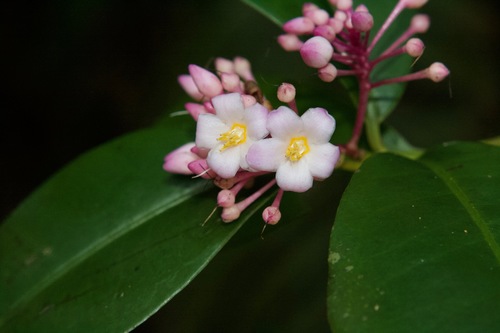
A small slender stemmed tree. The branches are alternately crowded not branched and bending upwards. They are thickened at the base. The leaves are similarly crowded, oblong and like a thin pliable sheet. The flower arrangement is shaped like a pyramid at the ends of branches and is smooth. The flowers are pale pink and clustered on the thickened ends of branches. The fruit have a crust like surface and are about 8 mm across.
How to Grow
Plants can be grown by seeds. They can be sown directly or put in pots in a nursery and transplanted.
Notes
There are about 250-300 Ardisia species. They are mainly in the tropics. Also put in the family Myrsinaceae.
Names & Synonyms
References (2)
- Monsalud, M.R., Tongacan, A.L., Lopez, F.R., & Lagrimas, M.Q., 1966, Edible Wild Plants in Philippine Forests. Philippine Journal of Science. p 509
- Polinag, M. A., 2003, Food from the Wilderness. Department of Environment and Natural Resources. Laguna.