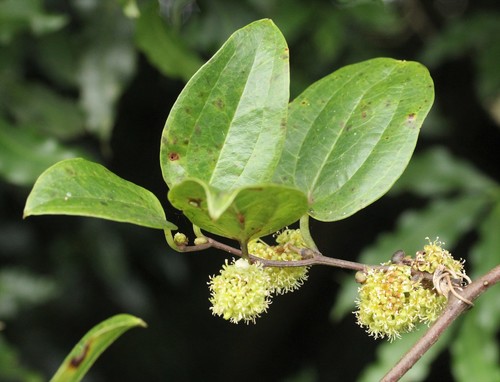
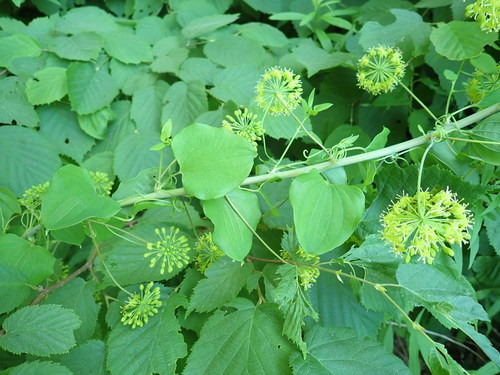
Smilax herbacea
L.
Carrion flower, Jacob's ladder
no rights reserved, uploaded by Lynn Harper

(c) Tom Norton, some rights reserved (CC BY)

(c) Duncan McKenzie, some rights reserved (CC BY-NC), uploaded by Duncan McKenzie
What to Eat
Edible parts: Fruit, Leaves, Root
Leaves and young shoots can be eaten raw or cooked and used much like asparagus — they make a delicate and palatable vegetable. The fruit, which is about 10mm in diameter, can be eaten raw or used in jellies, but should only be used when fully ripe, when it has a pleasant flavour. The root can be cooked, or dried and ground into a powder to mix with cereals for bread-making. It also serves as a gelatine substitute.
Where to Find It
It is a temperate plant. It grows on the edges of woodlands. It is often on calcareous soils. It suits hardiness zone 4.
Canada, North America, USA,
How to Identify
An annual vine. It is smooth and without thorns. The stems are green and not woody. It grows 2.5 m long. The branches have long green tendrils with prickles. The leaves are oval and heart shaped. They are widest at the base. The male and female flowers are on separate vines. They are greenish white. The fruit are round and like berries. They are 8-15 mm across. The fruit occur in clusters. They are dark blue to black. There are several seeds.
How to Grow
Succeeds in most soils in sun or semi-shade. Hardy to about -20°c. A polymorphic species, varying in both leaf shape and growth habit. The flowers are malodorous, they smell like dead rats. A vigorous plant, it can be grown through trees or shrubs or over tree stumps. The sub-species S. herbacea nipponicum is used in Japan. This report probably refers to the species S. nipponica. Dioecious. Male and female plants must be grown if seed is required. Growth habit is a single or multiple shooting vine from a crown. Herbaceous.
Propagation: Sow seed in March in a warm greenhouse, though this guidance likely applies to tropical members of the genus. Seeds from cooler-climate plants appear to need cold stratification, with some species taking two or more years to germinate. For temperate species, sow in a cold frame as soon as seed is received, or ideally as soon as it is ripe. Once seedlings germinate, prick out into individual pots when large enough to handle and grow on under glass for at least the first year — normally two years in pots — before planting into permanent positions in early summer. Divide in early spring as new growth begins; larger divisions can go directly into permanent positions, while smaller ones are best potted up and grown on in a lightly shaded cold frame until established, then planted out in summer. Cuttings of half-ripe shoots can be taken in July and rooted in a frame.
Medicinal Uses
Eating the fruit is said to be effective in treating hoarseness. Parched, powdered leaves have been used as a dressing on burns, while wilted leaves have been applied to boils. The root is analgesic; a decoction has been used to treat back pain, stomach complaints, lung disorders, and kidney problems.
Other Uses
None known.
Wikipedia
Source ↗Smilax herbacea is a perennial, herbaceous climbing vine in the family of Smilacaceae. It is native to eastern North America, including parts of eastern Canada and the eastern United States. It is commonly known by people as the smooth carrion flower, smooth herbaceous greenbrier, carrion vine, or as Jacob's-ladder. The species is known for being smooth in texture, and usually has thornless stems, it is a plant that can grow by climbing, and it has green colored flowers that have a foul, carrion-like odor which attracts flies and beetles for pollination. This plant grows in moist forests, savannas, meadows, and thickets, at moderate to high elevations. This allows it to serve as an understory vine (a climbing plant that grows in the forest's lower layer, beneath the main tree canopy). The plant blooms in May and June, and female individuals produce clusters of dark blue to nearly black berries later in the season. In addition to its ecological role, the species has a long history of use as both a food and medicinal plant.
Notes
There are about 300 Smilax species.
Names & Synonyms
Greenbrier
References (11)
- Beckstrom-Sternberg, Stephen M., and James A. Duke. "The Foodplant Database." http://probe.nalusda.gov:8300/cgi-bin/browse/foodplantdb.(ACEDB version 4.0 - data version July 1994)
- Elias, T.S. & Dykeman P.A., 1990, Edible Wild Plants. A North American Field guide. Sterling, New York p 66
- Esperanca, M. J., 1988. Surviving in the wild. A glance at the wild plants and their uses. Vol. 1. p 192
- Facciola, S., 1998, Cornucopia 2: a Source Book of Edible Plants. Kampong Publications, p 230
- Fisk, J. R. & Hoover, E., 2015, Wild Fruits of Minnesota. A Field Guide. University of Minnesota p 30
- Jackes, D. A., 2007, Edible Forest Gardens
- Kermath, B. M., et al, 2014, Food Plants in the Americas: A survey of the domesticated, cultivated and wild plants used for Human food in North, Central and South America and the Caribbean. On line draft. p 810
- MacKinnon, A., et al, 2009, Edible & Medicinal Plants of Canada. Lone Pine. p 162
- Moerman, D. F., 2010, Native American Ethnobotany. Timber Press. p 533
- Plants for a Future database, The Field, Penpol, Lostwithiel, Cornwall, PL22 0NG, UK. http://www.scs.leeds.ac.uk/pfaf/
- Sp. pl. 2:1030. 1753