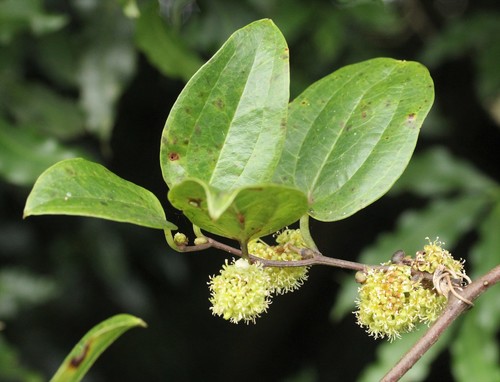
Smilax lanceifolia
Roxb.

(c) portioid, some rights reserved (CC BY), uploaded by portioid
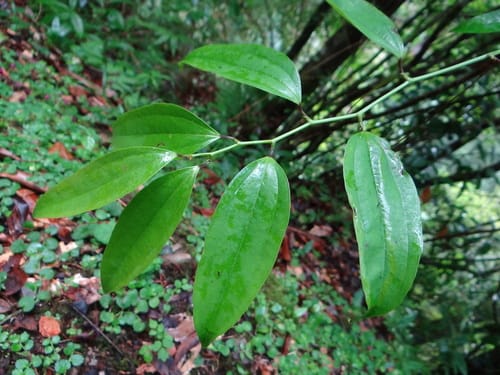
(c) 呂一起(Lu i-chi), some rights reserved (CC BY)
What to Eat
Edible parts: Leaves, Fruit
Tender young shoots and leaves can be cooked and used as a vegetable. Ripe fruits can be eaten raw.
Where to Find It
A tropical and subtropical plant. In Nepal they grow to about 2000 m altitude. They grow in moist places in forested areas. In China they grow from 100-2800 m altitude. In Sichuan and Yunnan.
Asia, Bhutan, Cambodia, China, Himalayas, India, Indochina, Indonesia, Laos, Malaysia, Myanmar, Nepal, Northeastern India, Pacific, Philippines, SE Asia, Sikkim, Taiwan, Thailand, Vietnam,
How to Identify
A thorny twining shrub. Stems are 1-2 m long. They are woody. The leaves are stalked. The leaf stalks are 1-2 cm long and with narrow wings. The leaf blades are oval or sword shaped and fattened towards the base. They taper to the tip. They are 6-17 cm long by 2-8 cm wide. The flowers are small and yellow. They occur in many flowered heads. The fruit is a berry. They are green when young. This plant varies a lot.
How to Grow
We have very little information on this species and do not know if it will be hardy in Britain, though judging by its native range it should succeed outdoors in many parts of the country. An extremely variable species, it has been subdivided into a number of subspecis. The following notes are based on the general needs of the genus. Succeeds in most soils in sun or semi-shade. Dioecious. Male and female plants must be grown if seed is required.
Propagation: Sow seed in March in a warm greenhouse, though this guidance likely applies to tropical members of the genus. Seeds from cooler-climate plants appear to need cold stratification, with some species taking two or more years to germinate. For temperate species, sow in a cold frame as soon as seed is received, or ideally as soon as it is ripe. Once seedlings germinate, prick out into individual pots when large enough to handle and grow on under glass for at least the first year — normally two years in pots — before planting into permanent positions in early summer. Divide in early spring as new growth begins; larger divisions can go directly into permanent positions, while smaller ones are best potted up and grown on in a lightly shaded cold frame until established, then planted out in summer. Cuttings of half-ripe shoots can be taken in July and rooted in a frame.
Medicinal Uses
The juice of the fresh root is taken internally for rheumatism, while the remaining root residue is applied externally to the affected areas.
Other Uses
None known.
Wikipedia
Deciduous climbing vine reaching 2 m in height. Flowers appear from September to March with seeds ripening November to March. Dioecious species requiring both male and female plants for seed production. Tolerates light sandy, medium loamy, and heavy clay soils across a range of pH levels from mildly acidic to mildly alkaline. Grows in semi-shade or full sun and prefers consistently moist soil.
Notes
There are about 300 Smilax species.
Names & Synonyms
Chhatiwan, Chubi Chini, Dao, Gutea shuk china, Hindichobchini, Kubiraina, Kukurdaino, Ma jia ba qia, Naam dao, Thao yang dong
References (11)
- Altschul, S.V.R., 1973, Drugs and Foods from Little-known Plants. Notes in Harvard University Herbaria. Harvard Univ. Press. Massachusetts. no. 374
- Ambasta, S.P. (Ed.), 2000, The Useful Plants of India. CSIR India. p 577
- Chen Xinqi, Liang Songyun, Xu Jiemei, Tamura M.N., Liliaceae. Flora of China. p 38
- Dangol, D. R. et al, 2017, Wild Edible Plants in Nepal. Proceedings of 2nd National Workshop on CUAOGR, 2017.
- Joshi, N., et al, 2007, Traditional neglected vegetables of Nepal: Their sustainable utilization for meeting human needs. Tropentag 2007. Conference on International Agricultural Research for Development.
- Joshi, N. & Siwakoti, M., 2012, Wild Vegetables Used by Local Community of Makawanpur District and Their Contribution to Food Security and Income Generation. Nepal Journal of Science and Technology Vol. 13, No. 1 (2012) 59-66
- Kachenchart, B., et al, 2008, Phenology of Edible Plants at Sakaerat Forest. In Proceedings of the FORTROP II: Tropical Forestry Change in a Changing World. Bangkok, Thailand.
- Manandhar, N.P., 2002, Plants and People of Nepal. Timber Press. Portland, Oregon. p 429
- Plants for a Future database, The Field, Penpol, Lostwithiel, Cornwall, PL22 0NG, UK. http://www.scs.leeds.ac.uk/pfaf/
- PROSEA 12(1)
- Rijal, A., 2011, Surviving on Knowledge: Ethnobotany of Chepang community from mid-hills of Nepal. Ethnobotany Research & Applications 9:181-215