Smilax elegans
Wall. ex Kunth
Kukar-daru
iNaturalist · cc-by-nc
(c) Shanta Budha-Magar, some rights reserved (CC BY-NC), uploaded by Shanta Budha-Magar
(c) Shanta Budha-Magar, some rights reserved (CC BY-NC), uploaded by Shanta Budha-Magar
What to Eat
Edible parts: Leaves, Shoots
The tender shoots are boiled and eaten with salt, sometimes mixed with curd. Both leaves and shoots are edible portions.
Where to Find It
Western Himalayas. In Pakistan it grows between 1,000-2,000 m above sea level.
Asia, India, Myanmar, Pakistan, SE Asia,
Countries: United Arab Emirates, Afghanistan, Armenia, Azerbaijan, Bangladesh, Bahrain, Brunei, Bhutan, China, Georgia, Indonesia, Israel, India, Iraq, Iran, Jordan, Japan, Kyrgyzstan, Cambodia, North Korea, South Korea, Kuwait, Kazakhstan, Laos, Lebanon, Sri Lanka, Myanmar, Mongolia, Maldives, Malaysia, Nepal, Oman, Philippines, Pakistan, Qatar, Saudi Arabia, Singapore, Syria, Thailand, Tajikistan, Timor-Leste, Turkmenistan, Turkey, Taiwan, Uzbekistan, Vietnam, Yemen
How to Identify
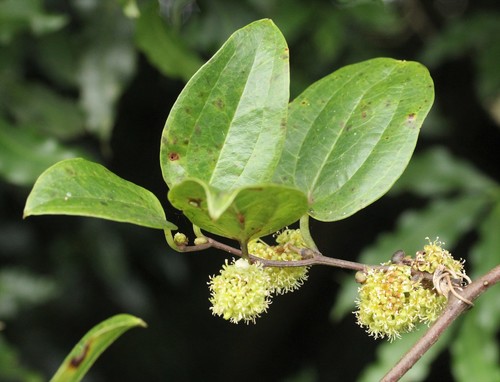
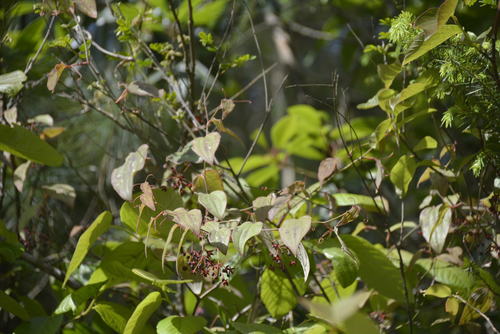
A climber. The leaves are 8-35 cm long by 15-42 mm wide. They are oval with a rounded or heart shaped base. There is a tip at the end. The flowers are small and purple. The fruit are round berries 4 mm across. They are blue black.
Medicinal Uses
The tender shoots are prepared through boiling as a traditional preparation.
Notes
There are about 300 Smilax species.
Names & Synonyms
Smilax glaucophylla KlotschSmilax parviflora Wall. ex Hook.f.
References (1)
- BHARGAVA, (As Smilax parviflora) Probably parvifolia