Ardisia sieboldii
Miquel
Tree lycium, Duo zhi ji jin niu

(c) liushengyu, some rights reserved (CC BY-NC), uploaded by liushengyu

(c) 眼子菜, some rights reserved (CC BY-NC), uploaded by 眼子菜
(c) Max Hsieh(雁子), some rights reserved (CC BY-NC), uploaded by Max Hsieh(雁子)
What to Eat
Edible parts: Fruit
Edible Parts: Fruit Edible Uses: Fruit - cooked. A famine food used when all else fails.
Where to Find It
It is a subtropical plant. It grows in mixed forests and mountains and hillsides between 100-600 m altitude in China.
Asia, China, Japan, Taiwan,
How to Identify
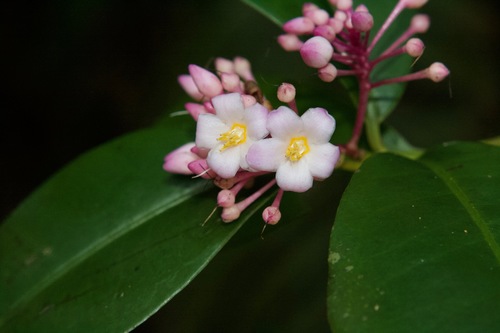
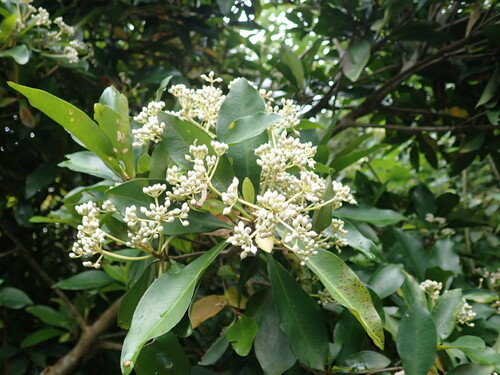
A shrub or small tree. It can grow to 10 m high. The small branches are 2-3 mm across and brown and scaly. The leaf stalk is 5-10 mm long. The leaf blade is oval and 7-14 cm long by 2-4 cm wide. It is leathery. It is dull on the upper surface and can be brown and scaly underneath. The base is wedge shaped and the edges can be curled back. There are 14-25 secondary veins on each side of the main vein. The flowers are in the axils of leaves near the ends of branches. They are in an arrangement 3-4 cm long. The flowers are white and about 3 mm across. The fruit is round and red to black. It is about 7 mm across. It is somewhat fleshy.
How to Grow
We have very little information on this species and do not know if it will be hardy in Britain. The following notes are based on the general needs of the genus. Prefers a well-drained humus rich soil in partial shade in a position sheltered from cold drying winds.
Propagation: Seed - best harvested when it is ripe in the winter and sown immediately in a greenhouse. Sow stored seed as early in the year as possible. When large enough to handle, prick the seedlings out into individual pots and grow them on in a shady part of the greenhouse for at least their first winter. Plant out into their permanent positions in late spring or early summer, once the plants are 20cm or more tall. Cuttings of half-ripe wood in summer. Grow on in cool, shaded humid conditions until well rooted.
Medicinal Uses
None known
Other Uses
None known Special Uses
Wikipedia
Ardisia sieboldii is an evergreen shrub reaching 6 m in height with year-round foliage. Flowers appear March to June with seed ripening January to April. It adapts to light sandy, medium loamy, and heavy clay soils with good drainage across mildly acid to mildly alkaline pH, grows in semi-shade, and prefers moist soil conditions.
Notes
There are about 250-300 Ardisia species. They are mainly in the tropics. Also put in the family Myrsinaceae.
Names & Synonyms
References (4)
- Ann. Mus. Bot. Lugduno-Batavum 3:190. 1867
- Chen Jie, Pipoly 3, J.J., Myrsinaceae. Flora of China.
- Hu, Shiu-ying, 2005, Food Plants of China. The Chinese University Press. p 614
- Plants for a Future database, The Field, Penpol, Lostwithiel, Cornwall, PL22 0NG, UK. http://www.scs.leeds.ac.uk/pfaf/