Ardisia squamulosa
Presl.
Spicy berry

no rights reserved, uploaded by 葉子
no rights reserved, uploaded by 葉子
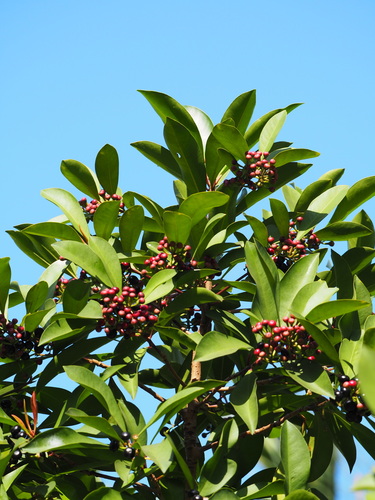
no rights reserved, uploaded by 葉子
What to Eat
Edible parts: Fruit, Flowers, Spice
The fruit, flowers, and spice are cooked and eaten with fish. Flowers and fruit are sold in local markets.
Where to Find It
A tropical plant. They are widely distributed in primary forest at low and medium altitudes in the Philippines. It grows up to 1000 m altitude.
Asia, Cambodia, Indochina, Pacific, Philippines, SE Asia, Vietnam,
How to Identify
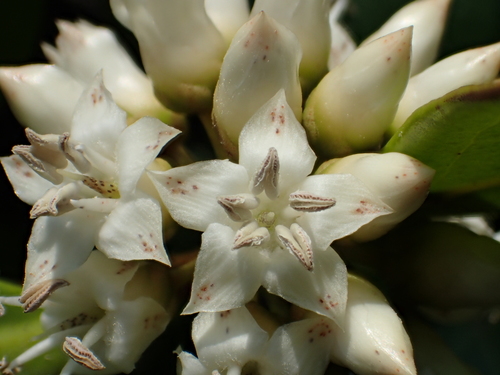
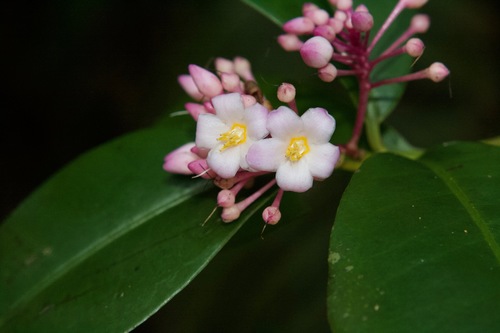
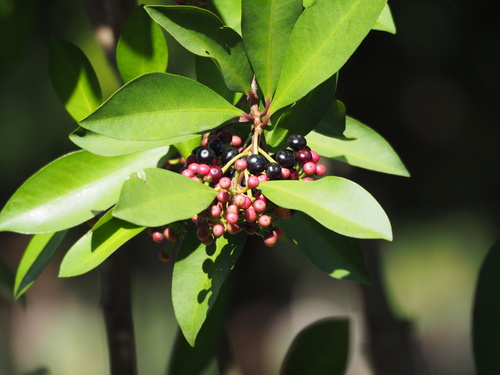
A small shrub or tree. It grows 1-2 m tall. It can grow 10 m tall and be 15 cm across the trunk. The leaves are alternate, rather slender and pointed at both ends. They are 6-15 cm long by 2-6 cm wide. The flowers are white or pink and have a smell. They are borne on compound flower arrangements at or near the ends of branches. About 4-5 flowers occur together. The flower arrangements are 1 cm long. The fruit are dark blue or purple, round and less than 1 cm across.
Nutrition Score: 26/100
| Part | Moisture | kJ | kcal | Protein | Vit A | Vit C | Iron | Zinc |
|---|---|---|---|---|---|---|---|---|
| Fruit | 29 | — | — | 15 | — | — | — | — |
| Flowers | — | — | — | — | — | — | — | — |
How to Grow
Plants are grown by seed.
Medicinal Uses
Used traditionally as food and spice in Philippine cuisine.
Wikipedia
Source ↗Ardisia squamulosa is a species of plant in the family Primulaceae. It is endemic to the Philippines. It is used to flavor fish.
Other Information
Flowers and fruit are sold in local markets.
Notes
There are about 250-300 Ardisia species. They are mainly in the tropics. The fresh fruit are 29% water, 15% protein, 2% fat, 22% carbohydrates, 27% fibre and 5% ash. Also put in the family Myrsinaceae.
Names & Synonyms
Babagion, Ba'y ka'k, Butau, Tagpo
References (5)
- Bircher, A. G. & Bircher, W. H., 2000, Encyclopedia of Fruit Trees and Edible Flowering Plants in Egypt and the Subtropics. AUC Press. p 40
- Monsalud, M.R., Tongacan, A.L., Lopez, F.R., & Lagrimas, M.Q., 1966, Edible Wild Plants in Philippine Forests. Philippine Journal of Science. p 510
- Phon, P., 2000, Plants used in Cambodia. © Pauline Dy Phon, Phnom Penh, Cambodia. p 47
- PROSEA handbook Volume 13 Spices. p 247
- Seidemann J., 2005, World Spice Plants. Economic Usage, Botany, Taxonomy. Springer. p 49