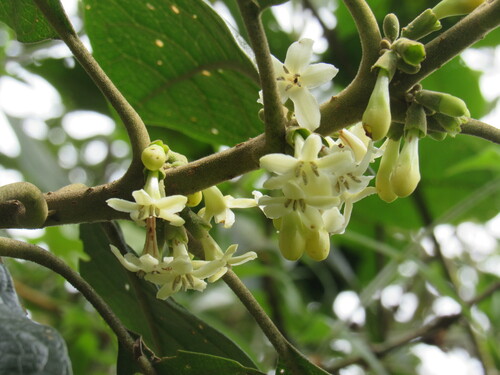
Plectranthus monostachyus
(P. Beauv.) B. J. Pollard
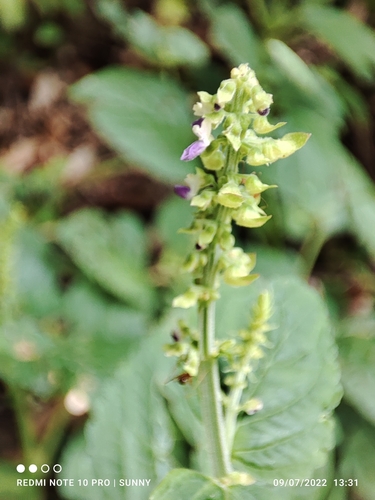
(c) SunGW, some rights reserved (CC BY-NC)
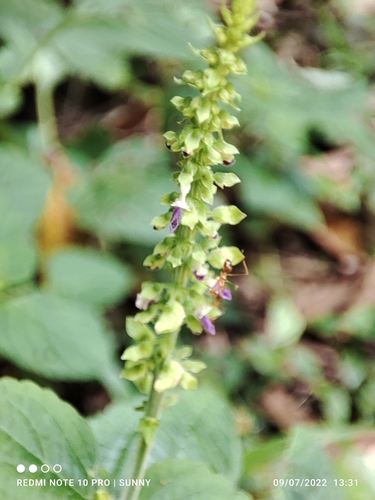
(c) SunGW, some rights reserved (CC BY-NC)

(c) Geeverughese C.George, some rights reserved (CC BY-NC)
What to Eat
Edible parts: Leaves, Vegetable, Tuber, Root
The leaves are cooked and eaten as a potherb; it is also used as a minor vegetable, with edible tubers and roots in addition to the leaves.
Where to Find It
A tropical plant. It grows in rocky savannah in West Africa.
Africa, Angola, Benin, Burkina Faso, Central Africa, Central African Republic, CAR, Chad, Congo, Côte d'Ivoire, Gabon, Ghana, Guinea, Guinée, Guinea-Bissau, Ivory Coast, Liberia, Nigeria, Senegal, Sierra Leone, Togo, West Africa,
How to Identify
An annual herb. It is erect and branched. It grows 1 m tall. The stems are 4 angled. They have short hairs. The leaves are simple and opposite. They are 5-9 cm long by 3-6 cm wide. They are wedge shaped at the base and taper to a short tip. The flowers are in groups at the top. It has long flower arrangements of violet flowers. The fruit is made up of 4 nutlets. These are 1 mm across. There are 4 subspecies.
Nutrition Score: 31/100
| Part | Moisture | kJ | kcal | Protein | Vit A | Vit C | Iron | Zinc |
|---|---|---|---|---|---|---|---|---|
| Leaves raw | 82 | 230 | 55 | 4.3 | — | — | — | — |
How to Grow
Although we have seen no reports for this plant as an invasive weed outside its native range, it is a common weed within its range.
Medicinal Uses
The plant has numerous medicinal uses. The ethanolic leaf extract contains an anticonvulsant principle which depresses the central nervous system. The leaf essential oil contains beta-pinene (13%), oct-1-en-3-ol (12.5%), beta-caryophyllene (7%), octan-3-ol (7%) and (E,E)-α-farnesene (6%) as the major constituents.. The leaf sap is considered sedative and stomachic and is applied internally to treat colic, convulsions, fever, headache and cough, especially in children. Moreover, leaves are used to treat dysmenorrhoea, haematuria, femalesterility, rheumatism, foot infections and snakebites. The leaf sap is applied externally as a treatment against eyesight troubles and aphthae. The roots are used to treat onchocerciasis (river-blindness, crawcraw). The plant has many ritual uses, especially related to pregnancy.
Other Information
It is a minor vegetable.
Notes
There are about 60 Solenostemon species. They grow in the tropics. Some Solenostemon were included in Plectranthus.
Names & Synonyms
Sisiworodo
References (12)
- Abbiw, D.K., 1990, Useful Plants of Ghana. West African uses of wild and cultivated plants. Intermediate Technology Publications and the Royal Botanic Gardens, Kew. p 41 (As Solenostemon monostachys)
- Burkill, H. M., 1985, The useful plants of west tropical Africa, Vol. 3. Kew. (As Solenostemon monostachys)
- Busson, 1965, (As Solenostemon monostachys and Solenostemon ocymoides)
- Dalziel, J. M., 1937, The Useful plants of west tropical Africa. Crown Agents for the Colonies London. (As Solenostemon ocymoides)
- Food Composition Tables for use in Africa FAO http://www.fao.org/infoods/directory No. 792 (As Solenostemon monostachys)
- Grivetti, L. E., 1980, Agricultural development: present and potential role of edible wild plants. Part 2: Sub-Saharan Africa, Report to the Department of State Agency for International Development. p 24 (As Solenostemon ocymoides)
- Grubben, G. J. H. and Denton, O. A. (eds), 2004, Plant Resources of Tropical Africa 2. Vegetables. PROTA, Wageningen, Netherlands. p 501 (As Solenostemon monostachys)
- Jardin, C., 1970, List of Foods Used In Africa, FAO Nutrition Information Document Series No 2.p 104 (As Solenostemon monostachys)
- Martin, F.W. & Ruberte, R.M., 1979, Edible Leaves of the Tropics. Antillian College Press, Mayaguez, Puerto Rico. p 196 (As Solenostemon monostachys and Solenostemon ocymoides)
- Peters, C. R., O'Brien, E. M., and Drummond, R.B., 1992, Edible Wild plants of Sub-saharan Africa. Kew. p 119 (As Solenostemon monostachys and Solenostemon ocymoides)
- Terra, G.J.A., 1973, Tropical Vegetables. Communication 54e Royal Tropical Institute, Amsterdam, p 76 (As Solenostemon monostachys)
- World Checklist of Useful Plant Species 2020. Royal Botanic Gardens, Kew