Spathodea campanulata
P. Beauv
African Tulip Tree
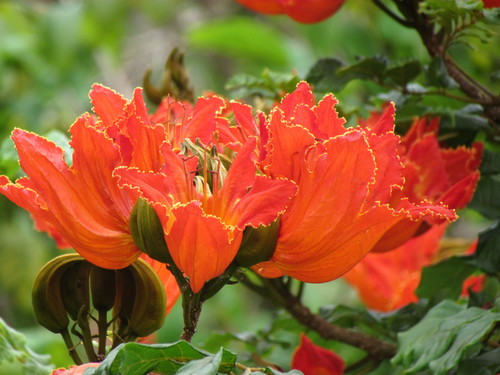
(c) squirrelwatcher019, some rights reserved (CC BY-NC), uploaded by squirrelwatcher019

(c) Juan Manuel de Roux, some rights reserved (CC BY-NC), uploaded by Juan Manuel de Roux

(c) sulan473, some rights reserved (CC BY-NC)
What to Eat
Edible parts: Seeds, Flowers
The seeds are eaten. The flower buds contain a sweet watery liquid that is used as a tonic.
Known Hazards
Where to Find It
A tropical plant. It grows naturally in tropical Africa. It has been spread to all parts of the tropics. In Nigeria it grows up to 900 m above sea level. It grows in forest along river banks. It suits plant hardiness zones 11-12. In XTBG Yunnan.
Africa*, Andamans, Angola, Asia, Australia, Bangladesh, Benin, Bermuda, Burkina Faso, Burundi, Cameroon, Caribbean, Central Africa, Central African Republic, CAR, Central America, Chad, China, Colombia, Comoros, Congo DR, Congo R, Cook Is., Costa Rica, Côte d'Ivoire, Cuba, Dominican Republic, East Africa*, Ecuador, El Salvador, Equatorial Guinea, Eritrea, Ethiopia, Fiji, Gabon, Gambia, Ghana, Guatemala, Guinea, Guinée, Guinea-Bissau, Haiti, Hawaii, Honduras, India, Indochina, Indonesia, Ivory Coast, Jamaica, Kenya, Laos, Liberia, Malawi, Malaysia, Maldives, Marianas, Marquesas, Mexico, Mozambique, Myanmar, Nigeria, Niue, Pacific, Papua New Guinea, PNG, Puerto Rico, Rotuma, Rwanda, Samoa, Sao Tome and Principe, SE Asia, Senegal, Sierra Leone, Singapore, South America, Sri Lanka, Sudan, Tanzania, Thailand, Togo, Tonga, Trinidad-Tobago, Uganda, USA, Vanuatu, Vietnam, West Africa, West Indies, Zambia, Zimbabwe,
How to Identify
A tree. It grows 25-30 m high. The bark is light grey. It forms buttresses. Leaves are opposite. The branches are rather short. In moist climates it may keep its leaves and in dry climates it may shed its leaves for a short time. The leaves are compound and divided into an odd number of leaflets. There are 9-19 pairs + one. The leaflets are oval and sword shaped. They have a long point. They are 5-10 cm long by 4-8 cm wide. The flower buds are velvety brown. They are in cone like masses at the ends of branches. The flowers are large and scarlet red. The flowers are wide and bell shaped. The fruit is a long, pointed woody pod. It is 20 cm long. It contains many winged seeds.
How to Grow
Plants are grown from seed. It also forms suckers. It can be grown from softwood cuttings or suckers.
Propagation: Seed - Cuttings Root suckers
Medicinal Uses
The unopened flower buds contain a sweet, watery liquid that is considered to be tonic. The bark has laxative and antiseptic properties. The bark is chewed and sprayed over swollen cheeks. The bark may also be boiled in water used for bathing newly born babies to heal body rashes The seeds, flowers and roots are used as medicine. The plant has many medicinal uses, both where it is native and introduced. Extracts of the bark, leaves and flowers are used to treat malaria, HIV, diabetes mellitus, oedema, dysentery, constipation, gastrointestinal disorders, ulcers, skin diseases, wounds, fever, urethral inflammation, liver complaints and as a poison antidote. It may be effective as a malaria prophylactic and in the control of Aedes mosquitoes.
Other Uses
As they mature, the unopened flower buds become engorged with a red, liquid nectar. Children love them because they can be used as water pistols to squirt the nectar. The brownish-white wood is soft. It is generally of little value but, because it is difficult to burn, is used for making blacksmiths' bellows. The wood is used for carving, but is considered inferior for other purposes. Plywood seems the only widespread commercial use for the timber. The wood is used for fuel and to make charcoal. The tree is planted for soil improvement, reforestation, erosion control and land rehabilitation, and also as a live fence. It is able to colonize even heavily eroded sites, though form and growth rate suffer considerably on difficult sites. Its dense crown does not allow intercropping, but its leaves make a useful mulch. It has been used as a shade tree in coffee plantations. In teak plantations, the tree can be used to attract initial populations of teak defoliator (Hyblaea puera), which can then easily be destroyed.
Production
It is fast growing.
Notes
There is only one Spathodea species. It can be invasive.
Names & Synonyms
Ar-fri-ka-hyu-lit-pin, Arvore das chamas, Cafauano, Culasseque, Flame of the Forest, Flame tree, Fountain tree, Gabonski tulipovec, Hirunduni, Kibobakasi, Kifabakazi, Lujjekaye, Masamasa, Mukulukulu, Munsasa, Nandi flame, Neerukaye, Nsasa mpwatu, Panchut-panchut, Patade, Patadi, Patadiya, Piquerio, Pohon cahaya hutan, Pohon kecrutan, Rugtoora, Scarlet bell tree, Sebetaiyet, Squirt tree, Sula-selo, Suncunde, Teme, Tombo-lembei, Tulip tree, Tumbo-lembei, Zowa zowa
References (49)
- Ambasta, S.P. (Ed.), 2000, The Useful Plants of India. CSIR India. p 591
- Barwick, M., 2004, Tropical and Subtropical Trees. A Worldwide Encyclopedic Guide. Thames and Hudson p 378
- Bekele-Tesemma A., Birnie, A., & Tengnas, B., 1993, Useful Trees and Shrubs for Ethiopia. Regional Soil Conservation Unit. Technical Handbook No 5. p 412
- Bodkin, F., 1991, Encyclopedia Botanica. Cornstalk publishing, p 942
- Bole, P.V., & Yaghani, Y., 1985, Field Guide to the Common Trees of India. OUP p 3
- Borrell, O.W., 1989, An Annotated Checklist of the Flora of Kairiru Island, New Guinea. Marcellin College, Victoria Australia. p 59
- Brickell, C. (Ed.), 1999, The Royal Horticultural Society A-Z Encyclopedia of Garden Plants. Convent Garden Books. p 974
- Burkill, H. M., 1985, The useful plants of west tropical Africa, Vol. 1. Kew.
- Cooper, W. and Cooper, W., 2004, Fruits of the Australian Tropical Rainforest. Nokomis Editions, Victoria, Australia. p 90
- Cundall, P., (ed.), 2004, Gardening Australia: flora: the gardener's bible. ABC Books. p 1361
- Dalziel, J. M., 1937, The Useful plants of west tropical Africa. Crown Agents for the Colonies London.
- Dharani, N., 2002, Field Guide to common Trees & Shrubs of East Africa. Struik. p 163
- Engel, D.H., & Phummai, S., 2000, A Field Guide to Tropical Plants of Asia. Timber Press. p 23, 114
- Facciola, S., 1998, Cornucopia 2: a Source Book of Edible Plants. Kampong Publications, p 49
- Fl. Oware 1:47, t. 27, 28. 1805
- Fowler, D. G., 2007, Zambian Plants: Their Vernacular Names and Uses. Kew. p 78
- Hall, N. et al, 1972, The Use of Trees and Shrubs in the Dry Country of Australia, AGPS, Canberra. p 202
- Hearne, D.A., & Rance, S.J., 1975, Trees for Darwin and Northern Australia. AGPS, Canberra p 105, Pl 33, Colour Pl 6
- Hibbert, M., 2002, The Aussie Plant Finder 2002, Florilegium. p 293
- http://www.botanic-gardens-ljubljana.com/en/plants
- Jackes, B.R., 2001, Plants of the Tropics. Rainforest to Heath. An Identification Guide. James Cook University. p 44
- Jardin, C., 1970, List of Foods Used In Africa, FAO Nutrition Information Document Series No 2.p 48
- JSTOR Global Plants edible
- Kew Plants of the World Online
- Krishen P., 2006, Trees of Delhi, A Field Guide. DK Books. p 254
- Latham, P & Mbuta, A., 2017, Useful Plants of Central Province, Democratic Republic of Congo. Volume 2. Salvation Army p 183
- Llamas, K.A., 2003, Tropical Flowering Plants. Timber Press. p 142
- Lord, E.E., & Willis, J.H., 1999, Shrubs and Trees for Australian gardens. Lothian. p 73
- Marinelli, J. (Ed), 2004, Plant. DK. p 469
- Mbuya, L.P., Msanga, H.P., Ruffo, C.K., Birnie, A & Tengnas, B., 1994, Useful Trees and Shrubs for Tanzania. Regional Soil Conservation Unit. Technical Handbook No 6. p 444
- Morley, B. & Everard, B., 1970, Wild Flowers of the World. Ebury press. Plate 62
- Peekel, P.G., 1984, (Translation E.E.Henty), Flora of the Bismarck Archipelago for Naturalists, Division of Botany, Lae, PNG. p 508, 510
- Peters, C. R., O'Brien, E. M., and Drummond, R.B., 1992, Edible Wild plants of Sub-saharan Africa. Kew. p 69
- Plants of Haiti Smithsonian Institute http://botany.si.edu
- Savill, P. S. & Fox, J. E. D., Trees of Sierra Leone. p 53
- Staples, G.W. and Herbst, D.R., 2005, A tropical Garden Flora. Bishop Museum Press, Honolulu, Hawaii. p 185
- Sujanapal, P., & Sankaran, K. V., 2016, Common Plants of Maldives. FAO & Kerala FRI, p 247
- Sukarya, D. G., (Ed.) 2013, 3,500 Plant Species of the Botanic Gardens of Indonesia. LIPI p 517
- Swaminathan, M.S., and Kochnar, S.L., 2007, An Atlas of Major Flowering Trees in India. Macmillan. p 224
- Terashima, H., et al, 1992, Ethnobotany of the Lega in the Tropical Rainforest of Eastern Zaire (Congo): Part Two, Zone de Walikale, African Study Monographs, Suppl. 19:1-60
- Unwin, A. H., 1920, West African Forests and Forestry. Fisher Unwin Ltd. pdf on Internet p 70
- van Wyk, B, van Wyk, P, and van Wyk B., 2000, Photographic guide to Trees of Southern Africa. Briza. p 289
- Vivien, J. & Faure, J.J., 1985, Abres des forets dense d'Afrique Centrale. Agence de Cooperation Culturelle et Technique. Paris. p 40
- von Katja Rembold, 2011, Conservation status of the vascular plants in East African rain forests. Dissertation Universitat Koblenz-Landau p 182
- Whistler, W.A., 2004, Rainforest Trees of Samoa. Isle Botanica Honolulu, Hawaii. p 34
- World Checklist of Useful Plant Species 2020. Royal Botanic Gardens, Kew
- www.worldagroforestrycentre.org/treedb/
- Zuchowski W., 2007, Tropical Plants of Costa Rica. A Zona Tropical Publication, Comstock Publishing. p 21
- Yuncker, T.G., 1959, Plants of Tonga, Bernice P. Bishop Museum, Hawaii, Bulletin 220. p 242


