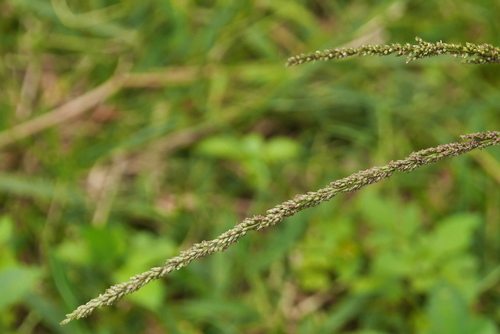
A grass that keeps growing from year to year. The stalks are erect. It grows 30-90 cm high. The leaf blades are slender and 25 cm long. They are 1-3 mm wide. The flowers are in dense spike-like groups. These are 1-4 cm long.
How to Grow
Succeeds in warm temperate to tropical areas.
Succeeds in any well drained soil in a sunny position.
The plant has become naturalised in many areas outside its original range. It spreads well in areas where there is traffic and the soil has been compacted and is particularly aggressive in wet and swampy soils.
Propagation: Sow seed in spring in a greenhouse, barely covering it; germination should occur within two weeks. Prick seedlings into individual pots once large enough to handle and plant out during summer if sufficiently developed, otherwise overwinter them in the greenhouse and plant out in late spring the following year. For division in spring, larger clumps can go directly into permanent positions, while smaller divisions do best potted up and grown on in a lightly shaded cold frame until well established, then planted out in summer.
Medicinal Uses
The plant is used to enrich the blood, reduce swellings, and treat gonorrhoea. It is also regarded as an antifertility agent in some countries.
Sporobolus indicus is a species of grass known by the common name smut grass.
Notes
There are about 160 Sporobolus species. They are mainly in the tropics and subtropics.
Names & Synonyms
Alambrillo, Harataa
Agrostis elongata Lam. [Illegitimate]Agrostis indica L.Agrostis orientalis Nees [Illegitimate]Agrostis tenacissima L. f.Agrostis tenuissima Spreng.Andropogon intortum CrantzPaspalum lanceifolium Desv.Paspalum parviflorum Desv. [Invalid]Sporobolus angustus BuckleySporobolus berteroanus (Trin.) Hitchc. & ChaseSporobolus exilis (Trin.) BalansaSporobolus indicus f. africanoides Jovet & GuédèsSporobolus indicus var. andinus RenvoizeSporobolus indicus var. exilis (Trin.) T. KoyamaSporobolus indicus var. indicusSporobolus indicus f. indicusSporobolus indicus subsp. indicusSporobolus indicus f. microspiculus Jovet & GuédèsSporobolus indicus var. tenacissimus (L.f.) PeterSporobolus lamarckii Desv. ex Ham. [Illegitimate]Sporobolus orientalis (Nees) Kunth [Illegitimate]Sporobolus tenacissimus (L.f.) P. Beauv.Vilfa angusta BuckleyVilfa berteroana Trin.Vilfa elongata (Lam.) P. Beauv. [Illegitimate]Vilfa exilis Trin.Vilfa indica (L.) Trin. ex Steud.Vilfa orientalis Nees ex Trin.Vilfa tenacissima (L.f.) KunthVilfa tenacissima var. exilis (Trin.) E. Fourn.
References (6)
Guinand, Y., & Lemessa, D., 2000, Wild-food Plants in Southern Ethiopia. University of Pennsylvania - African Studies Center. UN-EUE Addis Ababa.
Lulekal, E., et al, 2011, Wild edible plants in Ethiopia: a review on their potential to combat food insecurity. Afrika Focus - Vol. 24, No 2. pp 71-121
Plants for a Future database, The Field, Penpol, Lostwithiel, Cornwall, PL22 0NG, UK.
http://www.scs.leeds.ac.uk/pfaf/
Plants of Haiti Smithsonian Institute http://botany.si.edu/antilles/West Indies