Syzygium paniculatum
Gaertner
Magenta Lilly Pilly, Brush cherry

(c) John Tann, some rights reserved (CC BY)
(c) GERMAN LEONEL SARMIENTO CRUZ, some rights reserved (CC BY)

(c) Melissa Gunn, some rights reserved (CC BY-NC)
What to Eat
Edible parts: Fruit
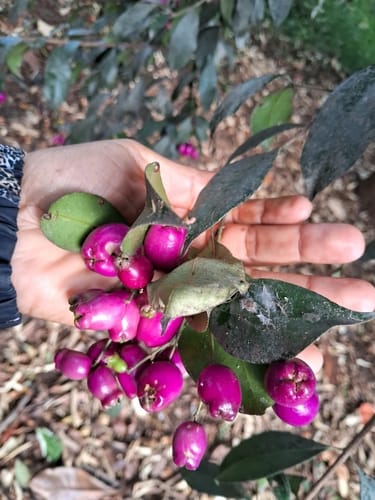
Fruit - raw or cooked. Crisp and very juicy, the aromatic rose-purple fruits are often eaten to quench the thirst. A succulent, fleshy pulp with a slightly sweet flavour. The fruit is up to 15mm long and 10mm wide.The magenta fruits are 15-25 mm in diameter and contain a single seed.
Where to Find It
It is better suited to warm temperate places than the subtropics or tropics. It occurs naturally in New South Wales and Queensland in Australia. It is a rainforest species. It suits humid locations. It does best on medium to heavy soils. It requires moist soils in a shady position. But plants can grow with full sun. It can withstand drought. It is damaged by frost. It needs a minimum temperature above 7°C. It can stand slight frosts. It suits hardiness zones 9-12. In Hobart Botanical gardens. Melbourne Botanical Gardens. Wittunga Botanical Gardens.
AUSTRALASIA: Australia (New South Wales (east))
How to Identify
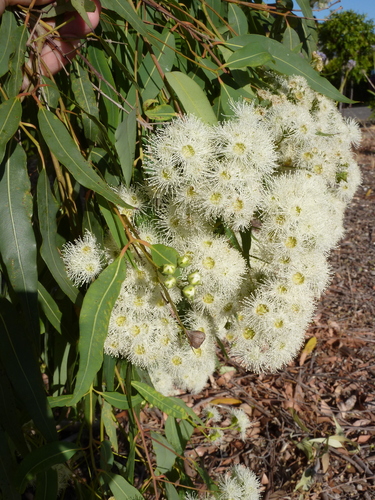
An evergreen tree. It grows 6-20 m tall and with a spread of 4-8 m across. The stem is erect and the branches are spreading. It has a dense crown of leaves. The young leaves are bronze coloured. The leaves are shiny and dark green on the upper surface but paler underneath. They are oval or curved but taper towards the ends and are 5-9 cm long by 3 cm wide. The flowers are white and 1-1.5 cm across. They occur in clusters in the angles where leaves join and at the ends of branches. The fruit is round or oval and dark red. The fruit can also be pink or purple. It is 2.5 cm across. There is a fleshy crown at the end of the fruit. The fruit is edible. The seed contains 2-8 embryos. If the seed is squeezed it will break into several uneven segments.
How to Grow
193106 200 Succeeds in any good well-drained soil. This species is not very cold-hardy, tolerating temperatures down to about -3°c.
Propagation: Seed - polyembryonic, usually producing several seedlings from each seed. Germination taks 3 - 4 weeks. Stem cuttings root fairly easily.
Medicinal Uses
None known
Other Uses
Plants are used for hedging in frost-free areas of California.
Wikipedia
Source ↗Syzygium paniculatum, the magenta lilly pilly or magenta cherry, is a species of flowering plant in the myrtle family Myrtaceae, native to New South Wales, Australia. A broad dense bushy rainforest tree, in cultivation it grows to a height of 15 m (49 ft) with a trunk diameter up to 35 cm (14 in). The largest known example is at Ourimbah Creek, 35 m (115 ft) metres tall. The leaves are 3–9 cm (1.2–3.5 in) long, opposite, simple and slightly obovate, tapering at the leaf base. They are dark glossy green above, and paler below. White flowers are produced in clusters. The edible fruit is usually magenta, but can be white, pink or purple. The seeds are polyembryonic. A population of Syzygium paniculatum occurs on the eastern side of Jervis Bay, with trees 20–30 m (66–98 ft) tall, some with a diameter at breast height of 1.5 m (4.9 ft).
Names & Synonyms
Australian Brush cherry, Creek Lilly-Pilly, Jambinho-roxo, Jambinho, Jambo-da-australia, Rose apple, Scrub cherry
References (29)
- Bodkin, F., 1991, Encyclopedia Botanica. Cornstalk publishing, p 964
- Brickell, C. (Ed.), 1999, The Royal Horticultural Society A-Z Encyclopedia of Garden Plants. Convent Garden Books. p 995
- Cherikoff V. & Isaacs, J., The Bush Food Handbook. How to gather, grow, process and cook Australian Wild Foods. Ti Tree Press, Australia p 51, 197
- Cronin, L., 1989, The Concise Australian Flora. Reed. p 141
- Cundall, P., (ed.), 2004, Gardening Australia: flora: the gardener's bible. ABC Books. p 1393
- Doran, J.C., & Turnbull, J.W. (Eds), 1997, Australian Trees and Shrubs: species for land rehabilitation and farm plantings in the tropics. ACIAR Monograph No 24. p 358
- Fruct. sem. pl. 1:167, t. 33, fig. 1. 1788
- Greig, D., 1996, Flowering Natives for Home Gardens. Angus & Robertson. p 312
- Hibbert, M., 2002, The Aussie Plant Finder 2002, Florilegium. p 296
- Holliday, I., 1989, A Field Guide to Australian Trees. Hamlyn. p 300
- http://www.botanic-gardens-ljubljana.com/en/plants
- Jones D, L, 1986, Ornamental Rainforest Plants in Australia, Reed Books, p 81, 340
- Kermath, B. M., et al, 2014, Food Plants in the Americas: A survey of the domesticated, cultivated and wild plants used for Human food in North, Central and South America and the Caribbean. On line draft. p 847
- Kiple, K.F. & Ornelas, K.C., (eds), 2000, The Cambridge World History of Food. CUP p 1738
- Lord, E.E., & Willis, J.H., 1999, Shrubs and Trees for Australian gardens. Lothian. p 21
- Lorenzi, H., Bacher, L., Lacerda, M. & Sartori, S., 2006, Brazilian Fruits & Cultivated Exotics. Sao Paulo, Instituto Plantarum de Estuados da Flora Ltda. p 464
- Low, T., 1991, Wild Food Plants of Australia. Australian Nature FieldGuide, Angus & Robertson. p 77
- Molyneux, B. and Forrester, S., 1997, The Austraflora A-Z of Australian Plants. Reed. p 152
- Morley, B.D., & Toelken, H.R., (Eds), 1983, Flowering Plants in Australia. Rigby. p 180
- Nicholson, N & H., 1994, Australian Rainforest Plants 4, Terania Rainforest Publishing. NSW. p 66
- Plants for a Future database, The Field, Penpol, Lostwithiel, Cornwall, PL22 0NG, UK. http://www.scs.leeds.ac.uk/pfaf/
- Queensland Forest Service, 1991, Trees and Shrubs. Department of Primary Industries. p 117
- Ratcliffe D & P., 1987, Australian Native Plants for Indoors. Little Hills press. p 135
- Roa, J. A. G. & Boada, D. S. G., 2018, Fundación para el Fortalecimiento de la Fruticultura y Plantas Alimenticias no Convencionales en Colombia.
- Smith, K., 1998. Growing Uncommon Fruits and Vegetables. New Holland. p 98
- Staples, G.W. and Herbst, D.R., 2005, A tropical Garden Flora. Bishop Museum Press, Honolulu, Hawaii. p 430
- Swaziland's Flora Database http://www.sntc.org.sz/flora
- van Wyk, B., 2005, Food Plants of the World. An illustrated guide. Timber press. p 358
- Williams, J.B., Harden, G.J., and McDonald, W.J.F., 1984, Trees and shrubs in rainforests of New South Wales and Southern Queensland. Univ. of New England, Armidale. p 112