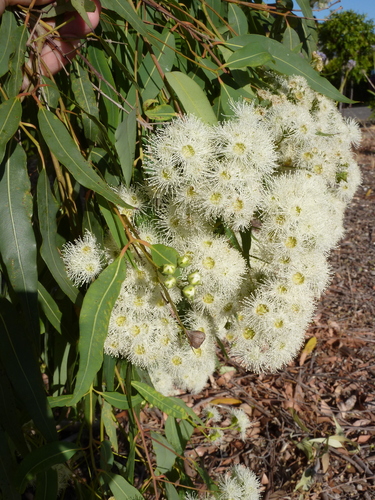
Syzygium puberulum
Merr. & L. M. Perry
White satinash

(c) Thomas Mesaglio, some rights reserved (CC BY), uploaded by Thomas Mesaglio

(c) Thomas Mesaglio, some rights reserved (CC BY), uploaded by Thomas Mesaglio
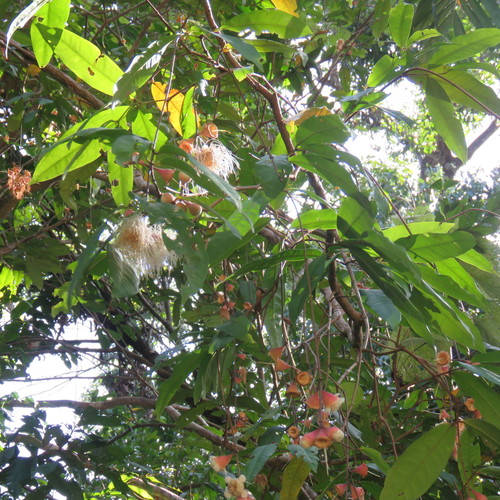
(c) Ian Cowan, some rights reserved (CC BY-NC), uploaded by Ian Cowan
What to Eat
Edible parts: Fruit
Fruit - raw or cooked. The red, globular or ovoid fruit is about 30 - 50mm long and 30 - 45mm wide, containing 1 - 5 large seeds.
Known Hazards
Where to Find It
A tropical plant. It grows in north east Queensland in Australia. It grows from sea level to 300 m altitude. Trees especially when young need plenty of moisture. They need a shady position.
Australia*, Papua New Guinea, PNG,
How to Identify
A shrub or small tree. It grows up to 6-8 m tall. It often has several stems. The branches hang over. The leaves are large and sword shaped. They can be 20 cm long by 5 cm wide. They are dull green on the upper surface and paler underneath. The flowers are large and white. They occur in dense clusters at the ends of small branches. The fruit are round and about 2 cm across. They are pink to red. They are edible.
How to Grow
They can be grown from fresh seed. It may be possible to used cuttings.
Propagation: Seed - fresh, viable seed can germinate within a few weeks.
Wikipedia
Source ↗Syzygium puberulum, commonly known as white satinash or downy satinash, is a plant in the family Myrtaceae which is native to rainforests of Cape York Peninsula, Queensland, and Papua New Guinea. It was first described in 1942.
Production
Planst grow slowly. In Australia the fruit are ripe January to April.
References (6)
- Barwick, M., 2004, Tropical and Subtropical Trees. A Worldwide Encyclopedic Guide. Thames and Hudson p 393
- Cooper W & Cooper W T, 1994, Fruits of the Rain Forest. RD Press p 276
- Cooper, W. and Cooper, W., 2004, Fruits of the Australian Tropical Rainforest. Nokomis Editions, Victoria, Australia. p 367
- Hartley, T. G. & Perry, L. M., 1973, Syzygium (Myrtaceae) from Papuasia J. Arn. Arb. Vol 54 p 193
- Jones D, L, 1986, Ornamental Rainforest Plants in Australia, Reed Books, p 81
- Townsend, K., 1994, Across the Top. Gardening with Australian Plants in the tropics. Society for Growing Australian Plants, Townsville Branch Inc. p 349