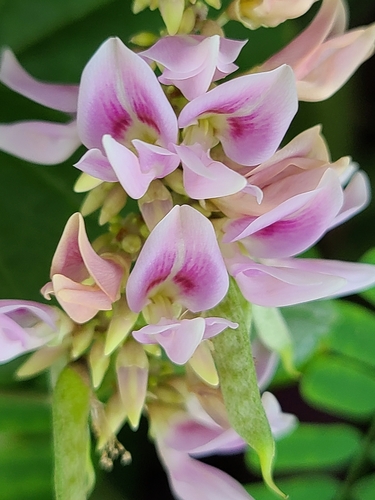
Tephrosia linearis
(Willd.) Pers.

(c) Marco Schmidt, some rights reserved (CC BY-NC-SA)

Wikimedia Commons - NMNH
What to Eat
Edible parts: Leaves
The leaves are pulped and used as a seasoning, added to milk or to millet or guinea corn.
Where to Find It
A tropical plant. It grows in sandy and grassy places in West Africa. It grows up to 2,400 m above sea level. It grows in dry sandy and poorly drained soils. It grows in areas with an annual rainfall 800-1,500 mm. It can grow in arid places.
Africa, Angola, Benin, Burkina Faso, Burundi, Cameroon, Central Africa, Central African Republic, CAR, Chad, Congo, East Africa, Ethiopia, Gambia, Ghana, Guinea, Guinée, Guinea-Bissau, Kenya, Madagascar, Malawi, Mali, Mauritania, Mozambique, Niger, Nigeria, Senegal, Sierra Leone, South Africa, Southern Africa, Sudan, Tanzania, Togo, Uganda, Pantropical, West Africa, Zambia, Zimbabwe,
How to Identify
A herb. It grows each year from seeds. It grows 1 m high. The leaves have 3-6 pairs of leaflets. The leaflets are 15-40 mm long by 1-4 mm wide. The flowers are in the axils of leaves or at the ends of branches. They are in groups 12 cm long. The petals are yellow or red. The fruit are pods 40-55 mm long by 3-4 mm wide. They are brown and have hairs. There are 9-13 seeds. These are 2-3 mm long by 2 mm wide.
Names & Synonyms
Gagneraye, Ndogdial, Ndon, Temei-tenu, Tiekre
References (9)
- Burkill, H. M., 1985, The useful plants of west tropical Africa, Vol. 3. Kew.
- Dalziel, J. M., 1937, The Useful plants of west tropical Africa. Crown Agents for the Colonies London.
- ILDIS Legumes of the World http:www:ildis.org/Legume/Web
- Martin, F.W. & Ruberte, R.M., 1979, Edible Leaves of the Tropics. Antillian College Press, Mayaguez, Puerto Rico. p 200
- Peters, C. R., O'Brien, E. M., and Drummond, R.B., 1992, Edible Wild plants of Sub-saharan Africa. Kew. p 138
- Royal Botanic Gardens, Kew (1999). Survey of Economic Plants for Arid and Semi-Arid Lands (SEPASAL) database. Published on the Internet; http://www.rbgkew.org.uk/ceb/sepasal/internet [Accessed 29th April 2011]
- Syn. pl. 2(2):330. 1807
- Terra, G.J.A., 1973, Tropical Vegetables. Communication 54e Royal Tropical Institute, Amsterdam, p 79
- World Checklist of Useful Plant Species 2020. Royal Botanic Gardens, Kew