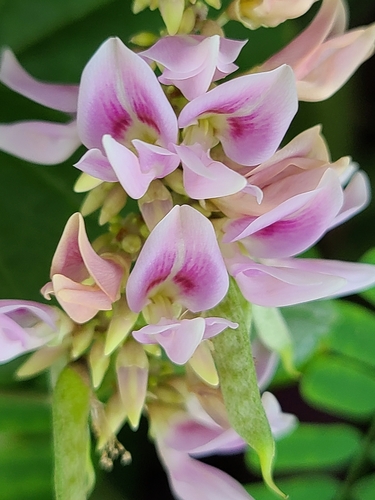
Teramnus labialis
(L. f.) Spreng.
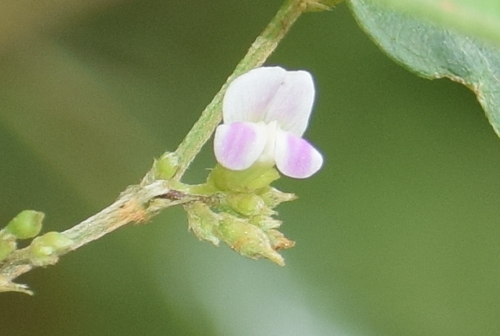
(c) Aniruddha Singhamahapatra, some rights reserved (CC BY-NC), uploaded by Aniruddha Singhamahapatra
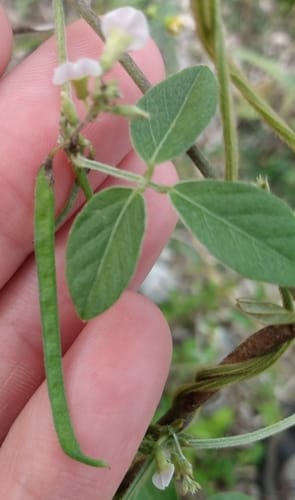
(c) Ben Machado, some rights reserved (CC BY)
What to Eat
Edible parts: Leaves, Seeds, Vegetable
The very young leaves are eaten.
Where to Find It
A tropical plant. It grows in slightly dry places. In Papua New Guinea it grows from sea level to 100 m altitude. In Africa it grows in grassland between 600-1,800 m above sea level.
Africa, Asia, Burkina Faso, Cambodia, Cameroon, Central Africa, Central America*, Cuba*, Dominican Republic, East Africa, Eswatini, Guam, Guyana, Haiti, India, Indochina, Indonesia, Jamaica*, Laos, Lesser Antilles*, Madagascar, Malaysia, Mexico*, Mozambique, Myanmar, Nigeria, North America, Pacific, Papua New Guinea, PNG, Philippines, Puerto Rico, SE Asia, Senegal, Sierra Leone, South Africa, Southern Africa, South America, Sri Lanka, Swaziland, Thailand, Vietnam, West Africa, West Indies*, Zambia, Zimbabwe,
How to Identify
A variable climbing or trailing herb. It grows 30 cm to 3 m long. The rootstocks are woody and the stems slender. Sometimes plants root at the nodes. The leaves are made up of rounded leaflets 1-8 cm long by 0.5-4 cm wide. They taper towards the tip and are rounded at the base. The leaf stalk is 0.9-4 cm long. The flowering stalk is slender with few flowers. The fruit are 2.5-6 cm long and 2-4 mm wide. The seeds can be smooth or covered with a grainy crust. There are 2 subspecies in West Africa.
How to Grow
A plant of the moist tropics, where it is found at elevations from sea level up to 3,000 metres. It grows best in areas where annual daytime temperatures are within the range 17 - 27°c, but can tolerate 10 - 36°c. When dormant, the plant can survive temperatures down to about -3°c, but young growth can be severely damaged at -1°c. It prefers a mean annual rainfall in the range 750 - 1,500mm, but tolerates 500 - 2,500mm. Succeeds in full sun and in light shade. Tolerates a wide range of moist, fertile soils. Prefers a pH in the range 6 - 8, tolerating 5 - 9. Established plants are relatively drought tolerant.
Propagation: Generally, the seed does not require scarification. However, levels of hard seed can be high, and scarification may be necessary in some instances to achieve at least 50% germination. This can usually be done by pouring a small amount of nearly boiling water on the seeds (being careful not to cook them!) and then soaking them for 12 - 24 hours in warm water. By this time they should have imbibed moisture and swollen - if they have not, then carefully make a nick in the seedcoat (being careful not to damage the embryo) and soak for a further 12 hours before sowing. The seed can be broadcast or sown at 2 - 3 kilos per hectare in rows 50 - 75cm apart, and no more than 3 cm deep. Seed is small and seedling development relatively slow, so seed should be sown into a well-prepared seedbed, with the area rolled after sowing. Stands take 6 - 8 months to become established. Although this species appears somewhat promiscuous in relation to rhizobial requirements, inoculation with CB 756 (Australia) or an equivalent strain may be beneficial.
Medicinal Uses
Plant extracts are used in natural medicines in India.
Other Uses
The plant has grown well under citrus (Citrus sinensis), banana (Musa sp.) and coconut (Cocos nucifera). It can be cut to provide green manure.
Notes
There are 8 Teramnus species.
Names & Synonyms
Chantingan, Curvican de jutia, Dau-chi, Kakachangan sapi, Kattualandu, Kattukanam, Koselan, Mashani, Mashaparni, Mashoni, Mashparui, Ran-udid, Ron kaka, Taw-pe, Tripa de jutia, Valiyovelo
References (16)
- Ambasta, S.P. (Ed.), 2000, The Useful Plants of India. CSIR India. p 626
- Arinathan, V., et al, 2007, Wild edibles used by Palliyars of the western Ghats, Tamil Nadu. Indian Journal of Traditional Knowledge. 6(1) pp 163-168
- Burkill, H. M., 1985, The useful plants of west tropical Africa, Vol. 3. Kew.
- Burkill, I.H., 1966, A Dictionary of the Economic Products of the Malay Peninsula. Ministry of Agriculture and Cooperatives, Kuala Lumpur, Malaysia. Vol 2 (I-Z) p 2172
- Flora of Pakistan. www.eFloras.org
- Fowler, D. G., 2007, Zambian Plants: Their Vernacular Names and Uses. Kew. p 40 (As subsp. arabicus)
- Grubben, G. J. H. and Denton, O. A. (eds), 2004, Plant Resources of Tropical Africa 2. Vegetables. PROTA, Wageningen, Netherlands. p 565
- Heyne, K., 1927, p 821
- Martin, F.W. & Ruberte, R.M., 1979, Edible Leaves of the Tropics. Antillian College Press, Mayaguez, Puerto Rico. p 200
- Plants of Haiti Smithsonian Institute http://botany.si.edu/antilles/West Indies
- Pullaiah, T., et al, Ethnobotany of India, Volume 1: Eastern Ghats and Deccan.
- Syst. veg. 3:235. 1826
- Swaziland's Flora Database http://www.sntc.org.sz/flora
- Verdcourt, B., 1979, Manual of New Guinea Legumes. Botany Bulletin No 11, Division of Botany, Lae, Papua New Guinea. p 496 (Drawing)
- Viswanathan, M. B., et al, 1999, Chemical analysis and nutritional assessment of Teramnus labialis (L.) Spreng. (Fabaceae) Plant Foods for Human Nutrition. 54:345-352
- World Checklist of Useful Plant Species 2020. Royal Botanic Gardens, Kew