Terminalia catappa
L.
Java almond, Coastal almond
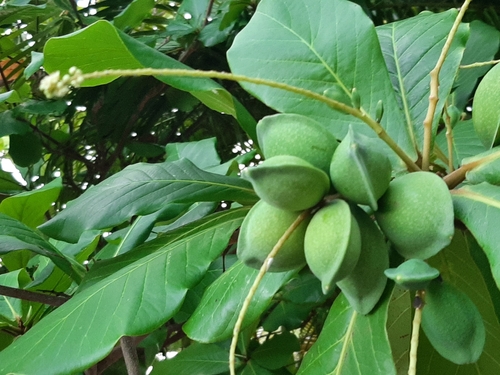
(c) Michael Davidson, some rights reserved (CC BY-NC), uploaded by Michael Davidson
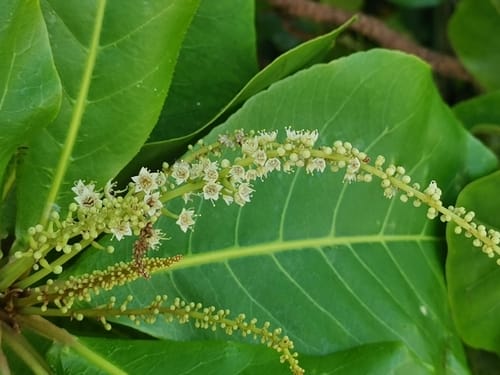
(c) Darren Obbard, some rights reserved (CC BY)

(c) 106611639464075912591, some rights reserved (CC BY-NC-SA), uploaded by 106611639464075912591
What to Eat
Edible parts: Kernel, Nuts, Nuts-oil, Fruit
The almond-flavoured seeds can be eaten raw or roasted, and chopped into cookies, bread mixes, dessert fillings, sweets, soups and stews. Each seed is 3–4cm long and 3–5mm thick, enclosed in a thick shell that is difficult to crack. The seeds are a rich source of zinc and contain about 50% oil. They yield 38–54% of a colourless, bland-tasting yellow semi-drying oil used for cooking, similar to almond oil but less prone to going rancid. The fruits have a tender skin with a thin layer of subacid juicy flesh that is often fibrous and not particularly tasty despite its pleasant smell. The sweetish, fibrous flesh is palatable when very young and is generally liked by children.
Known Hazards
Where to Find It
A tropical plant. This tree occurs on the beach front in most tropical countries in the world. They are sometimes cultivated as a shade tree. The tree is common in lowland areas particularly on sandy or rocky beaches. Seeds are spread by both bats and sea water as well as being planted by people. Trees are common along streets in coastal towns. It is highly salt tolerant, They will grow from sea level up to about 800 m altitude. In PNG it is mostly below 300 m altitude. It can grow with a soil pH of 4.0-8.5. Plants are frost tender. They can tolerate drought. It grows in areas with a temperature range of 17-32°C. It suits hardiness zones 11-12.
Afghanistan, Africa, American Samoa, Andamans, Angola, Anguilla, Antigua & Barbuda, Asia, Australia, Bahamas, Bangladesh, Barbados, Belize, Bermuda, Bougainville, Brazil, British Indian Ocean Terr., BIOT, Burkina Faso, Cambodia, Cameroon, Cape Verde, Caribbean, Caroline Islands, Cayman Islands, Central Africa, Central America, China, Christmas Island, Chuuk, Colombia, Congo DR, Cook Islands, Costa Rica, Côte d'Ivoire, Cuba, Dominican Republic, East Africa, East Timor, Ecuador, El Salvador, Ethiopia, Fiji, FSM, French Guiana, French Polynesia, Gabon, Ghana, Grenada, Guam, Guiana, Guianas, Guyana, Haiti, Hawaii, Honduras, India, Indochina, Indonesia*, Ivory Coast, Jamaica, Japan, Kenya, Kiribati, Kosrae, Laos, Lesser Antilles, Liberia, Madagascar, Malawi, Malaysia, Maldives, Mariana Islands, Marquesas, Marshall Islands, Mauritius, Mexico, Micronesia, Mozambique, Myanmar, Nauru, Netherlands Antilles, Nicaragua, New Caledonia, Niger, Nigeria, Niue, North America, Northeastern India, Pacific, Pakistan, Palau, Papua New Guinea, PNG, Peru, Philippines, Pohnpei, Polynesia, Puerto Rico, Rotuma, Samoa, Sao Tome and Principe, SE Asia, Senegal, Seychelles, Sierra Leone, Singapore, Society Islands, Solomon Islands, Somalia, South America, Sri Lanka, St. Kitts and Nevis, St Lucia, St Vincent and the Grenadines, Sudan, Suriname, Tahiti, Taiwan, Tanzania, Thailand, Timor-Leste, Tokelau, Tonga, Torres Strait, Trinidad and Tobago, Tuvalu, Uganda, United Arab Emirates, UAE, USA, Vanuatu, Vietnam, Virgin Islands, Wallis & Futuna, West Africa, West Indies, Yap,
How to Identify
A large tree up to 25-40 m tall. It loses its leaves during the year. The trunk can be straight or twisted. There can be buttresses up to 3 m tall. The branches lie horizontally and come out in layers. The leaves are long, smooth and shiny with an abrupt point at the tip and a rounded base. Leaves tend to be near the ends of branches. Leaves can be 17-29 cm long and 10-15 cm wide. Young leaves have soft hairs. The leaves turn red and fall off twice a year. Flowers are greenish white and in a spike at the end of the branches. The lower flowers on a spike are female, then the others are male. The fruit is about 6 cm long by 3-4 cm wide, thick and flattened with a flange around the edge. The fruit are green and turn red when ripe. The pulp is edible.
Nutrition Score: 71/100
| Part | Moisture | kJ | kcal | Protein | Vit A | Vit C | Iron | Zinc |
|---|---|---|---|---|---|---|---|---|
| Nuts dried | 4.2 | 2987 | 715 | 20 | 0 | 2 | 6.3 | 41 |
| Nuts | 31 | 1810 | 433 | 15.9 | 0 | 4 | 4.6 | 4.9 |
How to Grow
Plants grow best in the lowland tropics at elevations below 800 metres. It grows best in areas where the mean maximum and minimum annual temperatures are within the range 21 - 32°c, though it can tolerate 10 - 36°c. It prefers a mean annual rainfall in the range 1,500 - 3,400mm, though can tolerate from 700 - 4,200mm. Succeeds in any moderately fertile, well-drained soil in a sunny position. Prefers sands and loamy sands, though it also does well on silts, loam, and even clays if the drainage is good. Tolerates saline soils. Prefers soil that are neutral to moderately alkaline and rich in bases, however it will also grow in strongly acid soils. A particularly useful plant for coastal gardens, being tolerant of salt spray. Established plants are drought tolerant. Prefers a pH in the range 5 - 7, but tolerates 4.3 - 8. Plants are fast growing, often in excess of 1 metre a year when young. Trees can yield two crops a year in some areas, and in places have been known to exhibit more or less continuous fruiting. A tree may yield around 5 kg of kernels per year. There has been some selection in cultivating forms with larger seeds. The tree sheds its leaves all at once, quite suddenly, usually twice a year (January or February and July or August). Unlike most tropical trees, the leaves turn first yellow, then vivid red before falling, giving a well-marked 'autumn colour'. The inconspicuous flowers have a sweet, delicate fragrance. Various species of biting and stinging ants have been found inhabiting hollow twigs on this tree. Flowering Time: Late Winter/Early Spring Mid Spring Late Spring/Early Summer Mid Summer Late Summer/Early Fall. Bloom Color: Cream/Tan Inconspicuous/none (white). Spacing: 15-20 ft. (4.7-6 m).
Propagation: Pre-soak seed in cold water for 24 hours before sowing. About 70% of ripe seeds germinate in approximately 20 days. Seeds remain viable for a long time and germinate readily, even after travelling long distances in water.
Medicinal Uses
Various parts of the tree, including the leaves and fruit, contain tannins and are astringent. The leaves, crushed together with Dacrydium elatum and rhizomes of Cyperus rotundus, are combined to treat dysentery. Red leaves act as a vermifuge, while the sap of young leaves cooked with oil from the kernel is used to treat leprosy. Leaf juice is ingested for coughs, and an infusion of the leaves is used to treat jaundice and indigestion. Young leaves are used for headaches and colic. Externally, leaves may be rubbed on breasts to relieve pain, or applied when heated to numb areas of the body. They can be used as a dressing for swollen rheumatic joints and, when applied to the head and sides, are considered refreshing and sudorific. Leaves, bark and fruit are used to treat yaws. Bark and root bark are used for bilious fever, diarrhoea, thrush, and as a remedy for sores and abscesses. Fluid from the bark treats diabetes and is taken as a tonic. An infusion of the bark is used for stomach ache and as an emetic for infants. Externally, bark is applied to sores, pimples and fungal skin diseases. The kernel of the fruit mixed with beeswax stops putrid exudation and bloody faeces, and is recommended as a mild laxative and galactagogue for women, though too frequent use causes diarrhoea.
Other Uses
The tree's extensive root system binds sandy and poor soils, and its heavy leaf fall provides good mulch for soil protection. It is a promising species for reforesting sandy areas and can help eradicate Imperata cylindrica and other aggressive grasses. The trunk yields a gum. Seed oil is used for soap making, though industrial use is limited by difficulty in extracting the kernel. Bark, leaves, roots and fruit are all important sources of tannin; the astringent bark contains 9–23% tannin and is used in leather preparation and as a base for inks, with roots and fruits sometimes used for the same purposes. A black dye used for making ink is extracted from the bark and fruit. The leaves yield a yellow-green dye, and the trunk yields both yellow and black dyes; wood chips soaked in water also give a yellow colour. The heartwood ranges from light to dark brown or reddish-brown, often with irregular lighter and darker belts, not clearly distinct from the lighter sapwood. The texture is fine to coarse with a crossed, often curly and twisted grain. The wood is moderately hard, moderately heavy, strong and pliable, somewhat durable but very susceptible to termite damage. It seasons well and works easily. It is used for cabinetwork, furniture, buildings, boats, bridges, floors, panelling, boxes, crates, planks, carts, wheelbarrows, barrels and water troughs.
Wikipedia
Source ↗Terminalia catappa is a large tropical tree in the leadwood tree family, Combretaceae, native to Asia, Australia, the Pacific, Madagascar and Seychelles. Common names in English include country almond, Indian almond, Malabar almond, sea almond, tropical almond, beach almond and false kamani. The species epithet is based on its Malay name ketapang.
Production
It is fast growing. Nut production is seasonal.
Other Information
In coastal areas of Papua New Guinea trees are common and the nuts are popular. The nuts are especially eaten by children. It is cultivated.
Notes
There are about 200-250 Terminalia species. They are tropical. The kernel is 55% oil.
Names & Synonyms
Aas, Aasaas, Amiaka, 'aua, Adamarram, Ai-kalesi, Alita, Alite, Almendro, Almendro de las indias, Amandel, Amans, Antafana, Arete, Arite, Arjun, As, Asas, Autera'a, Badam, Badamier, Badan, Badamuchettu, Banda, Bang, Bangla-badam, Beydaan, Catappa, Chambak barang, Cham bak baraing, Coastal almond, Dalisai, Demerara, Deshi badam, Deshibadam, Dipwoapw, Fetau, Gil, Gobu gas, Gul, Grahadruma, Harman, Hu-kwang, Indian-almond, Janglibadam, Kadoru, Kal, Kalihu, Kalisai, Kamani haole, Kamani, Kariking, Kasas, Kathbadam, Kauariki, Kauriki, Kel, Ker, Ketapang, Koa'i'i, Kodal, Kotal, Kotamba, Kotang, Kotol, Kottai, Kungu, Kunikuni, Lenga, Lingtak, Loz-hindi, Madame, Madhu gas, Mai'i, Malabar almond, Meke, Merkai, Midhili, Miich, Mkungu, Myrobalan, Naklise, Natapoa, Nativi, Natvadom, Nyia nyingaa, Oko, Otochel, Salisa, Sea almond, Selie, Sif, Srifacf, Ta pang, Tafoa, Talasai, Talia suka, Talie, Talima, Talisai, Talisai, Talisay, Talise, Talisi, Tamanu, Tangie, Taraire, Tatalise, Talisai, Tavoa, Tavola lato, Tavola, Tavola tivi, Te kunikun, Telie, Telis, Tepop, Tipop, Towo, Tropical almond, Vedam, White bombway, Yalisai, Zamann
References (145)
- Java almond references Terminalia cattapa
- Abbiw, D.K., 1990, Useful Plants of Ghana. West African uses of wild and cultivated plants. Intermediate Technology Publications and the Royal Botanic Gardens, Kew. p 42
- Adams, C. 1972. Flowering plants of Jamaica.
- Ambasta, S.P. (Ed.), 2000, The Useful Plants of India. CSIR India. p 628
- Arora, K., Indigenous Forest Management in the Andaman and Nicobar Islands, India.
- Arora, R. K., 2014, Diversity in Underutilized Plant Species - An Asia-Pacific Perspective. Bioversity International. p 96
- Ashton, M. S., et al 1997, A Field Guide to the Common Trees and Shrubs of Sri Lanka. WHT Publications Ltd. p 154
- Awasthi, A.K., 1991, Ethnobotanical studies of the Negrito Islanders of Andaman Islands, India - The Great Andamanese. Economic Botany 45(2) pp 274-280
- Backer & Bakh. f. 1963-1968. Flora of Java.
- BARC, 2016, State of Biodiversity for Food and Agriculture in Bangladesh. Bangladesh Agricultural Research Council.
- Barrau, J., 1976, Subsistence Agriculture in Melanesia. Bernice P. Bishop Museu, Bulletin 219 Honolulu Hawaii. Kraus reprint. p 54
- Barrau, J., 1976, Subsistence Agriculture in Polynesia and Micronesia. Bernice P. Bishop Museu, Bulletin 223 Honolulu Hawaii. Kraus reprint. p 56
- Barwick, M., 2004, Tropical and Subtropical Trees. A Worldwide Encyclopedic Guide. Thames and Hudson p 408
- Beasley, J., 2011, Plants of Tropical North Queensland - the compact guide. Footloose publications. p 23
- Berhaut. 1971-. Flore illustree du Senegal.
- Bernholt, H. et al, 2009, Plant species richness and diversity in urban and peri-urban gardens of Niamey, Niger. Agroforestry Systems 77:159-179
- Bhargava, N., 1983, Ethnobotanical Studies of the Tribes of Andaman and Nicobar Islands, India. 1. Onge. Economic Botany 37(1): 110-119
- Blench, R., 2004, Fruits and Arboriculture in the Indo-Pacific Region. Indo-Pacific Prehistory Association Bulletin 24. (Taipei Papers Volume 2) p 40
- Bodkin, F., 1991, Encyclopedia Botanica. Cornstalk publishing, p 971
- Bole, P.V., & Yaghani, Y., 1985, Field Guide to the Common Trees of India. OUP p 35
- Borrell, O.W., 1989, An Annotated Checklist of the Flora of Kairiru Island, New Guinea. Marcellin College, Victoria Australia. p 61
- Bourke, M., 1995, Edible Indigenous Nuts in Papua New Guinea. In South Pacific Indigenous Nuts. ACIAR Proceedings No 69, Canberra. p 46
- Bourke, R. M., Altitudinal limits of 230 economic crop species in Papua New Guinea. Terra australis 32.
- Bourret, D., 1981, Bonnes-Plantes de Nouvelle-Caledonie et des Loyaute. ORSTOM. p 17
- Boutelje, J. B., 1980. Encyclopedia of world timbers, names and technical literature.
- Bradacs, G., 2008, Ethnobotanical Survey and Biological Screening of Medicinal Plants from Vanuatu. PhD thesis Frankurt University. p 101
- Brickell, C. (Ed.), 1999, The Royal Horticultural Society A-Z Encyclopedia of Garden Plants. Convent Garden Books. p 1003
- Brown, W.H., 1920, Wild Food Plants of the Philippines. Bureau of Forestry Bulletin No. 21 Manila. p 130
- Burkill, H. M., 1985, The useful plants of west tropical Africa, Vol. 1. Kew.
- Burkill, I.H., 1966, A Dictionary of the Economic Products of the Malay Peninsula. Ministry of Agriculture and Cooperatives, Kuala Lumpur, Malaysia. Vol 2 (I-Z) p 2176
- Cabalion, P. and Morat, P., 1983, Introduction le vegetation, la flore et aux noms vernaculaires de l'ile de Pentcoste (Vanuatu), In: Journal d'agriculture traditionnelle et de botanique appliquee JATBA Vol. 30, 3-4
- Carrisso et al., eds. 1937-. Conspectus florae angolensis.
- Chandrashekara, U. M., 2009, Tree species yielding edible fruit in the coffee-based homegardens of Kerala, India: their diversity, uses and management. Food Sec. 1:361-370
- Coe, F. G. & Anderson, G. J., 1997, Ethnobotany of the Miskitu of Eastern Nicaragua. Journal of Ethnobiology 17(2): 171-214
- Coode, M.J.E., in Womersley, J.S., (Ed), 1978, Handbooks of the Flora of Papua New Guinea. Melbourne University Press. Vol 1. p 72
- Cooper W & Cooper W T, 1994, Fruits of the Rain Forest. RD Press p 284
- Cooper, W. and Cooper, W., 2004, Fruits of the Australian Tropical Rainforest. Nokomis Editions, Victoria, Australia. p 128
- Coronel, R.E., 1982, Fruit Collections in the Philippines. IBPGR Newsletter p 10
- Correll & H. B. Correll. 1982. Flora of the Bahama archipelago.
- Cowie, I, 2006, A Survey of Flora and vegetation of the proposed Jaco-Tutuala-Lore National Park. Timor-Lests (East Timor) www.territorystories.nt/gov.au p 45
- Cribb, A.B. & J.W., 1976, Wild Food in Australia, Fontana. p 93
- Cronin, L., 1989, The Concise Australian Flora. Reed. p 153
- Cuf. 1953-1972. Enumeratio plantarum aethiopiae: Spermatophyta.
- Cundall, P., (ed.), 2004, Gardening Australia: flora: the gardener's bible. ABC Books. p 1405
- D'Ambrosio, U., & Puri, R. K., 2016, Foodways in transition: food plants, diet and local perceptions of change in a Costa Rican Ngäbe community. Journal of Ethnobiology and Ethnomedicine (2016) 12:3 p 22
- Dale, I. R. and Greenway, P. J., 1961, Kenya Trees and Shrubs. Nairobi. p 152
- Darley, J.J., 1993, Know and Enjoy Tropical Fruit. P & S Publishers. p 77
- Dharani, N., 2002, Field Guide to common Trees & Shrubs of East Africa. Struik. p 174
- Dobriyal, M. J. R. & Dobriyal, R., 2014, Non Wood Forest Produce an Option for Ethnic Food and Nutritional Security in India. Int. J. of Usuf. Mngt. 15(1):17-37
- Duarte, M. C., et al, 2022, Diversity of Useful Plants in Cabo Verde Islands: A Biogeographic and Conservation Perspective. Plants 2022, 11, 1313 p 10
- Dunlop, C.R., Leach, G.J. & Cowie, I.D., 1995, Flora of the Darwin Region. Vol 2. Northern Territory Botanical Bulletin No 20. p 145
- Duke, J. A. 1989. Handbook of Nuts. CRC Press
- Edwards. S., et al, (Eds), 1995, Flora of Ethiopia and Eritrea. Vol.2, Part 2 Canellaceae to Euphorbiaceae. Uppsala, Sweden. p 92
- Elevitch, C.R.(ed.), 2006, Traditional Trees of the Pacific Islands: Their Culture, Environment and Use. Permanent Agriculture Resources, Holualoa, Hawaii. p 727
- Encke, F., et al. 1984. Zander: Handworterbuch der Pflanzennamen, ed. 13.
- Eriksson, O., et al. 1979. Flora of Macaronesia: checklist of vascular plants, ed. 2.
- Evans, B. R, 1999, Edible nut Trees in Solomon Islands. A variety collection of Canarium, Terminalia and Barringtonia. ACIAR Technical Report No. 44 96pp
- Exell et al., eds. 1960-. Flora zambesiaca.
- Facciola, S., 1998, Cornucopia 2: a Source Book of Edible Plants. Kampong Publications, p 80
- Fell, D.G. & Stanton, D.J., 2015: The vegetation and flora of Mabuyag, Torres Strait, Queensland. Memoirs of the Queensland Museum – Culture 8(1):1-33. Brisbane. ISSN 1440-4788.
- Flora Malesiana Vol 13 p 568
- Flora of Solomon Islands
- Flora Somalia. http://plants.jstor.org
- Flora of Pakistan. www.eFloras.org
- Forest Inventory and Planning Institute, 1996, Vietnam Forest Trees. Agriculture Publishing House p 109
- Food Composition Tables for use in East Asia FAO http://www.fao.org/infoods/directory No. 345
- Foreman, D. B., 1971, A checklist of the Vascular Plants of Bougainville with Descriptions of some Common Forest Trees. Botany Bulletin No. 5. Department of Botany. p 170
- Fox, F. W. & Young, M. E. N., 1982, Food from the Veld. Delta Books. p 157
- Franklin, J., Keppel, G., & Whistler, W., 2008, The vegetation and flora of Lakeba, Nayau and Aiwa Islands, Central Lau Group, Fiji. Micronesica 40(1/2): 169–225, 2008
- French, B.R., 1986, Food Plants of Papua New Guinea, A Compendium. Asia Pacific Science Foundation p 168
- French, B.R., 2010, Food Plants of Solomon Islands. A Compendium. Food Plants International Inc. p 184
- Gardner, S., et al, 2000, A Field Guide to Forest Trees of Northern Thailand, Kobfai Publishing Project. p 189
- Greuter et al., eds. 1989. International code of botanical nomenclature, Berlin ed.a of Costa Rica.
- Habitat Management Profile – Saibai Island. Appendix C. Preliminary List of Useful Plants for Saibai Island. p 117
- Hardwick, G., 2001, Economically Useful Plants for Northern Australia: Master Species List. Crusader eBooks.
- Hedrick, U.P., 1919, (Ed.), Sturtevant's edible plants of the world. p 645 (As Terminalia mauritiana)
- http://www.botanic-gardens-ljubljana.com/en/plants
- Jones D, L, 1986, Ornamental Rainforest Plants in Australia, Reed Books, p 247, 340
- JSTOR Global Plants edible
- Karim, F. M. & Dakheel, A, J., 2006, Salt-tolerant plants of the United Arab Emirates. 2006. International Center for Biosaline Agriculture, Dubai, UAE.
- Khan, D. & Shaukat, S.S., 2006, The Fruits of Pakistan: Diversity, Distribution, Trends of Production and Use. Int. J. Biol. Biotech., 3(3):463-499
- Kiran, K. C., et al, 2019, Diversity and Seasonal Availability of Potential Wild Edible Plants from Vidarbha Region of Maharashtra State, India. Int.J.Curr.Microbiol.App.Sci (2019) 8(2): 1434-1446
- Kitalong, A. H., DeMeo, R. A., & Holm, T., 2013, A Field Guide to the Native Trees of Palau. 2nd edition. USDA p164
- Kohila, A. & Kensa, V. M., 2019, Survey of Wild Edible Plants of Dhanakarkulam Panchayath, Tirunelveli District, Tamil Nadu, India. Kong. Res. J. 6(2): 20-27, 2019
- Latham, P., 2004, Useful Plants of Bas-Congo province. Salvation Army & DFID p 276
- Lebot, V. & Sam, C., Green desert or ‘all you can eat’? How diverse and edible was the flora of Vanuatu before human introductions?. Terra australis 52 p 410
- Liefting, A., et al, Samoan plant names. http://en.wikipedia.org
- Mahony, D., 1991, Trees of Somalia. A Field Guide for Development Workers. Oxfam Research Paper 3. p 9
- Martin, F. W., et al, 1987, Perennial Edible Fruits of the Tropics. USDA Handbook 642 p 24
- McClatchey, W. C., 2012, Wild food plants of Remote Oceania. Acta Societatis Botanicorum Poloniae 81(4) 371-380
- Menninger, E.A., 1977, Edible Nuts of the World. Horticultural Books. Florida p 62 (As Terminalia mauritiana)
- Miguel, E., et al, 1989, A checklist of the cultivated plants of Cuba. Kulturpflanze 37. 1989, 211-357
- Moon, H. K., et al, 2010, Tropical Tree of Indonesia. Korea Forest Research Institute. p 55
- Mua Bioversity Profile, 2013, Profile for Management of the Habitats and Related Ecological and Cultural Resources of Mua Island. Torres Strait Regional Authority Land & Sea Management Unit. p 32
- Mutie, F. M., et al, 2023, Important Medicinal and Food Taxa (Orders and Families) in Kenya, Based on Three Quantitative Approaches. Plants 2023, 12, 1145
- Nombo, P. & Leach, J. 2010, Reite Plants: An Ethnobotanical Study in Tok Pisin and English. ANU press. p 108
- NYBG Herbarium "edible"
- Parham, B. E. V., 1971, The Vegetation of the Tokelau Islands with special reference to the Plants of Nukunonu Atoll. New Zealand Journal of Botany. 9:4, 576-609
- Parham, B. E. V., 1972, Plants of Samoa. New Zealand Department of Scientific and Industrial Research. Information Series. No. 85 p 117
- Pasha, M. K. & Uddin, S. B., 2019, Minor Edible Fruits of Bangladesh. Bangladesh J. Plant Taxon. 26(2): 299–313
- Prins, H. & Maghembe, J. A., 1994, Germination studies on seed of fruit trees indigenous to Malawi. Forest Ecology and Management 64:111-125
- Roa, J. A. G. & Boada, D. S. G., 2018, Fundación para el Fortalecimiento de la Fruticultura y Plantas Alimenticias no Convencionales en Colombia.
- Seeman, B., 1865-1873, Flora Vitiensis p 63
- Segura, S., et al, 2018, The edible fruit species in Mexico. Genet Resour Crop Evol (2018) 65:1767–1793
- Selvam, V., 2007, Trees and shrubs of the Maldives. RAP Publication No. 2007/12 p 164
- Slik, F., www.asianplant.net
- Standley & Steyerm. 1946-1976. Flora of Guatemala.
- Staples, G.W. and Herbst, D.R., 2005, A tropical Garden Flora. Bishop Museum Press, Honolulu, Hawaii. p 244
- Styger, E., et al, 1999, Indigenous fruit trees of Madagascar: potential components of agroforestry systems to improve human nutrition and restore biological diversity. Agroforestry Systems 46: 289-310
- Sujanapal, P., & Sankaran, K. V., 2016, Common Plants of Maldives. FAO & Kerala FRI, p 269
- Sukarya, D. G., (Ed.) 2013, 3,500 Plant Species of the Botanic Gardens of Indonesia. LIPI p 546
- Swaminathan, M.S., and Kochnar, S.L., 2007, An Atlas of Major Flowering Trees in India. Macmillan. p 158
- Syst. nat. ed. 12, 2:674. 1767
- Terrell et al. 1986. Agric. Handb. no. 505.
- Thaman, R.R., 1976, The Tongan Agricultural System, University of the South Pacific, Suva, Fiji. p 427
- Thaman, R. R., 1987, Plants of Kiribati: A listing and analysis of vernacular names. Atoll Research Bulletin No. 296
- Thaman, R. R., et al, 1994, The Flora of Nauru. Atoll Research Bulletin No. 392. Smithsonian Institute p 116
- Thaman, R. R, 2016, The flora of Tuvalu. Atoll Research Bulletin No. 611. Smithsonian Institute p 77
- The Pacific Islands Food Composition Tables http://www.fao.org/docrep No F073
- Topp, J. M. W., 1988, An Annotated Check List of the Flora of Diego Garcia, British Ocean Territory. Atoll Research Bulletin No. 313
- Torre, de la, L., et al, 2008, Enciclopedia de las Plantas Útiles del Ecuador. Herbario QCA. Pontificia Universidad Católica del Ecuador. p 290
- Townsend, K., 1994, Across the Top. Gardening with Australian Plants in the tropics. Society for Growing Australian Plants, Townsville Branch Inc. p 354
- Tsering, J., et al, 2017, Ethnobotanical appraisal on wild edible plants used by the Monpa community of Arunchal Pradesh. Indian Journal of Traditional Knowledge. Vol 16(4), October 2017, pp 626-637
- USDA, ARS, National Genetic Resources Program. Germplasm Resources Information Network - (GRIN). [Online Database] National Germplasm Resources Laboratory, Beltsville, Maryland. Available: www.ars-grin.gov/cgi-bin/npgs/html/econ.pl (10 April 2000)
- van Roosmalen, M.G.M., 1985, Fruits of the Guianan Flora. Utrecht Univ. & Wageningen Univ. p 95
- Vivien, J., & Faure, J.J., 1996, Fruitiers Sauvages d'Afrique. Especes du Cameroun. CTA p 135
- Walker, E., 1976. Flora of Okinawa and the southern Ryukyu Islands.
- Walter, A & Sam, C., 1995, Indigenous Nut Trees in Vanuatu: Ethnobotany and Variability. In South Pacific Indigenous Nuts. ACIAR Proceedings No 69. Canberra. p 57
- Walter, A. & Sam C., 2002, Fruits of Oceania. ACIAR Monograph No. 85. Canberra. p 254
- Whistler, W. A., 1988, Ethnobotany of Tokelau: The Plants, Their Tokelau Names, and Their Uses. Economic Botany 42(2): 155-176
- Whistler, W.A., 2004, Rainforest Trees of Samoa. Isle Botanica Honolulu, Hawaii. p 42
- Wickens, G.E., 1995, Edible Nuts. FAO Non-wood forest products. FAO, Rome. p 64, 116
- Wiersema, J. H. & Leon, B., 2013, World Economic Plants. A Standard Reference CRC Press. 2nd Ed. p 679
- Williams, K.A.W., 1999, Native Plants of Queensland Volume 4. Keith A.W. Williams North Ipswich, Australia. p 366
- Williamson, J., 2005, Useful Plants of Malawi. 3rd. Edition. Mdadzi Book Trust. p 244
- World Checklist of Useful Plant Species 2020. Royal Botanic Gardens, Kew
- www.manoa.hawaii.edu/botany/plants of micronesia
- www.worldagroforestrycentre.org/treedb/
- Yuncker, T.G., 1959, Plants of Tonga, Bernice P. Bishop Museum, Hawaii, Bulletin 220. p 198
- Yuncker, T.G., 1940, Flora of the Aguan Valley and the coastal regions near La Ceiba, Honduras. Botany Series, Field Museum of Natural History 9(4) p 300
- Yunupinu Banjgul, Laklak Yunupinu-Marika, et al. 1995, Rirratjinu Ethnobotany: Aboriginal Plant Use from Yirrkala, Arnhem Land, Australia. Northern Territory Botanical Bulletin No 21. Parks and Wildlife Commission of the Northern Territory. p 73
- Zarones, L. 2014, Native Plants of the Northern Mariana Islands for Wildlife and Ornamental Use.
- Zawiah, N. & Othaman, H., 2012, 99 Spesies Buah di FRIM. Institut Penyelidikan Perhutanan Malaysia. p 236
- Zeven, A. C. & de West, J. M. J., 1982, Dictionary of cultivated plants and their regions of diversity. Wageningen. p 51
- Zuchowski W., 2007, Tropical Plants of Costa Rica. A Zona Tropical Publication, Comstock Publishing. p 238, 331


