Thysanotus multiflorus
R. Br.
Many-flowered fringed lily

(c) Arthur Chapman, some rights reserved (CC BY-NC-SA)

(c) Arthur Chapman, some rights reserved (CC BY-NC-SA)
(c) Thomas Mesaglio, some rights reserved (CC BY), uploaded by Thomas Mesaglio
What to Eat
Edible parts: Tuber, Root
The tubers and roots are edible.
Where to Find It
It is native to Western Australia. It grows in temperate and semi-arid regions. It needs well drained soil. It needs full sun. It can stand light frost.
Australia*,
How to Identify
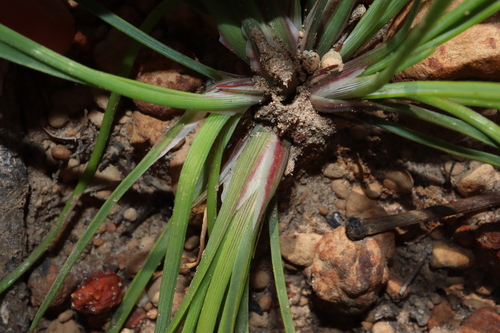
A lily which forms a clump. It grows 15-30 cm high. It spreads 10-20 cm wide. The leaves are erect and tubular. The flowering stems are slender. They bear clusters of fringed pale or mauve flowers. The flowers have 3 petals.
Wikipedia
Source ↗Thysanotus multiflorus, commonly known as many-flowered fringe lily, is a species of flowering plant in the Asparagaceae family, and is endemic to the south-west of Western Australia. It is a tufted perennial herb, with linear to lance-shaped leaves, and usually a single umbel of four to 60 purple flowers with linear to lance-shaped sepals, elliptic, fringed petals and three stamens.
Notes
There are about 50 Thysanotus species mostly in Australia. Also put in the family Laxmanniaceae.
References (7)
- Hibbert, M., 2002, The Aussie Plant Finder 2002, Florilegium. p 300
- Lavelle, M., 2008, Wild Flowers of Australia and Oceania. Southwater. p 116
- Molyneux, B. and Forrester, S., 1997, The Austraflora A-Z of Australian Plants. Reed. p 154
- Morley, B. & Everard, B., 1970, Wild Flowers of the World. Ebury press. Plate 141
- Paczkowska, G. & Chapman, A.R., 2000, The Western Australian Flora. A Descriptive Calatogue. Western Australian Herbarium. p 35
- Prodr. 285. 1810
- Rolsh, 1994, Wildflowers of the Western State, Rolsh Productions Albany WA. p 35