Agave atrovirens
Karw. ex Salm-Dyck
Maguey agave
(c) Silvano LG, some rights reserved (CC BY-NC), uploaded by Silvano LG
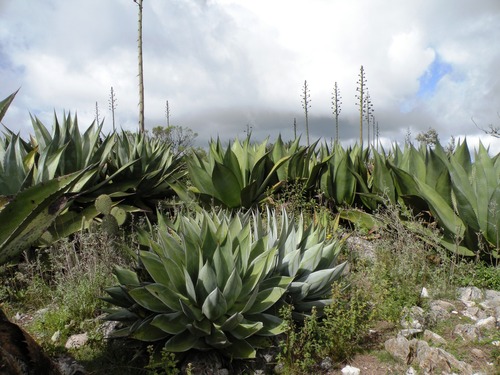
(c) M. Socorro González Elizondo, some rights reserved (CC BY-SA), uploaded by M. Socorro González Elizondo
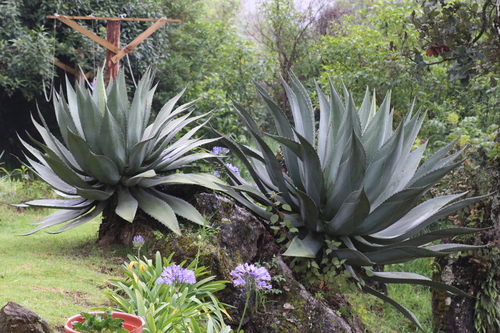
(c) chayitoglzhdz, some rights reserved (CC BY-NC)
What to Eat
Edible parts: Sap, Flower stalk, Stem, Fruit
The sap and crushed stem base are used to produce an alcoholic drink, while the sap, stem, and roasted flower stalks are eaten.
Known Hazards
Where to Find It
It is a subtropical plant. It grows in open areas between 1,800-3,400 m above sea level.
Asia, Indonesia, Mexico*, North America, SE Asia, USA,
How to Identify
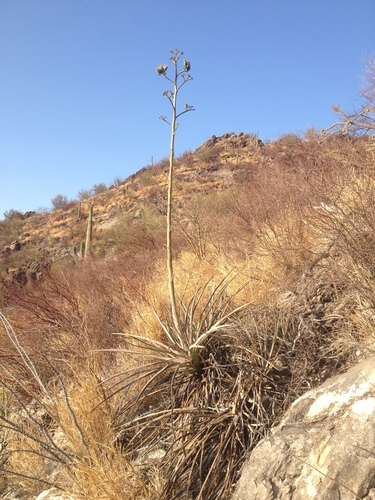
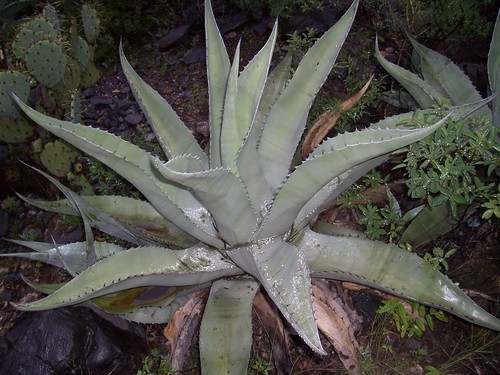
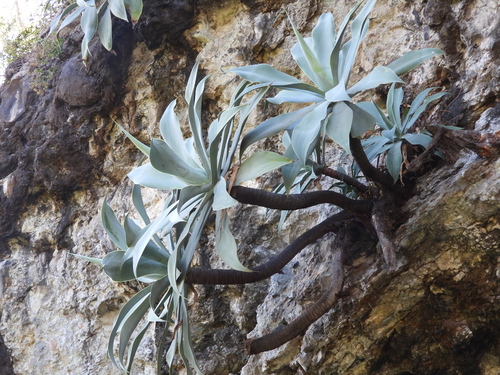
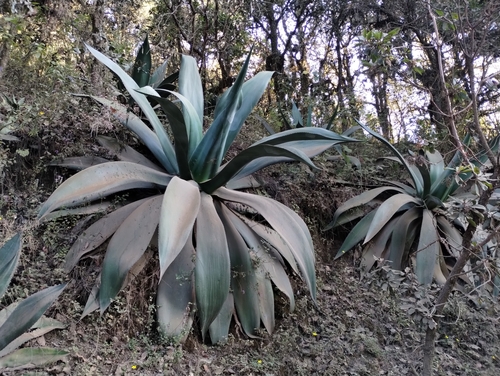
An agave. It is a short stemmed succulent plant. It grows 1.8 m tall. It has rings of large fleshy leaves. There can be 100 leaves and they are about 1m long. There is a spine at the end 2.5 cm long. The flower stalks can be 3-10 m long.
How to Grow
Plants can be grown from seeds or suckers.
Propagation: Seed - surface sow in a container in a light position. The seed usually germinates in 1 - 3 months at 15 - 20°c. Prick out the seedlings into individual pots of well-drained soil when they are large enough to handle and grow them on in a sunny position until they are at least 10cm tall before planting out. Offsets and suckers can be potted up at any time they are available. Bulbils, where produced, are an easy method of propagation. Simply pot them up and plant out at the beginning of a growing season when they are 10cm or more tall.
Other Uses
A fibre from the leaves is used for making rope. The fibre is prepared by boiling the leaves for six hours, putting them through rollers, and then scraping. The fibre is white, wavy, and of medium strength. The root contains saponins and can be used as a soap substitute. The dried flowering stem is used as fence posts and as poles when making huts etc. An extract of the heart of the rosette is used as an ingredient in commercial cosmetic preparations as a humectant and skin conditioner. The plant is grown along the edges of fields as a fence and stock-proof barrier. The plant is grown to fix the soil of terraces on steep cultivated slopes.
Wikipedia
Source ↗Agave atrovirens, called maguey verde grande is a species of Agave (family Agavaceae) native to Oaxaca, Puebla and Veracruz states in Mexico. It is one of the largest of all the Agaves, approached in size only by Agave missionum, and occasionally reaching a weight of 2 t (2.0 long tons; 2.2 short tons). Each succulent leaf can be up to 4.5 m (15 ft) long and weigh 45 kg (99 lb) apiece. In the nominate variety A. a. var. atrovirens these leaves can also be up to 40 cm (16 in) wide. As in other Agaves the leaves form a rosette, from the center of which, after many years, a panicle of flowers emerges on a long scape or peduncle which at first looks like a vast stalk of asparagus, but later grows to more than 12 m (39 ft) height, develops side branches near the top and numerous flowers which open red and gradually turn yellow. Each rosette flowers and fruits once, then dies. According to Fayaz this is one of the species which makes offsets or "pups". It grows naturally only between 1,800–3,400 m (5,900–11,200 ft) where cloud cover is more frequent. Two varieties are accepted by Plants of the World Online: Agave atrovirens var. atrovirens (syn. A. a. cochlearis) Agave atrovirens var. mirabilis (Trel.) Gentry A. atrovirens is one of the pulque agaves used in the production of mezcal.
Production
Plants take 16-20 years to reach their full height.
Notes
There are about 250 Agave species. The Agavaceae are mostly in the tropics and subtropics.
Names & Synonyms
Lechuguilla, Maguey del cumbre, Maguey, manso, Pulque agave
References (15)
- Agaves of Continental North America 473. 1982 (As Agave atrovirens var. mirabilis)
- Bircher, A. G. & Bircher, W. H., 2000, Encyclopedia of Fruit Trees and Edible Flowering Plants in Egypt and the Subtropics. AUC Press. p 13
- Delgado-Lemus, A., et al, 2014, Vulnerability and risk management of Agave species in the Tehuacan Valley, Mexico. Journal of Ethnobiology and Ethnomedicine 10:53
- Facciola, S., 1998, Cornucopia 2: a Source Book of Edible Plants. Kampong Publications. p 2
- FAO, 2012, Forest Genetic Resources Situation in Mexico. Final Report of Project TCP/ 3301 p 286
- Farfan B., et al, 2007, Mazahua Ethnobotany and Subsistence in the Monarch Butterfly Biosphere Reserve, Mexico. Economic Botany 61(2) pp 173-191
- Forest Genetic Resources Situation in Mexico, FAO 2012 Annex 15 p 286
- Hort. dyck. 7:302. 1834
- Kermath, B. M., et al, 2014, Food Plants in the Americas: A survey of the domesticated, cultivated and wild plants used for Human food in North, Central and South America and the Caribbean. On line draft. p 24
- Lira, R., et al, 2009, Traditional Knowledge and Useful Plant Richness in the Tehuacan-Cuicatlan Valley, Mexico. Economic Botany XX(X): 1-17
- Mapes, C. & Basurto, F., 2016, Biodiversity and Edible Plants of Mexico. Chapter 5 in R. Lira, et al. (eds.), Ethnobotany of Mexico, Ethnobiology, Springer. p 116
- Piedra-Malagón, E. M. et al, 2022, Edible native plants of the Gulf of Mexico Province. Biodiversity Data Journal 10: e80565 p 12
- Sukarya, D. G., (Ed.) 2013, 3,500 Plant Species of the Botanic Gardens of Indonesia. LIPI p 996
- Wiersema, J. H. & Leon, B., 2013, World Economic Plants. A Standard Reference CRC Press. 2nd Ed. p 24
- World Checklist of Useful Plant Species 2020. Royal Botanic Gardens, Kew