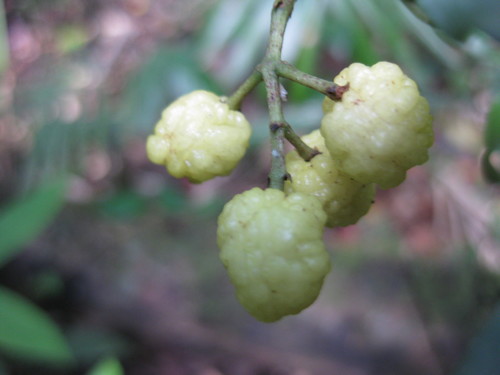
Toddalia asiatica
(L.) Lam.
Cockspur orange, Climbing orange
(c) 灶馬, some rights reserved (CC BY-NC)
(c) 灶馬, some rights reserved (CC BY-NC)
(c) 灶馬, some rights reserved (CC BY-NC)
What to Eat
Edible parts: Leaves, Fruit, Spice
The fruit are crushed and used as a peppery food flavoring, boiled to make soup, or pickled when ripe. All parts of the plant including the leaves are cooked and used for flavoring. The fruit are eaten especially by children, and leaves are sold in local markets.
Where to Find It
It is a tropical plant. Common throughout the islands of the Philippines in secondary forest and virgin forest at low altitudes but up to 1700 m. In Yunnan in China it grows up to 1500 m above sea level. In Swaziland it grows in the low veld only. It grows in the lowlands. In Sichuan. It occurs in the Western Ghats in India.
Africa*, Asia, Bangladesh, Bhutan, Cambodia, Central Africa, China, Congo, East Africa, Eswatini, Ethiopia, Himalayas, India, Indochina, Indonesia, Japan, Kenya, Laos, Madagascar, Malawi, Malaysia, Mauritius, Mozambique, Myanmar, Nepal, Northeastern India, Pacific, Philippines, Ryukyu, SE Asia, South Africa, Southern Africa, Sri Lanka, Sudan, Swaziland, Taiwan, Tanzania, Thailand, Vietnam, Zambia, Zimbabwe,
How to Identify
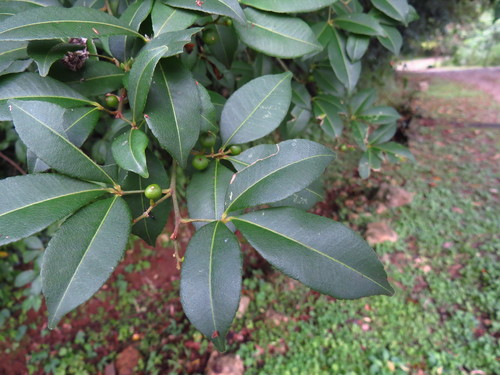
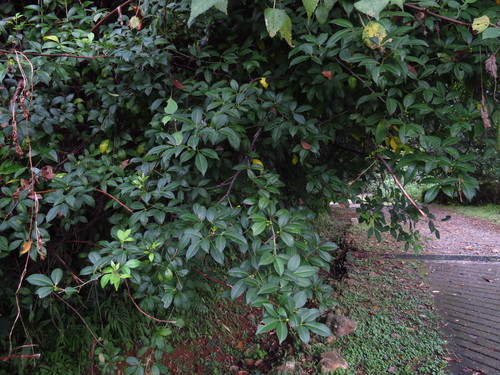
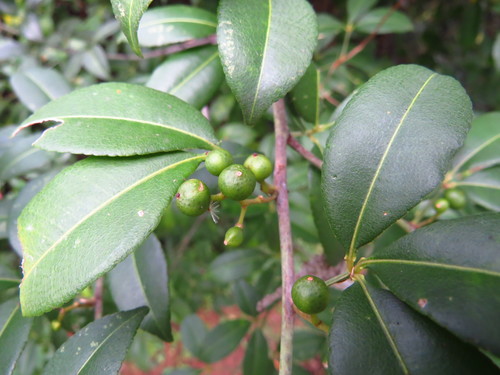
A spiny and woody vine. It is a shrub that grows 2-20 m long. The prickles are curved. The leaves are alternate and have 3 leaflets. The leaflets are pointed at both ends. The leaf stalk is 2 cm long. The leaflets are 3-10 cm long by 1-2.5 cm wide. The flowers are small, greenish and borne in large compound flower arrangements. This is 7.5 cm long. Male and female flowers are separate. The fruit are small and borne in fairly large clusters. They can be 3 to 5 angled. The fruit are 5-7 mm across. There are up to 7 seeds. Probably now Zanthoxylum asiaticum
Nutrition Score: 15/100
| Part | Moisture | kJ | kcal | Protein | Vit A | Vit C | Iron | Zinc |
|---|---|---|---|---|---|---|---|---|
| Fruit | 63.5 | — | — | 1.2 | — | 22 | — | — |
How to Grow
Plants can be grown from seeds.
Propagation: Seed - it germinates quickly. Cuttings about 30cm long taken from the growing tips. Place the cuttings in damp sand. A growth hormone can be used to stimulate the development of roots.
Medicinal Uses
The plant is used medicinally by many African peoples, including the Maasai, who use it for malaria, cough, and influenza. The roots contain coumarins that have antiplasmodial activity. Extracts of the plant have demonstrated antiviral activity against H1N1 influenza in the laboratory. The harvest of this slow-growing plant from the wild for medicinal use may cause its populations to decline. Protocols for domestication or propagation of the tree are being researched.
Other Uses
A yellow dye is obtained from the root bark. The leaves contain 0.08% of a valuable essential oil that is used in low-grade perfumery. The oil comprises mainly linalool and citronellal, it has an odour suggesting a mixture of camphor and lemon grass. With its prickles, this species could be used to make a good security barrier.
Other Information
Leaves are sold in local markets. Fruit are eaten especially by children.
Notes
There is only one Toddalia species.
Names & Synonyms
Akar kucing, Areuy beleketebek, Arbagube, Barbariburreed, Chingatti, Dahana, Dauag, Duri kengkeng, Forest pepper, Hujalashang, Jangli-kali-mirchi, Jangli-kalimirch, Jeruk merambat, Kaadumenagu, Kaara-mullu, Kaatukarimilaku, Kaboat, Kada-tod ali, Kaka-toddali, Kanchano, Kanj, Kanra, Kattumilagu, Keizi, Kondakashinda-verupatta, Kondakashinda, Krear kai ngor, Krue ngoo hao, Kulasa, Limri, Lopez root, Main kanra, Maiqiumaile, Manger, Mazhuanteng, Mdongo-nyesi, Milagaranai, Milagarnai, Mirapa-kandra-verupatta, Mirapakandra, Moolacamaymaram, Mrapagandra, Msangalusi, Mullumastigae, Nachi-wagum, Ngu: haux, Pos tsib nuas, Rabet kingking, Rocato, Saphijirik, Shia-sieng-ung, Shint-ma-tet, Sia-soh-sat, Singhanay, Siru kindu mullu annu, Subit, Taklesin, Tiktaksen, Tiktakshein, Tindupara, Tundapora, Tundpora, Wild orange tree, Yerakashida
References (52)
- Addis, G., et al, 2005, Ethnobotanical Study of Edible Wild Plants in Some Selected Districts of Ethiopia. Human Ecology, Vol. 33, No. 1, pp. 83-118 (As Toddalia asiatica)
- Altschul, S.V.R., 1973, Drugs and Foods from Little-known Plants. Notes in Harvard University Herbaria. Harvard Univ. Press. Massachusetts. no. 1918 (As Toddalia asiatica)
- Ambasta, S.P. (Ed.), 2000, The Useful Plants of India. CSIR India. p 641 (As Toddalia asiatica)
- Anderson, E. F., 1993, Plants and people of the Golden Triangle. Dioscorides Press. p 223 (As Toddalia asiatica)
- Asfaw, Z. and Tadesse, M., 2001, Prospects for Sustainable Use and Development of Wild Food Plants in Ethiopia. Economic Botany, Vol. 55, No. 1, pp. 47-62 (As Toddalia asiatica)
- Brown, W.H., 1920, Wild Food Plants of the Philippines. Bureau of Forestry Bulletin No. 21 Manila. p 72 (As Toddalia asiatica)
- Eiadthong, W., et al, 2010, Management of the Emerald Triangle Protected Forests Complex. Botanical Consultant Technical Report. p 52 (As Toddalia asiatica)
- Fowler, D. G., 2007, Zambian Plants: Their Vernacular Names and Uses. Kew. p 59 (As Toddalia asiatica)
- Fox, F. W. & Young, M. E. N., 1982, Food from the Veld. Delta Books. p 330
- Gangwar, A. K. & Ramakrishnan, P. S., 1990, Ethnobotanical Notes on Some Tribes of Arunachal Pradesh, Northeastern India. Economic Botany, Vol. 44, No. 1 pp. 94-105
- Ghorbani, A., et al, 2012, A comparison of the wild food plant use knowledge of ethnic minorities in Naban River Watershed Nature Reserve, Yunnan, SW China. Journal of Ethnobiology and Ethnomedicine; 8:17
- Ghosh, C. & Das A. P., 2011, Some useful and poisonous tea garden weeds from the Darjiling District of West Bengal, India. Pleione 5(1): 91 - 114
- Grivetti, L. E., 1980, Agricultural development: present and potential role of edible wild plants. Part 2: Sub-Saharan Africa, Report to the Department of State Agency for International Development. p 47
- Hedrick, U.P., 1919, (Ed.), Sturtevant's edible plants of the world. p 651 (As Toddalia aculeata)
- Jin, Chen et al, 1999, Ethnobotanical studies on Wild Edible Fruits in Southern Yunnan: Folk Names: Nutritional Value and Uses. Economic Botany 53(1) pp 2-14
- Kachenchart, B., et al, 2008, Phenology of Edible Plants at Sakaerat Forest. In Proceedings of the FORTROP II: Tropical Forestry Change in a Changing World. Bangkok, Thailand.
- Kar, A., et al, 2013, Wild Edible Plant Resources used by the Mizos of Mizoram, India. Kathmandu University Journal of Science, Engineering and Technology. Vol. 9, No. 1, July, 2013, 106-126
- Long, C., 2005, Swaziland's Flora - siSwati names and Uses http://www.sntc.org.sz/flora/
- Lulekal, E., et al, 2011, Wild edible plants in Ethiopia: a review on their potential to combat food insecurity. Afrika Focus - Vol. 24, No 2. pp 71-121
- Mahapatra, A. K., et al, 2012, Nutrient Analysis of some selected wild edible fruits of deciduous forests of India. Advance Journal of Food Science and Technology 4(1):15-21
- Medhi, P. & Borthakur, S. K., 2012, Phytoresources from North Cachur Hills of Assam -3: Edible plants sold at Hflong market. Indian Journal of Natural Products and Resources. 3(1) pp 84-109
- Medhi, P. & Borthakur, S. K., 2013, Wild edible plants sold by the Zeme Nagas at the makeshift market of Mahur, Dima Hasao district of Assam. Pleione 7(1): 84 - 93. 2013
- Medhi, P., Sarma, A and Borthakur, S. K., 2014, Wild edible plants from the Dima Hasao district of Assam, India. Pleione 8(1): 133-148
- Misra S. & Misra M., 2016, Ethnobotanical and Nutritional Evaluation of Some Edible Fruit Plants of Southern Odisha, India. International Journal of Advances in Agricultural Science and Technology, Vol.3 Issue.1, March- 2016, pg. 1-30
- Monsalud, M.R., Tongacan, A.L., Lopez, F.R., & Lagrimas, M.Q., 1966, Edible Wild Plants in Philippine Forests. Philippine Journal of Science. p 537
- Murtem, G. & Chaudhrey, P., 2016, An ethnobotanical note on wild edible plants of Upper Eastern Himalaya, India. Brazilian Journal of Biological Sciences, 2016, v. 3, no. 5, p. 63-81.
- Nakahara, K. et al, 2002, Antimutagenicity of Some Edible Thai Plants, and a Bioactive Carbazole Alkaloid, Mahanine, Isolated from Micromelum minutum. Journal of Agricultural and Food Chemistry. 50: 4796-4892
- Nayaham, M. C., et al, 1993, Less Known Edible Fruit - Yielding plants of Nilgiris. Ancient Science of Life. Vol. X11 Nos. 3 & 4, pp 363-376
- Peters, C. R., O'Brien, E. M., and Drummond, R.B., 1992, Edible Wild plants of Sub-saharan Africa. Kew. p 178
- Pradhan, R., et al, 2020, Potential Wild Edible Plants and its Significance in Livelihood of Indigenous People of Male Mahadeshwara Hills, Karnataka. Economic Affairs Vol. 64, No. 4 pp. 01-14
- PROSEA handbook Volume 13 Spices. p 265
- Reddy, K. N. et al, 2007, Traditional knowledge on wild food plants in Andhra Pradesh. Indian Journal of Traditional Knowledge. Vol. 6(1): 223-229
- Reis, S. V. and Lipp, F. L., 1982, New Plant Sources for Drugs and Foods from the New York Botanical Garden herbarium. Harvard. p 145 (As Toddalia aculeata)
- Sasi, R. & Rajendran, A., 2012, Diversity of Wild Fruits in Nilgiri Hills of the Southern Western Ghats - Ethnobotanical Aspects. IJABPT, 3(1) p 82-87
- Seyoum, Y., et al, 2015, Edible Wild Fruit Trees and Shrubs and Their Socioeconomic Significance in Central Ethiopia. Ethnobotany Research & Applications. 14:183-197
- Singh, H.B., Arora R.K.,1978, Wild edible Plants of India. Indian Council of Agricultural Research, New Delhi. p 38, 79
- Singh, V. B., et al, (Ed.) Horticulture for Sustainable Income and Environmental Protection. Vol. 1 p 220
- Sivakumar, A. & Murugesan, M., 2005, Ethnobotanical Studies of the wild edible plants used by the tribals of the Anaimalai Hills, the Western Ghats. Ancient Science of Life. XXV(2) Oct-Dec.
- Srichaiwong, P., et al, 2014, A Study of the Biodiversity of Natural Food Production to Support Community Upstream of Chi Basin, Thailand. Asian Social Science 10 (2):
- Srivastava, R. C., 2010, Traditional knowledge of Nyishi (Daffla) tribe of Arunachal Pradesh. Indian Journal of Traditional Knowledge. 9(1):26-37 (As Toddalia aculeata)
- Srivastava, R. C., et al, 2010, Indigenous biodiversity of Apatani plateau: Learning on biolcultural knowledge of Apani tribe of Qrunachal Pradesh for sustainable livelihoods. Indian Journal of Traditional Knowledge 9(3): 432-442 (As Toddalia aculeata)
- Sukarya, D. G., (Ed.) 2013, 3,500 Plant Species of the Botanic Gardens of Indonesia. LIPI p 984
- Swaziland's Flora Database http://www.sntc.org.sz/flora
- Tabl. encycl. 2(vol. 4):116. 1797, nom. cons.
- Thitiprasert, W., et al, 2007, Country report on the State of Plant Genetic Resources for Food and Agriculture in Thailand (1997-2004). FAO p 95
- Upreti, K., et al, 2010, Diversity and Distribution of Wild Edible Fruit Plants of Uttarakhand. Bioversity Potentials of the Himalaya. p 192
- White, F., Dowsett-Lemaire, F. and Chapman, J. D., 2001, Evergreen Forest Flora of Malawi. Kew. p 513
- Whitney, C. W., et al, 2014, Conservation and Ethnobotanical Knowledge of a Hmong Community in Long Lan, Luang Prabang, Lao People’s Democratic Republic. Ethnobotany Research and Applications 12:643-658
- Wild edible plants of Himachal Pradesh
- Williamson, J., 2005, Useful Plants of Malawi. 3rd. Edition. Mdadzi Book Trust. p 246
- World Checklist of Useful Plant Species 2020. Royal Botanic Gardens, Kew
- Xu, You-Kai, et al, 2004, Wild Vegetable Resources and Market Survey in Xishuangbanna, Southwest China. Economic Botany. 58(4): 647-667.