Torreya jackii
Chun
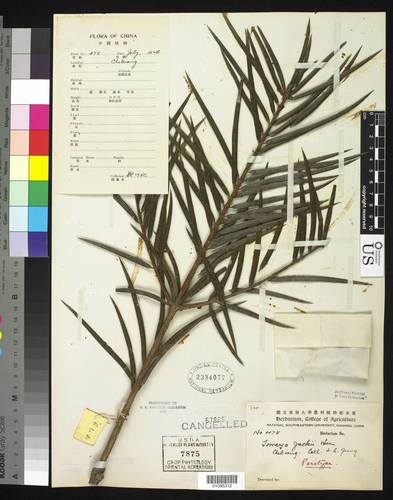
(c) Smithsonian Institution, National Museum of Natural History, Department of Botany, some rights reserved (CC BY-NC-SA)
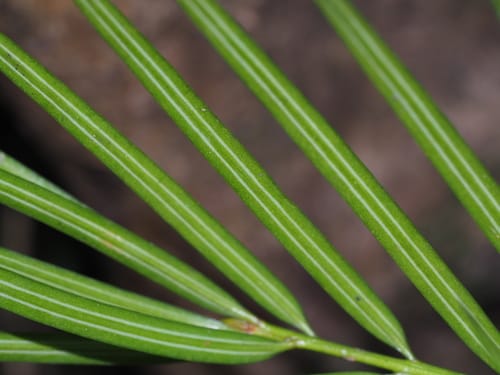
(c) 小铖/Smalltown, some rights reserved (CC BY-NC)
What to Eat
Edible parts: Seeds
The seeds are edible. No further details are given, but they are likely suitable eaten raw or cooked and are probably rich in oil, consistent with related species. An edible oil is also obtained from the seed.
Where to Find It
It is a temperate plant.
Asia, China,
How to Identify
Evergreen tree growing to 10 m tall at slow rate. Hardy to UK zone 8. Evergreen foliage with flowers April to May; seeds ripen October to November. Dioecious—both male and female plants required for reproduction. Wind-pollinated, not self-fertile. Grows in light sandy to heavy clay soils with mildly acidic to alkaline pH, tolerating full shade to full sun. Prefers moist conditions.
How to Grow
Succeeds in ordinary garden soil, tolerating some lime. Requires a sheltered position and either high humidity or a moist riverside soil. Dislikes wind exposure. Tolerates woodland shade very well. Requires hot, very humid summers for best growth. Quite rare in the wild, this is a vulnerable species at risk of becoming extinct in the wild. Torreya jackii is unlike the other Chinese members of the genus and is remarkably similar to Cephalotaxus fortunei, from which it can be distinguished by its sessile seed-bearing structures and by the peculiar, strongly twisted leaf arrangement. The seed takes two summers to mature. This species is not very hardy in Britain, though trees can be grown outdoors in the milder parts of the country. Plants are dioecious, but sometimes monoecious with dioecious branches. Male and female plants must usually be grown if seed is required.
Propagation: Seed is best sown as soon as it is ripe in a cold frame. Some seed should germinate the following spring, though much may take a further 12 months. Stored seed requires cold stratification and can take 18 months or more to germinate. Prick seedlings into individual pots as soon as growth appears and grow on in light shade in the greenhouse for at least the next two winters, potting on as needed. Plant out into permanent positions in early summer when plants are at least 20cm tall. Half-ripe shoot cuttings can be taken in late summer, though rooting success is poor. Layering is also an option.
Medicinal Uses
None known.
Other Uses
The leaves are highly aromatic when bruised or burned, releasing a fragrance similar to sandalwood oil. The wood is very fragrant and is used to make agricultural implements, utensils, and handicrafts.
Wikipedia
Source ↗Torreya jackii (Chinese: 长叶榧树; pinyin: fěishù; lit. 'longleaf torreya') is a species of conifer in the family Taxaceae. Common names include Jack's nutmeg tree, longleaf torreya, Jack torreya, and weeping torreya. It is endemic to eastern China, in Zhejiang, Fujian, and Jiangxi provinces. It can be up to 12 metres (39 ft) tall. It is threatened by habitat loss and logging.
Notes
Also put in the family Cephalotaxaceae.
References (2)
- J. Arnold Arbor. 6:144. 1925
- Plants for a Future database, The Field, Penpol, Lostwithiel, Cornwall, PL22 0NG, UK. http://www.scs.leeds.ac.uk/pfaf/
More from Taxaceae


